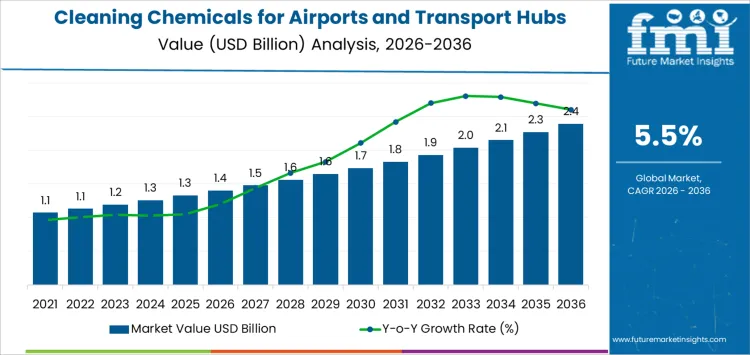
The global Cleaning Chemicals for Airports and Transport Hubs Market is projected to reach USD 2.4 billion by 2036, reflecting robust demand and sustained growth across aviation and mass transit infrastructure. In 2026, the market value is estimated at USD 1.4 billion, with a steady compound annual growth rate (CAGR) of approximately 5.5% through the forecast period. This expansion is driven by increased passenger flows, heightened expectations for hygiene and operational efficiency, and a rising emphasis on rapid, high-performance cleaning solutions suited to bustling terminals and transport terminals.
Airports and major transit hubs around the world are recalibrating their sanitation strategies to meet evolving passenger expectations and regulatory requirements. Leading manufacturers and emerging innovators in the cleaning chemicals space are expanding their product portfolios to deliver solutions that balance speed, surface safety, and environmental considerations. As terminals handle increased footfall and round-the-clock operations, demand for rapid-action surface cleaners, low-odour sanitizers, and specialized maintenance agents continues to strengthen. These products are critical in areas such as concourses, security checkpoints, restrooms, lounges, and baggage handling zones where cleanliness directly influences the passenger experience and facility reputation.
Market leaders like Ecolab, Diversey, and 3M are at the forefront of supplying advanced formulations and integrated cleaning systems tailored for large-scale usage. These companies are investing in technology-driven solutions that support automated delivery methods, dosing systems that optimize chemical use, and products designed for compatibility with mechanized cleaning equipment. Big names including CloroxPro, SC Johnson Professional, Zep, Betco, and Spartan Chemical are also expanding their reach with offerings that emphasize performance and reliability in diverse operational environments.
Alongside these established players, newer manufacturers and technology-centric firms are entering the market with innovative approaches. Companies that focus on sustainability, reduced chemical footprints, and smart integration with facility management software are gaining traction. These emerging participants are enabling facility operators to adopt cleaning programs that not only meet stringent hygiene benchmarks but also support eco-friendly practices and cost efficiencies across multi-site operations. As airports and transport hubs evolve, partnerships with manufacturers who bring novel chemistries and smart maintenance tools are becoming increasingly important.
The use zones driving the largest share of market demand include terminals and public areas, which alone account for a significant portion of overall consumption. These high-visibility zones require frequent cleaning to maintain appearance and ensure passenger confidence. In such spaces, cleaning protocols often prioritize fast-acting formulations that minimize disruption to passenger movement while delivering streak-free and odor-controlled results. Additional areas of strong demand include restrooms, food courts and lounges, and back-of-house maintenance areas, all of which benefit from tailored chemical solutions designed to maximize hygiene and operational throughput.
To access the complete data tables and in-depth insights, request a sample report here
Regional dynamics play a key role in shaping market growth. Rapid infrastructure expansion in Asia Pacific, particularly across airports and urban transit hubs in China and India, is stimulating increased chemical usage. Similarly, modernization efforts in Latin America — especially in Brazil — are encouraging facilities to adopt advanced cleaning technologies. Mature markets such as the United States, the United Kingdom, and Europe continue to exhibit steady growth, anchored by structured regulatory standards, outsourcing of facility management, and investment in premium sanitation programs.
A notable trend emerging across regions is the shift toward integrated facility management contracts and centralized procurement frameworks, which provide predictable volumes for suppliers and cost-effective solutions for facility operators. These contracts are streamlining purchasing cycles, improving supply chain reliability, and fostering closer collaboration between service providers and chemical manufacturers. As a result, service firms that can deliver consistent chemical performance across large, multi-location networks are gaining competitive advantage.
Looking ahead, the market is expected to benefit from continued innovation in chemical technologies, including low-odor and indoor air quality-safe products, heavy-duty degreasers for complex equipment surfaces, and specialized disinfectants that align with heightened sanitation protocols post-pandemic. Manufacturers who prioritize research and development, sustainability, and cross-functional application capabilities are well positioned to capitalize on the growing importance of cleanliness in airports, rail hubs, and other transport environments.
In summary, the Cleaning Chemicals for Airports and Transport Hubs Market is on a trajectory of sustained expansion, powered by rising passenger traffic, evolving hygiene standards, and a dynamic landscape of both established and new entrants focused on delivering next-generation cleaning technologies. Facility managers and procurement leaders are increasingly looking to partners that can offer scalable, high-performance, and environmentally responsible solutions to maintain world-class standards of cleanliness and safety across global transport infrastructure.