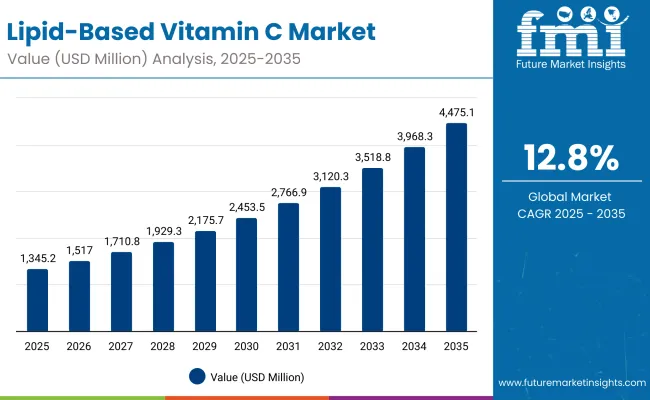
The global Lipid-Based Vitamin C Market is entering a high-growth phase, driven by advanced formulation technologies, rising consumer demand for clinically proven skincare, and aggressive expansion strategies by both established leaders and new-age manufacturers. Valued at USD 1,345.2 million in 2025, the market is projected to reach USD 4,475.1 million by 2035, registering a robust CAGR of 12.8% and a 3.3X increase in size over the decade.
This growth highlights how lipid-based Vitamin C has transitioned from a niche innovation into a mainstream, high-performance skincare ingredient, offering superior stability, deeper skin penetration, and longer-lasting efficacy compared to traditional Vitamin C formulations.
Gain access to detailed segment-wise analysis and forecast statistics – Request the Sample Report Today
Market Growth Highlights and Business Expansion Opportunities
Between 2025 and 2030, the market is expected to add USD 1,108.3 million, accounting for 35% of total decade growth, supported by steady adoption of lipid-based Vitamin C serums and creams. The second half of the forecast period (2030–2035) will contribute a larger 65% share of growth, adding USD 2,021.6 million, fueled by clinical-grade launches, clean-label innovations, and wider e-commerce penetration.
For manufacturers—both global leaders and emerging brands—this creates strong opportunities to:
- Expand portfolios with clinical-grade and dermatologist-tested formulations
- Invest in lipid-encapsulation and multi-functional skincare technologies
- Scale faster through digital-first retail and subscription-based models
Why Lipid-Based Vitamin C Is Gaining Traction
Unlike conventional Vitamin C, lipid-based formulations resist oxidation, ensuring longer shelf life and consistent potency. Their ability to penetrate the skin’s lipid layers makes them especially effective for:
- Brightening and radiance
- Anti-aging and wrinkle reduction
- Antioxidant protection against environmental stressors
These advantages align perfectly with the growing consumer shift toward science-backed, premium skincare, encouraging brands to position lipid-based Vitamin C as a core innovation ingredient.
Key Segments of the Lipid-Based Vitamin C Market
By Function
- Brightening (leading segment, 48.5% share in 2025)
- Antioxidant protection
- Anti-aging
- Even skin tone
By Product Type
- Serums (dominant with 52.5% market share)
- Creams and lotions
- Ampoules
- Oils
By Distribution Channel
- E-commerce
- Pharmacies
- Specialty beauty stores
- Mass retail
By Claim
- Clinical-grade (50.5% share in 2025)
- Dermatologist-tested
- Vegan
- Clean-label
By Region
- North America
- Europe
- Asia-Pacific
- Latin America
- Middle East & Africa
Serums and Clinical-Grade Products Lead Market Momentum
Serums remain the most preferred product type due to their high concentration of actives and fast absorption, making them ideal for lipid-based Vitamin C delivery. Clinical-grade claims dominate consumer trust, particularly in anti-aging and brightening applications, reinforcing demand in professional clinics, pharmacies, and premium beauty retailers.
At the same time, vegan and clean-label products are gaining traction among younger, eco-conscious consumers, encouraging manufacturers to balance efficacy with ethical and sustainable positioning.
Regional Outlook: Asia-Pacific Emerges as Growth Engine
The Asia-Pacific region is the fastest-growing market, led by:
- China (22.8% CAGR) – driven by e-commerce, influencer marketing, and clinical-grade trust
- India (21.6% CAGR) – supported by affordable launches and fusion with herbal formulations
- Japan (16.8% CAGR) – focused on brightening and anti-aging efficacy
North America and Europe continue to show steady expansion, with the USA, UK, and Germany emphasizing dermatologist-tested, sustainable, and premium skincare solutions.
Competitive Landscape: Innovation Meets Expansion
The market is moderately fragmented, with established players such as SkinCeuticals, Murad, Obagi, Kiehl’s, and Paula’s Choice leading clinical-grade adoption. Meanwhile, digitally native and niche brands like The Ordinary, Sunday Riley, Ole Henriksen, and Drunk Elephant are expanding rapidly through clean-label positioning and influencer-led engagement.
New and emerging manufacturers are increasingly focusing on:
- Cost-efficient lipid-encapsulation technologies
- Multi-functional formulations combining Vitamin C with hyaluronic acid, peptides, and antioxidants
- Sustainable packaging and transparent ingredient sourcing
Outlook for Manufacturers and Investors
As skincare consumers demand visible results, safety, and transparency, lipid-based Vitamin C is set to remain a cornerstone ingredient through 2035. Companies that successfully blend advanced technology, clinical credibility, and ethical branding will be best positioned to expand globally and capture long-term market share.
With strong growth fundamentals and innovation-driven competition, the Lipid-Based Vitamin C Market presents a compelling opportunity for both established brands and new entrants aiming to scale in the evolving global skincare industry.
Why FMI: https://www.futuremarketinsights.com/why-fmi
About Future Market Insights (FMI)
Future Market Insights, Inc. (FMI) is an ESOMAR-certified, ISO 9001:2015 market research and consulting organization, trusted by Fortune 500 clients and global enterprises. With operations in the U.S., UK, India, and Dubai, FMI provides data-backed insights and strategic intelligence across 30+ industries and 1200 markets worldwide.
Contact Us:
Future Market Insights Inc.
Christiana Corporate, 200 Continental Drive,
Suite 401, Newark, Delaware – 19713, USA
T: +1-347-918-3531
For Sales Enquiries: sales@futuremarketinsights.com
Website: https://www.futuremarketinsights.com
LinkedIn| Twitter| Blogs | YouTube