Global PET Depolymerization Technology Market Forecast and Strategic Insights
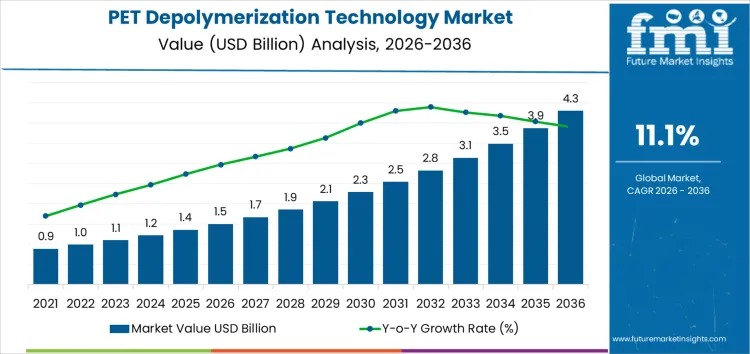
The PET Depolymerization Technology Market is witnessing rapid adoption across packaging, textiles, and industrial polymer sectors. Valued at USD 1.5 billion in 2026, the market is expected to reach USD 4.3 billion by 2036, reflecting a robust CAGR of 11.1%. Growth is primarily shaped by increasing regulatory oversight, feedstock traceability requirements, and approvals for food and industrial applications. Early alignment with these standards allows vendors to achieve faster market acceptance and mitigate compliance risk, giving established players a competitive edge over newer entrants.
Subscribe for Year-Round Insights → Stay ahead with quarterly and annual data updates:
The market’s evolution over the next decade reflects a shift from technical feasibility to large-scale commercial deployment. From 2026 to 2031, the market is projected to grow steadily from USD 1.5 billion to USD 2.2 billion, driven by incremental capacity expansion, validation of chemical recycling pathways, and early adoption by PET resin and packaging producers. Between 2031 and 2036, growth accelerates as industrial-scale depolymerization plants increase utilization rates, integrate more efficiently into PET supply chains, and cater to rising global demand for high-quality recycled materials.
Key Drivers of Market Growth
- Quality-Driven Demand: Depolymerization enables post-consumer PET to be chemically recycled into high-purity monomers, restoring properties comparable to virgin resin. This is critical for food-grade packaging and high-performance industrial applications where mechanical recycling falls short.
- Regulatory Mandates: Governments in Europe, North America, and Asia are enforcing recycled content targets and landfill reduction policies. PET depolymerization offers compliance-ready solutions, creating structural demand for scalable chemical recycling facilities.
- Technological Advancements: Innovations in catalyst systems, reactor designs, and feedstock preconditioning are enhancing process efficiency, reducing operational costs, and supporting the competitive positioning of chemical recycling over virgin PET production.
Technology and Feedstock Trends
Glycolysis systems dominate the market, accounting for roughly 42% of demand due to operational flexibility, moderate operating conditions, and proven commercial maturity. Methanolysis, hydrolysis, and hybrid systems provide alternatives for high-purity or challenging feedstocks but are less widely deployed due to higher complexity and cost.
In terms of feedstock, post-consumer PET bottles remain the primary input, representing 55% of market demand. Their consistent polymer composition, well-established collection infrastructure, and brand-driven incentives make them ideal for chemical recycling. Secondary feedstocks, such as trays, flakes, and mixed PET waste, offer growth potential but require more intensive pretreatment and sorting, limiting early commercial adoption.
Regional Insights Driving Market Adoption
- United States: Growing at a CAGR of 10.2%, driven by urban recycling hubs and industrial polymer facilities integrating depolymerization for monomer recovery and landfill reduction.
- Germany: CAGR of 9%, shaped by stringent EU mandates and audit-driven adoption of chemical recycling units across beverage and polymer manufacturing sectors.
- China: CAGR of 12.8%, fueled by large-scale plastic recycling operations and high demand for recycled PET in packaging and textiles.
- India: Fastest growth at 13.8%, supported by emerging industrial clusters, government incentives, and expanding recycling infrastructure.
- Brazil: CAGR of 9%, adoption concentrated in established chemical recycling hubs and packaging plants complying with environmental regulations.
Competitive Landscape and Strategic Approaches
Market leadership is defined not just by process efficiency but by the ability to navigate regulatory requirements and deliver consistently certified monomers. Eastman and BASF focus on integrating depolymerization into existing chemical and polymer supply chains, while Reliance Industries and Zhejiang Wankai target scale-driven production. Teijin emphasizes closed-loop recycling for textiles and packaging, whereas Loop Industries and Carbios leverage proprietary processes for difficult-to-recycle PET fractions. Competitive advantage hinges on yield stability, feedstock access, and compliance alignment rather than technology novelty alone.
Top Players:
- Eastman,
- BASF,
- Zhejiang Wankai,
- Reliance Industries,
- Teijin,
- Loop Industries,
- Carbios
Get data that aligns with your strategic priorities — ask for report customization today:
Related Reports:
Industrial Valves Market- https://www.futuremarketinsights.com/reports/industrial-valve-market
Micro Irrigation Systems Market- https://www.futuremarketinsights.com/reports/micro-irrigation-systems-market
Pneumatic Actuator Market- https://www.futuremarketinsights.com/reports/pneumatic-actuator-market
Have a specific Requirements and Need Assistant on Report Pricing or Limited Budget please contact us – sales@futuremarketinsights.com
About Future Market Insights (FMI)
Future Market Insights, Inc. (FMI) is an ESOMAR-certified, ISO 9001:2015 market research and consulting organization, trusted by Fortune 500 clients and global enterprises. With operations in the U.S., UK, India, and Dubai, FMI provides data-backed insights and strategic intelligence across 30+ industries and 1200 markets worldwide.
Contact Us:
Future Market Insights Inc.
Christiana Corporate, 200 Continental Drive,
Suite 401, Newark, Delaware – 19713, USA
T: +1-347-918-3531
Why FMI: https://www.futuremarketinsights.com/why-fmi
For Sales Enquiries: sales@futuremarketinsights.com
Website: https://www.futuremarketinsights.com
LinkedIn| Twitter| Blogs | YouTube