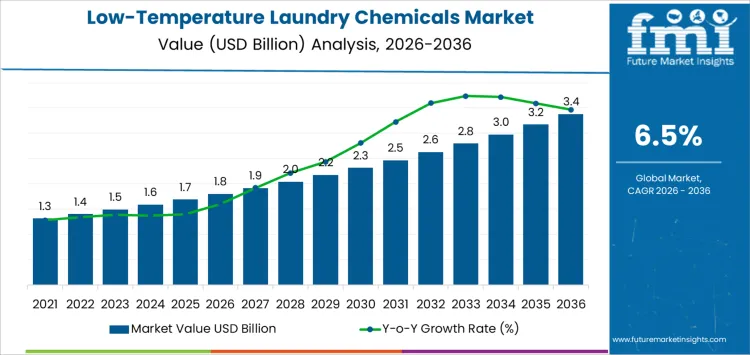
The global low-temperature laundry chemicals market is projected to grow from an estimated USD 1.8 billion in 2026 to USD 3.4 billion by 2036, reflecting a significant surge in demand for energy-efficient, eco-friendly cleaning solutions across residential, commercial, and industrial sectors. This dynamic expansion is being fueled by both long-standing industry leaders and innovative newcomers alike, as they capitalize on rising sustainability awareness, advanced technologies, and shifting consumer preferences toward lower-temperature washing practices that reduce energy consumption while maintaining superior cleaning performance.
As global energy costs continue to rise and environmental impact becomes a central concern for consumers and businesses, demand for low-temperature laundry chemicals has never been stronger. Products formulated to deliver high cleaning efficacy at cooler temperatures are appealing not only to households seeking cost savings, but also to large institutional laundry operations in sectors such as hospitality, healthcare, and garment services that are prioritizing energy conservation and reduced carbon footprints.
Market Growth Driven by Sustainability and Performance Innovations
At the heart of market growth are established multinational manufacturers who have consistently expanded their product portfolios to meet emerging needs. Procter & Gamble, Henkel, and Unilever remain prominent, leveraging decades of detergent formulation expertise to deliver high-performance low-temperature detergents that tackle tough stains without the need for hot water. These legacy players are also investing heavily in research and development to refine enzyme technologies and biodegradable formulations that align with evolving regulatory requirements and consumer expectations for transparency and sustainability.
Complementing these established brands are innovative manufacturers and niche players who are redefining the competitive landscape with disruptive technologies. Companies such as Ecolab and Diversey are enhancing commercial laundry solutions with formulations designed for large-scale operations that demand consistent cleaning results with minimal energy input. Meanwhile, Lion Corporation and Seventh Generation are tapping into the growing market segment of plant-based and eco-certified laundry products, attracting environmentally conscious consumers and carving out new growth opportunities in both mature and emerging markets.
Emerging firms are also leveraging digital and smart technologies to optimize low-temperature washing processes. Cutting-edge advancements in enzyme encapsulation, controlled release systems, and smart dosage mechanisms are enabling precise chemical action even at temperatures below 30°C, thereby improving fabric care and overall sustainability. These technologies are not only improving performance, but also enabling seamless integration with next-generation washing machines that automatically adjust wash cycles to maximize energy savings.
To access the complete data tables and in-depth insights, request a sample report here
Regional Dynamics and Business Expansion Opportunities
The Asia-Pacific region stands out as a key growth engine, driven by rapid urbanization, increasing disposable incomes, and heightened consumer awareness of energy efficiency. Manufacturers across the region are expanding production capabilities and forging strategic partnerships to tap into burgeoning demand in markets such as China and India. In China, urban households and commercial operations alike are aggressively adopting low-temperature laundry solutions, prompting both global and local players to establish deeper market penetration through localized product innovations and distribution networks.
In North America and Europe, sustainability regulations and energy-conservation initiatives are influencing procurement decisions among institutional buyers, leading to stronger uptake of advanced low-temperature laundry chemical solutions. These regional trends are prompting established players to strengthen their footholds and pursue acquisitions, co-development agreements, and collaborative innovation efforts with technology startups specializing in green chemistry and smart wash systems.
Driving Business Value Through Technological Advancements
Innovation remains a cornerstone of competitive differentiation in the low-temperature laundry chemicals market. Leading manufacturers are pushing the boundaries of formulation science, integrating bio-based enzymes, concentrated surfactants, and targeted booster additives that enhance soil removal in cold water. Such advancements not only deliver superior cleaning results but also reduce overall chemical and water usage, aligning product performance with global sustainability goals.
Simultaneously, digitalization is influencing market evolution, with manufacturers incorporating data analytics and IoT-enabled systems to better understand user behavior and optimize product recommendations. These technology integrations are lowering operational barriers for large laundry facilities, enabling predictive maintenance of washing equipment, and ensuring optimal chemical dosing that minimizes waste.
Outlook: Collaboration Across the Value Chain for Continued Growth
Industry experts anticipate that the momentum in the low-temperature laundry chemicals market will continue through the next decade, driven by heightened environmental awareness, supportive regulatory frameworks, and continuous technology innovation. Established players are expected to remain dominant, but the rise of agile, technology-first manufacturers could introduce fresh competition and collaborative opportunities that enhance market resilience.