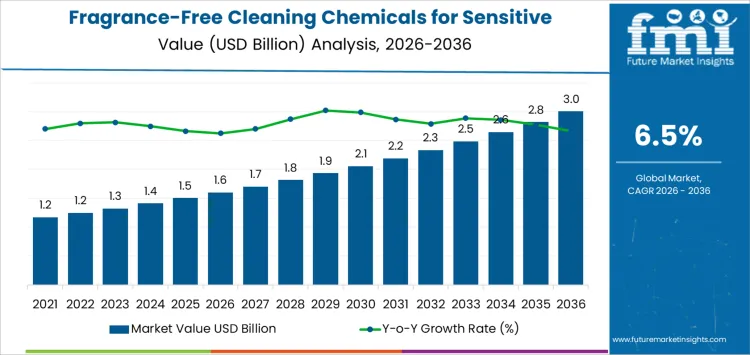
The global fragrance-free cleaning chemicals for sensitive environments market is projected to be valued at approximately USD 1.6 billion in 2026, with strong upward momentum expected over the next decade. Market forecasts indicate that this space could nearly double by 2036, reflecting rising awareness of occupant sensitivities, tightening indoor air quality expectations, and broader adoption of scent-neutral hygiene solutions across professional environments.
As demand for fragrance-free cleaning solutions quickly evolves, both established market leaders and emerging manufacturers are positioning themselves to seize growth opportunities. These players are focusing on advanced technologies, improved formulation efficacy, and expanded distribution channels to serve a wide range of sectors — from healthcare and clinical settings to offices, educational facilities, and public buildings.
Meeting the Needs of Sensitive Environments
Fragrance-free cleaning chemicals are gaining prominence in environments where occupants are particularly vulnerable to irritants — such as patients in healthcare facilities, children in schools, or individuals with asthma and other respiratory issues. Neutral scent profiles and low volatile organic compound (VOC) formulations are becoming essential criteria for procurement teams that prioritize indoor comfort and risk mitigation.
The increasing preference for unscented and low allergen cleaners has also encouraged manufacturers to innovate beyond traditional cleaning chemistries. New product formulations are not simply about removing fragrances but enhancing performance while maintaining safety and comfort in enclosed spaces with continuous human occupancy. This transition reflects a broader industry trend: cleaning solutions should be effective and considerate of occupant wellbeing.
To access the complete data tables and in-depth insights, request a sample report here
Established Leaders Drive Adoption and Innovation
Several established manufacturers are already shaping the market’s trajectory through robust product portfolios and deep expertise in industrial and institutional cleaning solutions. These companies have leveraged decades of experience to cater to stringent hygiene standards while aligning with evolving regulatory expectations.
Long-standing industry participants are focusing on:
- Comprehensive product suites that include general surface cleaners, disinfectants, restroom cleaners, and specialty solutions tailored for sensitive settings.
- Research and development initiatives that optimize cleaning performance without relying on masking agents or fragrances.
- Training and support programs for facility managers and cleaning professionals to ensure effective application and compliance with indoor air quality policies.
Their broad distribution networks and trusted brand reputations continue to support strong adoption across key regions, including North America, Europe, and Asia Pacific.
Emerging Players and Technologies Add Fresh Momentum
At the same time, a new wave of manufacturers is entering the fragrance-free cleaning segment with unique propositions aimed at capturing niche and high-growth areas. These emerging companies are driving innovation in several ways:
- Next-generation formulations that enhance cleaning efficacy while reducing irritation risks associated with chemical exposure.
- Sustainability-driven solutions, including biodegradable ingredients and low-impact packaging, that appeal to environmentally conscious buyers.
- Smart dosing systems and automated delivery technologies that optimize product use and reduce waste in high-frequency cleaning environments.
Such advancements are particularly resonating with commercial cleaning contractors and institutional procurement teams looking to differentiate their offerings and build long-term partnerships in the fragrance-free segment.
Expanding Market Reach Across Sectors
While healthcare and clinical environments remain the largest end-users due to strict hygiene requirements and occupant sensitivity concerns, fragrance-free products are increasingly being incorporated into schools, childcare facilities, offices, and public buildings. Decision makers in these sectors are embedding scent-neutral criteria into cleaning policies as part of broader workplace wellbeing initiatives, inclusive design standards, and facility management protocols.
This broader adoption is helping to fuel market growth, with manufacturers responding by scaling production, expanding geographic reach, and diversifying product portfolios to meet varied application needs.
Driving Future Growth Through Partnerships and Value Creation
Market growth is expected to be supported by strategic collaborations between manufacturers, distributors, and institutional buyers. These partnerships aim to accelerate the development of tailored solutions, improve supply chain resilience, and enhance customer education around the benefits of fragrance-free cleaning chemicals.
As companies continue to innovate and invest in new technologies, the fragrance-free cleaning chemicals market is well-positioned to deliver both performance and peace of mind for users in sensitive environments. With adoption increasing across key global markets and heightened focus on occupant health and comfort, this sector promises to be a bright spot in the professional cleaning chemicals landscape in the coming years.