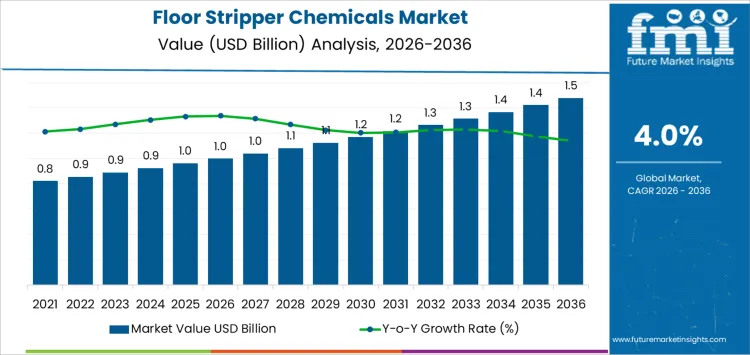
The global Floor Stripper Chemicals market is poised for steady expansion, projected to reach USD 1.5 billion by 2036, driven by sustained demand for effective, safe, and eco-friendly solutions across commercial, industrial, and institutional sectors. This compelling growth trajectory reflects a compound annual growth rate (CAGR) of around 4% over the forecast period and underscores significant opportunities for both established industry leaders and innovative newcomers seeking to expand their footprint in this essential floor care segment.
As operational excellence becomes a crucial differentiator in facility maintenance, leading players such as Diversey, Ecolab, 3M, SC Johnson Professional, Betco, Spartan Chemical, Zep, P&G Professional, Unilever Professional, and Solenis continue to shape the competitive landscape with versatile product portfolios tailored for complex cleaning needs. Their ongoing investments in formulation technology not only reinforce current market dominance but also signal readiness for emerging trends such as low-odor, low-toxicity, and biodegradable strippers that prioritize user safety without compromising performance.
The floor stripper chemicals market serves a diverse array of applications, ranging from high-traffic retail spaces and healthcare facilities to educational campuses and heavy-duty industrial environments. Traditional ammoniated strippers still hold strong appeal due to robust performance under demanding conditions, while low-odor and no-rinse alternatives are gaining adoption among environmentally conscious buyers and institutions with stringent air quality standards. This diversification in product types enables manufacturers to address specific customer pain points and unlock new avenues for value creation.
A major driver of market growth lies in the dominance of VCT (Vinyl Composition Tile) and resilient floor substrates, which command significant usage in commercial facilities where routine maintenance is critical. Regular stripping of old finishes and protective coatings is essential to maintain aesthetic appeal and safety standards, further fueling consistent demand for efficient chemical solutions. At the same time, concrete, terrazzo, stone, and other specialty surfaces present tailored opportunities for manufacturers who specialize in substrate-specific formulations.
Supply model dynamics are also evolving. Jan-San distributors maintain a leading share of commercial distribution, providing broad market reach and reliable product availability. Meanwhile, direct facility contracts and facility management providers are expanding their roles, offering customized maintenance solutions that increasingly incorporate advanced chemical applications. These diversified channels present strategic entry points for both established brands and agile startups aiming to forge deeper partnerships with end-users and service providers.
To access the complete data tables and in-depth insights, request a sample report here
Emerging technological trends are reshaping how floor stripper chemicals are developed and deployed. Manufacturers are innovating with greener chemistries that reduce toxic emissions, lower volatile organic compound (VOC) levels, and accelerate stripping efficiency. The integration of digital technologies and smart cleaning systems further enhances process effectiveness, enabling real-time monitoring, optimized chemical dosing, and reduced waste — all of which improve cost-effectiveness for customers while supporting sustainability goals.
Market growth is not uniform globally, offering region-specific insights for strategic expansion. The Asia Pacific and North America regions currently drive much of the market’s momentum, backed by expanding commercial infrastructure, heightened hygiene standards, and an increasing preference for eco-friendly products. Emerging economies with rapid urbanization and rising construction activity are particularly attractive for new entrants willing to tailor offerings for cost-sensitive and environmentally driven segments.
For established players, the focus remains on broadening product portfolios, deepening distribution networks, and investing in research that aligns with stricter regulatory landscapes and evolving customer expectations. Strategic collaborations with cleaning equipment providers and facility management firms are enhancing product compatibility with mechanized floor care systems, creating integrated solutions that elevate cleaning efficiency.
New market entrants, on the other hand, have fertile ground to differentiate through innovation. By prioritizing specialty formulations — such as biodegradable, low-odor, and user-friendly strippers — emerging companies can target niche segments with high growth potential. Collaborations with eco-certification bodies, targeted marketing in underpenetrated regions, and agile product development can help startups capture market share from legacy solutions and appeal to a growing base of environmentally conscious commercial customers.
Although challenges such as managing the safety profile of chemical formulations and balancing performance with sustainability remain, the floor stripper chemicals market’s long-term outlook is optimistic. Stakeholders who embrace cutting-edge technologies, align with changing customer preferences, and leverage digital and supply chain innovations are well-positioned to thrive in this dynamic environment.
As the demand for effective floor care and maintenance solutions continues to rise worldwide, both established manufacturers and new entrants stand to benefit from the robust growth prospects and the transformative technologies shaping the future of the floor stripper chemicals industry.