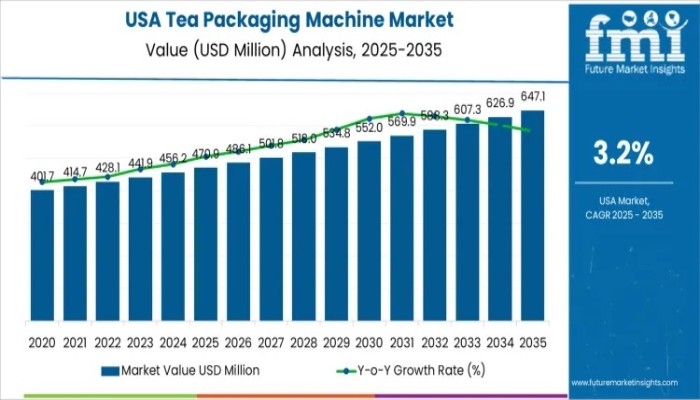
The demand for tea packaging machines in the United States is entering a phase of steady, technology-led expansion as beverage manufacturers modernize operations to meet changing consumer expectations. Valued at USD 470.9 million in 2025, the USA tea packaging machine market is projected to reach USD 647.1 million by 2035, registering a CAGR of 3.2% over the forecast period.
While tea consumption in the US is a mature category, growth is being reshaped by premiumization, sustainability-driven packaging innovation, and continued investment in automation upgrades rather than greenfield installations.
Rising consumption of premium, herbal, and wellness-focused teas is reshaping how tea is packaged and presented across retail and direct-to-consumer channels. Brands increasingly rely on advanced packaging machinery to preserve aroma, ensure fill accuracy, and maintain product consistency at scale. The growing popularity of ready-to-brew portion packs, pyramid tea bags, and single-serve sachets is reinforcing demand for equipment that combines speed, flexibility, and high sealing integrity.
Explore Opportunities – Get Your Sample of Our Industry Overview Now!
Quick Stats: USA Tea Packaging Machine Demand
- USA Tea Packaging Machine Sales Value (2025): USD 470.9 million
- USA Tea Packaging Machine Forecast Value (2035): USD 647.1 million
- Forecast CAGR (2025–2035): 3.2%
- Leading Machine Type: Form Fill-Seal (FFS) Equipment
- Key Growth Regions: West USA, South USA, Northeast USA
Automation Drives Efficiency in a Mature Market
Despite long-established tea consumption habits, the US tea packaging industry continues to invest in machinery upgrades to improve efficiency, reduce waste, and comply with evolving food-safety and sustainability standards. Many large tea producers and co-packers already operate fully automated primary and secondary packaging lines, shifting market demand toward replacement cycles, retrofits, and service contracts rather than large-scale new installations.
Commodity tea formats, particularly standard tea bags, are approaching saturation as operational efficiency levels are already optimized. In these segments, procurement is driven mainly by equipment replacement, maintenance, and performance upgrades. In contrast, premium formats such as biodegradable sachets, pyramid bags, and specialty pouches remain less saturated, offering targeted growth opportunities for machinery suppliers.
Form Fill-Seal Equipment Leads Machine Adoption
Form fill-seal (FFS) equipment dominates the US tea packaging machine market, accounting for an estimated 63.7% share. Its ability to integrate forming, filling, dosing, and sealing into a single continuous process makes it ideal for high-speed, high-volume tea production. Manufacturers favor FFS systems for their flexibility in handling multiple formats, strong sealing performance for aroma protection, and reduced material waste.
Filling and dosing machines represent 20.3% of demand, supporting precise measurement requirements for premium blends and functional teas. Secondary packaging equipment such as case packers and sealers (8.0%), cartoning machines (5.0%), and wrapping or bundling systems (3.0%) reflect growing downstream automation needs for retail-ready and palletized shipments.
Pouches and Flexible Formats Shape Application Trends
By application, pouches lead with a 35.0% share, driven by lightweight materials, airtight sealing, and strong shelf appeal. Bottles and jars follow at 27.0%, particularly for loose-leaf and specialty teas positioned as premium or gift products. Cans account for 17.0%, while traditional tea bags represent 12.0% of packaged output. Stick packs and sachets, at 9.0%, are gaining traction through on-the-go and single-serve consumption trends.
These application shifts underscore the growing importance of packaging machines that support diverse SKUs, fast changeovers, and compatibility with compostable or recyclable materials.
Regional Growth Patterns Across the United States
Regional adoption varies based on production concentration, brand mix, and automation maturity. West USA leads growth at a 3.7% CAGR, supported by specialty tea hubs in California and Washington that emphasize sustainable materials and advanced sealing technologies. South USA follows at 3.3% CAGR, driven by expanding co-packing operations and large-scale retail distribution networks.
The Northeast USA grows at 3.0%, fueled by artisanal and wellness tea brands requiring compact, flexible automation. The Midwest USA, at 2.6% CAGR, contributes steady demand from mainstream and private-label tea packaging focused on cost efficiency and high-volume repetition.
Competitive Landscape and Supplier Positioning
The competitive environment is shaped by machine reliability, regulatory compliance, service support, and flexibility across packaging formats. GEA Group AG leads with an estimated 24.2% market share, leveraging advanced, hygiene-compliant systems for large-scale operations.
I.M.A. Industria Macchine Automatiche S.P.A. and Syntegon Technology GmbH are recognized for modular, turnkey solutions supporting mid-sized and private-label producers. Teepack Spezialmaschinen GmbH & Co. KG specializes in premium tea-bagging technology, while Xiamen Sengong Packing Equipment Co. Ltd. serves cost-sensitive and regional operators seeking entry-level automation.
Why FMI: https://www.futuremarketinsights.com/why-fmi
About Future Market Insights (FMI)
Future Market Insights, Inc. (FMI) is an ESOMAR-certified, ISO 9001:2015 market research and consulting organization, trusted by Fortune 500 clients and global enterprises. With operations in the U.S., UK, India, and Dubai, FMI provides data-backed insights and strategic intelligence across 30+ industries and 1200 markets worldwide.
Contact Us:
Future Market Insights Inc.
Christiana Corporate, 200 Continental Drive,
Suite 401, Newark, Delaware – 19713, USA
T: +1-347-918-3531
For Sales Enquiries: sales@futuremarketinsights.com
Website: https://www.futuremarketinsights.com
LinkedIn| Twitter| Blogs | YouTube