Atomic Clock Market Outlook Signals Sustained Strategic Growth
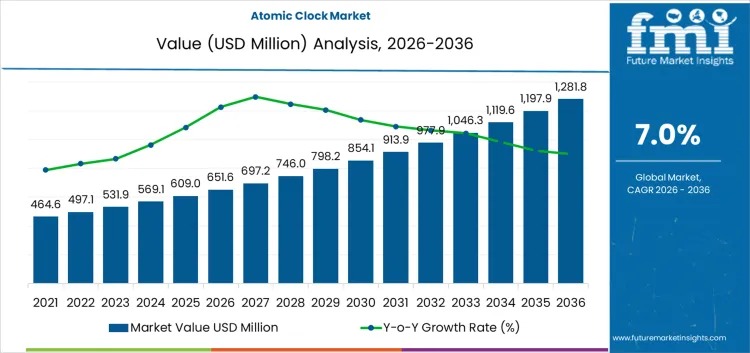
The Atomic Clock Market is entering a decade of structurally driven growth, supported by rising dependence on precise, autonomous timing references across mission-critical systems. Valued at USD 651.6 million in 2026, the market is forecast to reach USD 1,281.8 million by 2036, expanding at a CAGR of 7.0%. This value-led expansion reflects not short-term electronics cycles, but long-term investments in national infrastructure, defense readiness, space exploration, and high-reliability communications.
Unlike consumer-driven technology markets, atomic clock procurement is governed by system-level dependency. Defense agencies, space programs, and telecom operators invest in these solutions because timing accuracy directly affects operational integrity. As a result, capital allocation favors clocks offering long-term frequency stability, environmental robustness, and compliance with international time standards, rather than incremental performance upgrades.
Infrastructure-Driven Demand Shapes Market Fundamentals
Atomic clocks sit at the foundation of modern digital infrastructure. Telecommunications networks rely on nanosecond-level synchronization to maintain seamless handovers and data integrity, particularly as 5G and future network architectures densify. Satellite navigation systems depend on onboard atomic clocks to deliver accurate positioning signals, while defense platforms require resilient timing for secure communications, radar coordination, and electronic warfare resilience.
Subscribe for Year-Round Insights → Stay ahead with quarterly and annual data updates:
From an industry standpoint, demand visibility remains high because most procurement is tied to multi-year government and infrastructure programs. Replacement cycles are extended, placing emphasis on upfront validation, lifecycle assurance, and vendor support rather than high-volume turnover.
Market Economics Favor Performance Over Volume
Supply-side dynamics play a defining role in market scalability. Atomic clock manufacturing depends on specialized components, precision vacuum systems, and highly skilled expertise. Qualification requirements for space, military, and national infrastructure deployments lengthen adoption timelines, while export controls and security regulations restrict cross-border supply flexibility.
These constraints limit broader commercial penetration, but they also reinforce pricing discipline and long-term value creation. Network-based timing alternatives may cap substitution in some applications, yet they do not eliminate the need for local reference clocks, particularly where resilience and autonomy are essential.
Product Segmentation Reflects Miniaturization Trends
Rubidium and chip-scale atomic clocks account for 52.0% of global demand, making them the dominant product category. Their compact size, lower power consumption, and integration flexibility support deployment across satellites, portable defense systems, and telecom network equipment.
Key factors supporting this segment include:
- Compact designs enabling space-constrained integration
- Power efficiency suited for distributed and embedded systems
- Adequate stability for synchronization without large-system complexity
Cesium clocks continue to serve fixed installations requiring higher long-term accuracy, while hydrogen masers remain essential for specialized research and metrology applications.
Space and Defense Applications Anchor Demand
Space, military, and aerospace applications represent 41.0% of total demand, underscoring the market’s strategic orientation. Satellite constellations depend on atomic clocks for navigation accuracy and signal synchronization, while defense systems require stable timing for mission-critical coordination.
Additional application areas include scientific research, national metrology institutes, and telecommunications networks, where precise synchronization ensures latency control and data reliability. Across these sectors, timing accuracy is a non-substitutable input rather than an optimization feature.
Geographic Growth Mirrors Strategic Investment Patterns
Global demand expansion aligns closely with national priorities in space, defense, and advanced communications:
- China (7.5% CAGR): Driven by satellite navigation development, space missions, and domestic timing technology programs.
- United States (7.4% CAGR): Supported by defense modernization, satellite constellation expansion, and advanced telecom networks.
- India (7.0% CAGR): Fueled by indigenous navigation initiatives, telecom upgrades, and space research programs.
- Germany (6.9% CAGR): Anchored in precision engineering, metrology, and European space participation.
- United Kingdom (6.8% CAGR): Sustained by research institutions, satellite programs, and network synchronization needs.
Growth in these markets reflects long-term infrastructure resilience strategies rather than short-term electronics demand.
Competitive Landscape Focuses on Reliability and Standards Compliance
The competitive environment is defined by a small group of specialized manufacturers with proven performance credentials. Buyers prioritize suppliers capable of delivering validated frequency stability, environmental ruggedness, and compliance with international timing standards.
Leading participants include Microchip Technology (Symmetricom), Oscilloquartz (ADVA Group), Stanford Research Systems, and Vremya-Ch (Concern VKO Almaz-Antey). Differentiation increasingly depends on integration support, lifecycle services, and certified performance under stringent operating conditions.
Strategic Outlook: Precision Timing as a National Asset
Looking ahead, atomic clocks will continue to be treated as strategic infrastructure components. Their role in safeguarding navigation accuracy, network synchronization, and defense readiness positions the market for sustained, value-driven growth through 2036.
Get data that aligns with your strategic priorities — ask for report customization today:
Related Reports
Industrial Planetary Gearbox Market – https://www.futuremarketinsights.com/reports/industrial-planetary-gearbox-market
Instrumentation Valve and Fitting Market – https://www.futuremarketinsights.com/reports/instrumentation-valve-and-fitting-market
India Solar Panel Mounting Structure Market – https://www.futuremarketinsights.com/reports/industry-analysis-of-solar-panel-mounting-structure-in-india
Have a specific Requirements and Need Assistant on Report Pricing or Limited Budget please contact us – sales@futuremarketinsights.com
About Future Market Insights (FMI)
Future Market Insights, Inc. (FMI) is an ESOMAR-certified, ISO 9001:2015 market research and consulting organization, trusted by Fortune 500 clients and global enterprises. With operations in the U.S., UK, India, and Dubai, FMI provides data-backed insights and strategic intelligence across 30+ industries and 1200 markets worldwide.
Contact Us:
Future Market Insights Inc.
Christiana Corporate, 200 Continental Drive,
Suite 401, Newark, Delaware – 19713, USA
T: +1-347-918-3531
Why FMI: https://www.futuremarketinsights.com/why-fmi
For Sales Enquiries: sales@futuremarketinsights.com
Website: https://www.futuremarketinsights.com
LinkedIn| Twitter| Blogs | YouTube