Global Market Overview: Steady Growth Anchored in Efficiency Needs
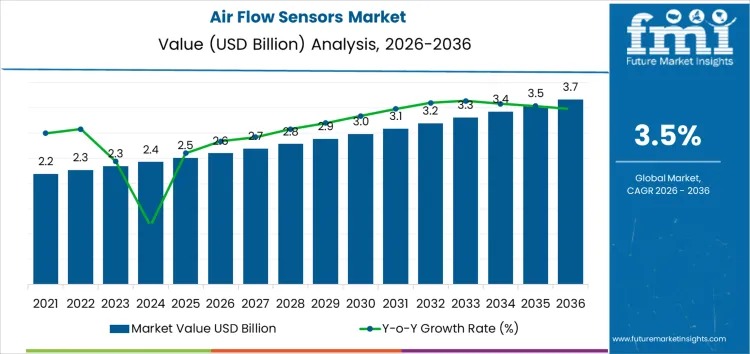
The Air Flow Sensors Market is entering a decade of consistent expansion, supported by global efforts to improve energy efficiency, emissions compliance, and system automation. The market is projected to reach USD 2.6 billion in 2026 and expand to USD 3.7 billion by 2036, reflecting a CAGR of 3.5%. While not hyper-growth, this trajectory underscores the market’s role as a foundational technology across automotive, HVAC, industrial manufacturing, and medical applications.
Air flow sensors are increasingly embedded into mission-critical systems where precision matters—engine management, climate control, cleanrooms, and medical ventilation. As industries demand real-time monitoring and tighter process control, airflow measurement is moving from a supportive component to a strategic necessity.
Subscribe for Year-Round Insights → Stay ahead with quarterly and annual data updates
This subscription model reflects rising demand from executives and product managers who require continuous market intelligence rather than static, one-time reports.
Key Market Drivers Shaping Demand
Several forces are collectively shaping the air flow sensors market:
- Automotive optimization: Air flow sensors, especially mass air flow (MAF) sensors, are essential for accurate air-fuel ratio control, emissions reduction, and fuel efficiency.
- Energy-efficient buildings: Smart HVAC systems rely on precise airflow data to minimize energy waste while maintaining indoor air quality.
- Industrial automation: Manufacturing environments increasingly require airflow monitoring to ensure process consistency, safety, and compliance.
- Healthcare expansion: Devices such as ventilators, CPAP machines, and anesthesia systems depend on reliable airflow sensing for patient safety.
Despite these drivers, adoption friction remains for small and medium enterprises, where upfront costs and system integration challenges can delay deployment.
Technology Trends Redefining Competitive Advantage
Technological innovation is central to market differentiation. MEMS-based air flow sensors are gaining traction due to their compact size, faster response times, and lower power consumption. These attributes align well with electric vehicles, portable medical devices, and IoT-enabled HVAC systems.
Wireless connectivity and cloud integration are also emerging trends, enabling predictive maintenance and remote diagnostics. As a result, air flow sensors are increasingly positioned as intelligent data sources rather than standalone hardware components.
Segment Insights: Where Demand Is Concentrated
Mass air flow (MAF) sensors dominate the product landscape, accounting for approximately 61% of total market demand. Their leadership stems from their accuracy in measuring intake air mass, a critical parameter for engine control units in meeting performance and emission standards.
From an application standpoint, automotive represents about 52.7% of market demand. However, non-automotive segments—HVAC, industrial processing, medical devices, and data centers—are expanding steadily, offering diversification opportunities for manufacturers seeking to reduce dependence on cyclical vehicle production.
Regional Outlook: Asia Pacific Leads the Growth Curve
Asia Pacific stands out as the most dynamic growth region, supported by industrial expansion, automotive production, and increasing environmental regulation.
- India leads with a CAGR of 4.3%, driven by industrialization, infrastructure development, and growing air quality awareness.
- China follows at 3.9%, supported by smart building adoption and environmental monitoring initiatives.
- United States records 3.7% growth, anchored in regulatory compliance, smart homes, and advanced manufacturing.
- Japan and South Korea continue to benefit from technology leadership, automotive innovation, and energy-efficient building policies.
These regional trends highlight how airflow sensing is becoming integral to both emerging and mature economies.
Competitive Landscape: Innovation Meets Execution Risk
Competition in the air flow sensors market is intensifying as global players invest in accuracy, durability, and integration capabilities. Companies such as Honeywell International Inc., Sensirion AG, TE Connectivity, Denso Corporation, and Bosch Sensortec GmbH are leveraging MEMS platforms, automotive-grade reliability, and digital interfaces to strengthen their market positions.
However, heightened innovation also raises execution risk. Manufacturers must manage supply chain volatility, raw material pricing, and the pressure to reduce unit costs while maintaining performance. Success increasingly depends on balancing technological leadership with scalable, cost-efficient production.
Market Outlook: Balancing Opportunity and Constraint
Looking ahead to 2036, the air flow sensors market is expected to benefit from long-term megatrends—automation, sustainability, and digitalization. Yet growth will remain measured, shaped by economic cycles in automotive manufacturing and budget sensitivity in industrial investments. Companies that align product roadmaps with energy efficiency mandates and smart system integration will be best positioned to capture value.
Before concluding, organizations are encouraged to explore tailored insights aligned with their strategies.
Get data that aligns with your strategic priorities — ask for report customization today:
Related Reports
Transformer Monitoring System Market – https://www.futuremarketinsights.com/reports/transformer-monitoring-system-market
Sulphur Recovery Technology Market – https://www.futuremarketinsights.com/reports/sulphur-recovery-technology-market
Marine Fuel Injection System Market – https://www.futuremarketinsights.com/reports/marine-fuel-injection-system-market
Have a specific Requirements and Need Assistant on Report Pricing or Limited Budget please contact us – sales@futuremarketinsights.com
About Future Market Insights (FMI)
Future Market Insights, Inc. (FMI) is an ESOMAR-certified, ISO 9001:2015 market research and consulting organization, trusted by Fortune 500 clients and global enterprises. With operations in the U.S., UK, India, and Dubai, FMI provides data-backed insights and strategic intelligence across 30+ industries and 1200 markets worldwide.
Contact Us:
Future Market Insights Inc.
Christiana Corporate, 200 Continental Drive,
Suite 401, Newark, Delaware – 19713, USA
T: +1-347-918-3531
Why FMI: https://www.futuremarketinsights.com/why-fmi
For Sales Enquiries: sales@futuremarketinsights.com
Website: https://www.futuremarketinsights.com
LinkedIn| Twitter| Blogs | YouTube