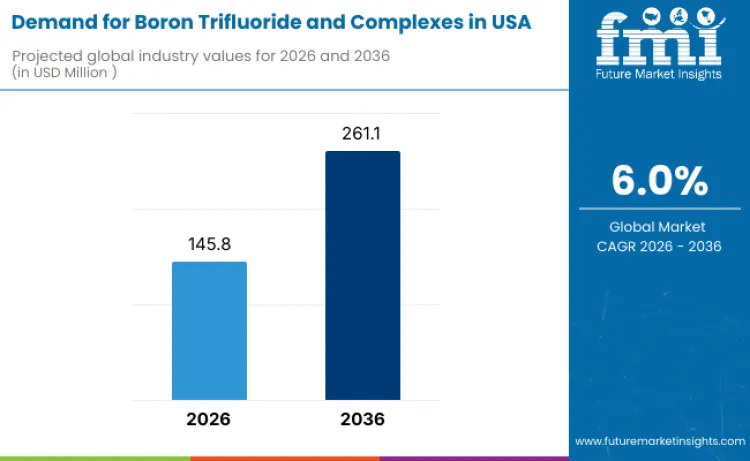
The United States boron trifluoride and complexes market is projected to grow robustly from approximately USD 145.8 million in 2026 to USD 261.1 million by 2036, expanding at a 6.0% CAGR during this period. This anticipated growth reflects a strengthening demand for boron trifluoride (BF₃) gas and its stabilized complexes across major industrial sectors, underscoring the critical role this class of chemicals plays in modern manufacturing, research, and technology-enabled production environments.
As manufacturing trends continue evolving, both established chemical producers and innovative new entrants are positioning themselves to capitalize on this expanding market. With applications ranging from industrial catalysis and specialty polymers to pharmaceutical synthesis and electronics fabrication, boron trifluoride is becoming increasingly central to high-value chemical processes. The growth story of this market is not just about volume — it’s about the emergence of new technologies, safer handling methods, and broader adoption in advanced industrial use cases.
Market Dynamics Fueling Demand Across Industries
Boron trifluoride, known for its potent Lewis acidity and unique catalytic properties, has long been a staple in chemical synthesis. Its versatility enables high-efficiency polymerization, alkylation, and esterification reactions — processes that are foundational to the production of high-performance plastics, specialty resins, and critical fine chemicals. In the United States, leading industrial clusters, from the Gulf Coast to the Midwest and West Coast, continue to anchor heavy use of BF₃ and its complexes, thanks to integrated supply chains and advanced safety frameworks.
In the petrochemical sector, BF₃ maintains strong demand as a catalyst in refining and resin production lines. Polymer manufacturers rely on its precise reactivity to produce specialty materials with enhanced attributes required by automotive, aerospace, and consumer goods industries. Pharmaceutical manufacturers value BF₃ complexes for controlled synthesis of intermediates, enabling high selectivity and consistent yields in active pharmaceutical ingredient (API) production. Meanwhile, electronics and agrochemical manufacturers are tapping into high-purity BF₃ complexes to meet stringent performance and safety standards in cutting-edge applications.
These broad industrial end uses create a mosaic of demand drivers that speak not only to quantity but to quality and sophistication. Companies that innovate in handling, packaging, and specialized complex formulations are uniquely positioned to capture new market opportunities as demand diversifies.
To access the complete data tables and in-depth insights, request a sample report here
Key Players — Bridging Legacy Expertise and New Innovation
The competitive landscape is anchored by established players with decades of manufacturing expertise, resilient supply networks, and deep technical knowledge. Industry stalwarts are reinforcing their positions through expanded production capacities, customer-centric technical support, and investment in safer, more efficient product variants that meet evolving regulatory expectations.
At the same time, new manufacturers and technology-forward entrants are reshaping the field by introducing cutting-edge formulations and process capabilities. These emerging players are focused on enhancing the performance characteristics of BF₃ complexes, improving thermal stability, and refining reactive control for niche high-purity applications. Their contributions are creating fresh technological momentum and attracting interest from sectors that demand precision, such as advanced materials manufacturing and semiconductor processing.
This blending of legacy operational strength with emergent technological innovation ensures the industry’s continued vibrancy. Manufacturers large and small are pursuing collaborative research and development initiatives, leveraging advanced containment technologies, and optimizing complex chemistry platforms that expand the practical reach of boron trifluoride products. These developments resonate especially well in segments where strict safety and environmental compliance are mandatory.
Innovation in Handling, Safety, and Sustainability
A notable theme in the market’s evolution is the increasing emphasis on safer handling, environmentally effective packaging, and sustainability-oriented practices. Given the inherent reactivity and corrosive nature of BF₃, manufacturers are investing in new containment and transport solutions that minimize risk and improve user confidence. Innovations include advanced cylinder linings, sealed vessel systems, and stabilizing complex agents that make BF₃ more accessible to a wider range of industrial users.
Furthermore, growing emphasis on lifecycle management and waste reduction is pushing both established and new firms to explore recycling methods for boron-based catalysts and greener catalytic processes. These technological trends are not simply regulatory responses; they represent commercially savvy adaptations that create value for customers seeking efficiency and compliance.
Looking Ahead: Opportunities and Outlook
As the United States boron trifluoride and complexes market continues its projected trajectory of growth, industry stakeholders are preparing for an era marked by expanding demand, technological advancement, and increased partnership across sectors. Established manufacturers are doubling down on quality and reliability, while newcomers bring fresh energy and innovation that broaden the market’s potential.
This synergy of experience and experimentation promises to unlock new industrial pathways — from ultra-high-purity materials in electronics to next-generation pharmaceuticals and advanced specialty polymers. For companies ready to embrace this momentum, the US boron trifluoride and complexes market offers not just growth, but transformation.