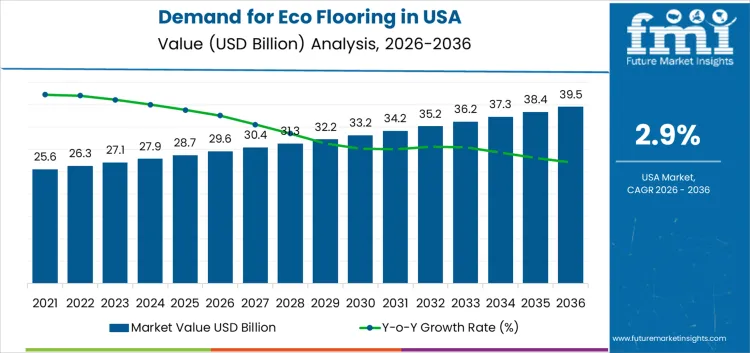
The United States eco flooring market is projected to grow from approximately $29.6 billion in 2026 to an estimated $39.5 billion by 2036, reflecting strong and steady demand for sustainable and environmentally responsible flooring solutions across residential, commercial, and institutional sectors. This growth is fueled by evolving consumer preferences, regulatory emphasis on green building standards, and groundbreaking technologies that support renewable material adoption, setting the stage for both established companies and new entrants to expand their footprint and innovate for the future.
In recent years, the eco flooring industry in the U.S. has outpaced traditional flooring segments by catering to environmentally conscious buyers who prioritize low-emission, recyclable, and rapidly renewable materials. Homeowners increasingly choose alternatives like bamboo, cork, and reclaimed wood not only for their aesthetic appeal but also for their superior indoor air-quality performance and reduced environmental footprint. Commercial developers and institutional buyers are similarly shifting toward certified sustainable options to meet rigorous green building certification criteria, creating broader demand across diverse applications.
Industry veterans such as BerryAlloc, Formica, Somerset Hardwood Flooring Inc., Provenza Floors Inc., and Boral Limited continue to maintain strong market positions by leveraging decades of experience in material science, manufacturing efficiency, and distribution networks. These players have built trusted portfolios of eco-friendly wood and composite flooring options that meet the stringent demands of modern construction and interior design trends.
At the same time, a new wave of manufacturers is entering the market with disruptive technologies and forward-looking product lines. Innovations in recycled content applications, moisture-resistant bio-composite materials, and ultra-low volatile organic compound (VOC) surface coatings are redefining what it means to be “eco-friendly” in the flooring space. These advancements are expanding the definition of eco flooring beyond traditional wood products to include cutting-edge performance materials that appeal to architects, builders, and consumers alike.
To access the complete data tables and in-depth insights, request a sample report here
The residential segment remains the largest end-use category, accounting for a significant share of total eco flooring demand. Home renovation activity, particularly in urban and suburban regions, is boosting sales of high-quality, sustainable flooring options that combine design versatility with long-term durability. Meanwhile, the non-residential segment is gaining momentum as businesses and public institutions adopt flooring solutions that support wellness goals, enhance interior environments, and contribute to corporate sustainability reporting objectives.
Regional dynamics within the U.S. also reflect differentiated growth patterns. The West and South regions, driven by strong construction markets and deeper penetration of green building initiatives, are at the forefront of adoption, while the Northeast and Midwest regions continue to integrate eco flooring into renovation and new build projects at a steady pace. Across all regions, increased awareness of lifecycle impacts and improved product accessibility through online and offline distribution channels are major growth enablers.
Technology and innovation are reshaping the competitive landscape. Manufacturers are investing in state-of-the-art production techniques that reduce waste, enhance resource efficiency, and improve product performance. Eco flooring producers are increasingly using digital tools for lifecycle analysis, blockchain-enabled material traceability, and AI-powered formulation optimization to meet sustainability benchmarks and provide transparent product credentials to buyers. These advancements are expected to reduce production costs over time and unlock new market segments previously constrained by price sensitivity.
Partnerships between flooring manufacturers and professional installation networks are also enhancing market reach. By offering turnkey solutions that combine sustainable products with expert installation services, companies are simplifying the customer journey — from selection to deployment — and strengthening long-term satisfaction and repeat business.
Despite the positive momentum, the industry faces challenges such as the higher upfront cost of eco materials relative to conventional flooring, supply chain complexities for certified inputs, and performance perceptions that sometimes lag behind traditional products. However, ongoing product improvements and scaling of production capacity are rapidly addressing these barriers, making eco flooring increasingly competitive on both cost and performance dimensions.
Looking ahead, the U.S. eco flooring market is well positioned for sustained growth as environmental awareness, regulatory requirements, and consumer expectations converge around sustainability. For established manufacturers, this presents opportunities to elevate their offerings with next-generation materials and enhanced eco-credentials. For new entrants, the market offers fertile ground to introduce innovative technologies and capture share by addressing unmet needs in niche segments such as high-traffic commercial flooring, smart material integrations, and bespoke eco design solutions.