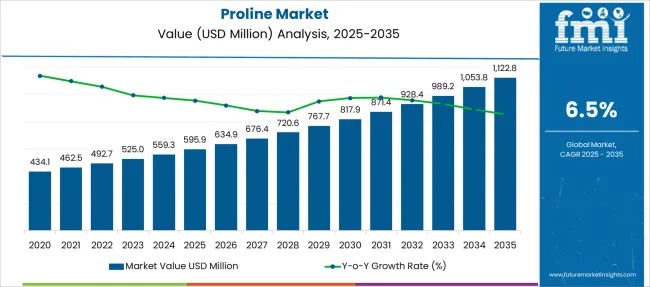
The global proline market is witnessing steady and resilient growth as demand for amino acids accelerates across food, nutrition, pharmaceuticals, and biotechnology applications. Valued at USD 595.9 million in 2025, the market is projected to reach USD 1,122.8 million by 2035, expanding at a compound annual growth rate (CAGR) of 6.5% during the forecast period. This upward trajectory reflects the growing role of proline in health-focused formulations, clean-label foods, and performance-driven dietary supplements.
Proline, a non-essential amino acid, has gained commercial significance due to its functional benefits in collagen synthesis, skin health, metabolic processes, and muscle recovery. Rising consumer awareness around preventive healthcare, combined with increasing adoption of protein-rich and fortified diets, has positioned proline as a high-value ingredient across multiple end-use industries.
Explore trends before investing – request a sample report today!
Quick Snapshot: Proline Market at a Glance
- Market value (2025): USD 595.9 million
- Forecast value (2035): USD 1,122.8 million
- Forecast CAGR (2025–2035): 6.5%
- Leading product type (2025): Plant-based (58.6% share)
- Key end-use segment: Health and dietary supplements
- High-growth regions: North America, Asia-Pacific, Europe
Strong Fundamentals Supporting Market Expansion
The proline market is benefiting from a convergence of nutrition science, consumer lifestyle shifts, and ingredient innovation. Growing preference for plant-based and naturally derived ingredients has encouraged manufacturers to invest in fermentation and plant-extraction technologies to produce high-purity proline. These developments align well with vegan, vegetarian, and sustainability-driven consumption patterns.
In parallel, food grade proline has emerged as the preferred choice for edible applications due to its safety profile, regulatory compliance, and consistent quality standards. Its inclusion in fortified foods, protein supplements, and functional beverages continues to rise, supported by tightening labeling regulations and demand for transparent ingredient sourcing.
Plant-Based Proline Dominates Product Type Segment
By product type, the plant-based segment is projected to account for 58.6% of total market revenue in 2025, making it the dominant category. This leadership is underpinned by:
- Rising global adoption of plant-based diets
- Demand for sustainable, non-animal ingredient sources
- Compatibility with clean-label and ethical food formulations
Plant-derived proline offers manufacturers flexibility in formulation while meeting evolving consumer expectations around sustainability and wellness. As environmental considerations remain central to sourcing decisions, this segment is expected to retain its strong position through 2035.
Food Grade Proline Leads by Grade
In terms of grade, food grade proline is estimated to contribute 60.2% of market revenue in 2025. Its widespread use in nutritional supplements, fortified foods, and functional nutrition products continues to fuel growth. Food manufacturers increasingly prioritize food grade amino acids to ensure:
- Regulatory compliance
- High safety standards
- Strong consumer trust
With innovation accelerating in functional and health-oriented foods, food grade proline is expected to remain the cornerstone of market demand.
Health and Dietary Supplements Drive End-Use Demand
Among end-use sectors, health and dietary supplements are projected to hold a 39.7% revenue share in 2025, leading the market. Proline’s role in collagen formation, joint support, skin health, and antioxidative activity has made it a popular ingredient in supplements targeting sports nutrition, beauty-from-within, and healthy aging.
The rapid expansion of e-commerce and direct-to-consumer health platforms has further amplified market reach, particularly in emerging economies where awareness of amino acid benefits is rising quickly.
Pharmaceutical and Feed Applications Add Momentum
Beyond nutrition, proline is gaining traction in pharmaceutical applications, especially in formulations related to cardiovascular health and metabolic support. This segment is expected to register the fastest growth rate over the forecast period. Additionally, increasing production of amino acids and exports of feed additives from countries such as China and Japan are strengthening regional demand, particularly in animal nutrition.
Regional Outlook: Asia-Pacific and North America in Focus
Regionally, growth is being shaped by Asia-Pacific, North America, and Europe. Asia-Pacific benefits from large-scale amino acid production, cost efficiencies, and expanding R&D investments. North America continues to see strong demand for proline-based health supplements, driven by fitness trends and aging demographics. Europe’s focus on high-quality animal feed and functional foods further supports steady consumption.
Competitive Landscape and Industry Developments
The global proline market is moderately consolidated, with key players including PepTech Corporation, Anaspec, Inc., Iris Biotech GmbH, Ajinomoto Co. Inc., ChemPep Inc., KYOWA HAKKO BIO CO., LTD., and Meihua Holdings Group. Strategic partnerships, capacity expansions, and technology upgrades are shaping competition. Notably, Ajinomoto’s authorization agreement with a Chinese manufacturer to produce amino acids for animal feed highlights the growing emphasis on regional production and supply chain efficiency.
Outlook
Supported by technological advancements, scalable production, and expanding health applications, the proline market is positioned for sustained growth. While raw material price volatility and regulatory variability may pose short-term challenges, long-term fundamentals remain strong as proline cements its role in the global health and nutrition ecosystem.