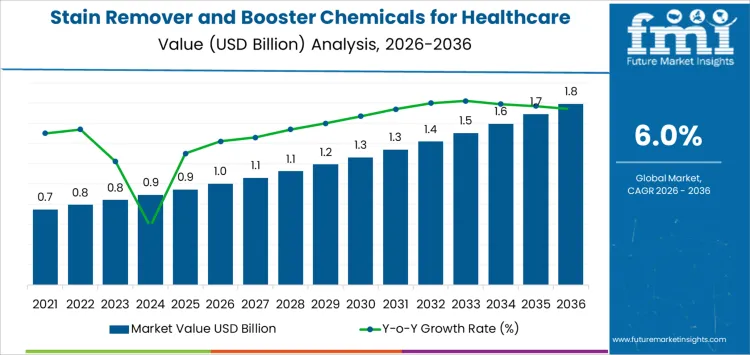
The global stain remover and booster chemicals for healthcare laundry market is poised for robust expansion, with its value projected to reach USD 1.8 billion by 2036, up from an estimated USD 1.0 billion in 2026, driven by rising hygiene requirements in healthcare environments and accelerating adoption of advanced laundry solutions. This upward trajectory reflects a compound annual growth rate of around 6%, signaling strong industry confidence and expanding demand for effective stain removal and booster technologies tailored to the critical needs of hospitals, clinics, and institutional laundries.
Healthcare laundries operate under exceptionally stringent hygiene standards, where removing blood, bodily fluids, and various contaminants is not just about aesthetics but essential infection control. As facilities worldwide continue to prioritize safety, the need for powerful, reliable, and advanced laundry chemicals has never been greater. In this context, both long-established manufacturers and innovative newcomers are strategically positioning themselves to capture share and drive differentiation through next-generation products and technologies.
Market Dynamics: Demand, Innovation, and Facility Focus
One of the standout trends fueling market growth is the dominance of hospital in-house laundry operations, accounting for a substantial share of global demand. Hospitals typically handle massive volumes of linens and garments that require thorough cleaning, sanitization, and stain removal — a combination that has elevated the importance of highly specialized chemical solutions in routine laundering processes.
In terms of application, main wash boosters are leading adoption due to their effectiveness in enhancing the overall performance of wash cycles. These boosters improve stain removal, bolster disinfectant action, and contribute to consistent fabric care, which is particularly critical when healthcare textiles must meet exacting sanitation benchmarks.
To access the complete data tables and in-depth insights, request a sample report here
A Competitive Landscape Balancing Legacy and Innovation
The competitive landscape features a mix of well-established multinational players alongside agile new entrants, all striving to innovate and expand their market footprints:
- Ecolab continues to be a benchmark for tailored stain removal and booster formulations designed for healthcare use, with products that combine high efficacy and fabric preservation.
- Diversey has strengthened its position with solutions that emphasize sustainability without compromising cleaning performance — an increasingly important requirement as healthcare buyers integrate environmental considerations into procurement.
- Henkel and Kao Corporation bring decades of expertise in surfactants and fabric chemistry to the table, leveraging their global R&D capabilities to refine performance and broaden application versatility.
- Procter & Gamble Professional targets the professional laundry segment with specialized boosters that offer both stain-fighting power and gentleness on sensitive fabrics.
Beyond these established leaders, a new wave of players is also gaining traction. Solenis, for example, is attracting attention with innovative chemistries that speak to complex laundering needs, while companies like Zep and Spartan Chemical are carving niches by addressing cost-effective, large-scale operations such as contract laundry services. Reckitt contributes with solutions that weave hygiene, safety, and stain removal into a cohesive value proposition.
This competitive mix is fostering a fertile environment for collaboration, technology sharing, and product reinvention, all of which are expanding the range of options available to healthcare laundry managers who must balance performance, cost, and compliance.
Regional Drivers and Growth Opportunities
Geographically, Asia Pacific and North America stand out as key growth regions. China and Brazil are exhibiting some of the fastest regional expansion rates, bolstered by rapid infrastructure development, increased healthcare spending, and growing expectations for healthcare cleanliness standards. In North America and Europe, steady market growth aligns with ongoing investments in infection control and sustainable chemical technologies.
In markets like South Korea and Germany, stringent regulatory expectations and heightened awareness of eco-friendly formulations are accelerating interest in advanced enzyme-based stain removers and boosters that reduce environmental impact while maintaining high cleanliness standards.
Looking Ahead: Technology, Sustainability, and Strategic Expansion
Innovation remains at the heart of the market’s evolution. Manufacturers are investing in next-generation boosters that enhance enzyme performance, improve biodegradability, and support lower water and energy usage — all aligned with broader industry trends toward sustainable operations. Moreover, digital integration, such as automated dosing systems, is gaining uptake as healthcare laundries seek smarter, more cost-efficient solutions.
For newer entrants, the path to growth lies in leveraging nimble product development and deep focus on specialized applications that legacy players may overlook. Meanwhile, established manufacturers are doubling down on brand strength, distribution reach, and strategic partnerships to remain competitive in an increasingly sophisticated marketplace.