Global Market Outlook: Steady Growth Through 2035
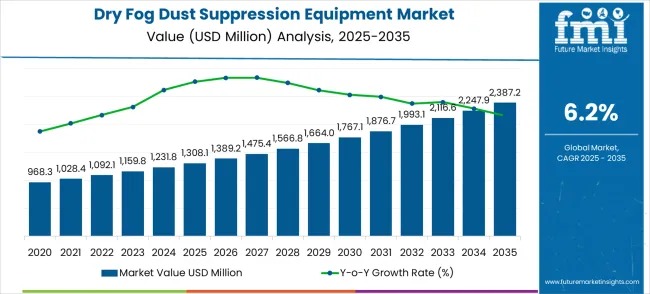
The Dry Fog Dust Suppression Equipment Market is on a decade-long growth trajectory, expected to expand from USD 1,308.1 million in 2025 to USD 2,387.2 million by 2035 at a CAGR of 6.2%. This growth reflects industries’ increasing commitment to environmental compliance, worker safety, and adoption of advanced air quality management technologies.
Between 2025 and 2030, the market is projected to rise to approximately USD 1,665 million, contributing to 39% of total decade growth. The adoption during this period will primarily be fueled by mobile dust suppression systems that allow rapid deployment in diverse industrial settings. From 2030 to 2035, the market will accelerate further, adding over USD 722 million in value, as fixed installation systems and integration with environmental management platforms become mainstream.
Subscribe for Year-Round Insights → Stay ahead with quarterly and annual data updates:
Key Market Drivers
- Environmental Compliance
Governments worldwide are enforcing stricter air quality and dust emission standards. Industries generating high particulate matter—such as mining, cement, and power generation—are adopting dry fog systems to meet these regulations efficiently. Dry fog systems minimize water usage while achieving 90–95% particle reduction, making them more sustainable than conventional spray-based methods. - Industrial Safety
Worker protection has become a top priority. Dry fog dust suppression complements ventilation systems, reducing occupational exposure to harmful dust and supporting compliance with health and safety regulations. Facilities deploying these systems see lower respiratory hazard risks and fewer operational interruptions due to air quality issues. - Technological Advancements
Innovation is driving the market forward. Key developments include IoT-enabled monitoring, automated activation based on real-time dust measurements, precision droplet control, and self-cleaning nozzle systems. These features reduce maintenance, improve operational efficiency, and enable industrial facilities to maintain continuous compliance with environmental standards.
Market Segmentation
By Installation Type:
- Mobile Systems (58.7% share): Lightweight, portable, and rapidly deployable for temporary or emergency dust control. Ideal for material handling, mining, and construction sites.
- Fixed Systems (41.3% share): Centralized, facility-wide installations providing continuous dust suppression, often integrated with industrial environmental management platforms.
By Application:
- Power Industry (42.1% share): Coal handling, conveyor belts, and storage areas require consistent dust suppression to meet regulatory standards.
- Mining & Metallurgy (28.4% share): Rugged environments demand durable, high-performance systems to manage dust in extraction and processing operations.
- Chemical Industry (18.7% share): Specialized solutions for powder handling, material transfer, and contamination control in chemical manufacturing.
- Other Industries (10.8% share): Includes cement plants, construction sites, and general manufacturing facilities requiring precise dust management.
By Region:
- Asia Pacific: Fastest-growing region, led by China (8.4% CAGR) and India (7.8% CAGR), driven by industrial modernization and environmental infrastructure development.
- Europe: Germany and France dominate with advanced environmental technology adoption, steady CAGR of 6–7%.
- North America: Moderate growth (5.9% CAGR), supported by industrial safety upgrades and federal environmental initiatives.
- Emerging Markets: Gradual adoption, supported by modernization programs and environmental compliance initiatives.
Competitive Landscape
The market is moderately consolidated, with the top five players controlling approximately 54–59% of global revenue.
- Market Leaders: Dust Control Technologies, Mideler, IKEUCHI, Enviropol Engineers, and Control Systems & Solutions.
- Focus Areas: Droplet size consistency, water efficiency, automation, and seamless integration with existing industrial infrastructure.
- Challengers: Clayton Equipment, Cloud Tech, Synery Spray System, ABCDust, and TRC-Raring Corp, offering modular and cost-effective systems for emerging regions.
Strategic Insights for Stakeholders:
- Modular platforms enable customers to scale from mobile to fixed installations.
- Integration with environmental monitoring enhances compliance reporting and operational efficiency.
- Regional manufacturing in China and India reduces deployment costs and accelerates market penetration.
Market Challenges
- High upfront capital costs may slow adoption in cost-sensitive industries.
- Extreme environmental conditions (temperature, humidity) can affect fog generation efficiency.
- Fragmentation across industrial standards may create compatibility issues between systems and existing infrastructure.
Country-Level Insights
- China: Leads global market with 8.4% CAGR; domestic manufacturers are developing automated, cost-effective systems.
- India: 7.8% CAGR, driven by modernization programs and ecological compliance initiatives in industrial hubs like Delhi, Mumbai, and Bangalore.
- Germany: 7.1% CAGR; advanced engineering and EU compliance support premium system adoption.
- Brazil: 6.5% CAGR; focus on cost-effective solutions balancing efficiency and environmental compliance.
- USA: 5.9% CAGR; federal programs and industrial upgrades promote precision dust control technologies.
- Japan & UK: Steady growth with emphasis on precision, reliability, and seamless integration with facility systems.
Strategic Outlook for the Next Decade
The dry fog dust suppression market will continue to expand as industries prioritize environmental compliance, worker safety, and operational efficiency. Mobile systems will dominate near-term demand, while fixed installations will gain importance for facility-wide integration. Ongoing technological innovation, supported by regional environmental policies and government modernization programs, will drive long-term adoption across power generation, mining, chemical, and manufacturing sectors.
Get data that aligns with your strategic priorities — ask for report customization today:
Related Reports
Conveyor Dryer Market – https://www.futuremarketinsights.com/reports/conveyor-dryer-market
USA Power Tool Market – https://www.futuremarketinsights.com/reports/united-states-power-tool-market
Emulsion Explosive Market – https://www.futuremarketinsights.com/reports/emulsion-explosive-market
Have a specific Requirements and Need Assistant on Report Pricing or Limited Budget please contact us – sales@futuremarketinsights.com
About Future Market Insights (FMI)
Future Market Insights, Inc. (FMI) is an ESOMAR-certified, ISO 9001:2015 market research and consulting organization, trusted by Fortune 500 clients and global enterprises. With operations in the U.S., UK, India, and Dubai, FMI provides data-backed insights and strategic intelligence across 30+ industries and 1200 markets worldwide.
Contact Us:
Future Market Insights Inc.
Christiana Corporate, 200 Continental Drive,
Suite 401, Newark, Delaware – 19713, USA
T: +1-347-918-3531
Why FMI: https://www.futuremarketinsights.com/why-fmi
Website: https://www.futuremarketinsights.com
LinkedIn| Twitter| Blogs | YouTube