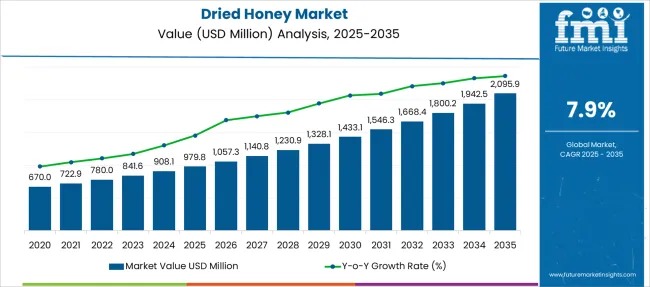
The global dried honey market is entering a strong growth phase, supported by rising demand for natural sweeteners that combine functionality with long shelf life. The market is estimated to be valued at USD 979.8 million in 2025 and is projected to reach USD 2,095.9 million by 2035, registering a solid CAGR of 7.9% over the forecast period. This momentum reflects the growing preference for low-moisture, easy-to-handle ingredients across food, nutraceutical, and personal care formulations.
Unlike liquid honey, dried honey offers advantages that align closely with modern manufacturing needs. Its resistance to microbial spoilage, improved flowability, and precise dosage control make it a preferred ingredient in large-scale processing. As global food systems increasingly prioritize clean-label, shelf-stable, and naturally derived components, dried honey is emerging as a strategic alternative to conventional sweeteners.
Explore trends before investing – request a sample report today!
The market’s expansion is further reinforced by the rise of ready-to-eat foods, snack bars, bakery premixes, and powdered beverages, where moisture sensitivity and formulation consistency are critical. In addition, the wellness economy continues to reshape ingredient choices, favoring naturally sourced sweeteners that deliver flavor intensity without synthetic additives. Dried honey’s ability to retain aroma and bioactive compounds through advanced spray-drying and vacuum-drying technologies is strengthening its value proposition across applications.
Market Snapshot: Data-Driven Overview
- Market size (2025): USD 979.8 million
- Forecast value (2035): USD 2,095.9 million
- Forecast CAGR (2025–2035): 7.9%
- Leading product segment (2025): Blend (42.6% share)
- Key growth regions: North America, Asia-Pacific, Europe
Why Dried Honey Is Gaining Industry Attention
Manufacturers are increasingly shifting toward dried honey due to its logistical and economic advantages. Compared to liquid honey, dried variants are easier to transport, store, and incorporate into dry formulations. Cost efficiency also plays a role, as dried honey is often more economical than traditional honey and several alternative sweeteners, making it attractive for foodservice providers and large-volume processors.
Beyond food, the personal care and cosmetics industry is emerging as a high-potential demand center. Dried honey is being integrated into face masks, scrubs, soaps, and haircare products for its humectant properties and natural positioning, significantly broadening the market’s end-use landscape.
Blend Segment Leads Product Type Landscape
By product type, blended dried honey is projected to account for 42.6% of total market revenue in 2025, making it the dominant category. Blends typically combine honey with carriers such as maltodextrin or gum arabic, enhancing flow properties and preventing caking during storage and transport.
Food processors favor these formulations for their consistency and adaptability in applications such as powdered drink mixes, cereal bars, and baking premixes. The standardized sweetness profile helps reduce batch-to-batch variability, while customization options allow manufacturers to tailor blends for specific flavor or nutritional requirements without compromising clean-label claims.
Organic Segment Reflects Clean-Label Momentum
The organic dried honey segment is expected to hold 28.3% of market revenue in 2025, reflecting rising consumer awareness around sustainability, traceability, and ingredient purity. Demand is particularly strong in premium food products, wellness beverages, herbal teas, and export-oriented baked goods.
As regulatory frameworks around organic labeling tighten globally, certified organic dried honey is gaining wider acceptance across both mainstream retail and specialty health food channels. This trend is reinforcing long-term growth prospects for organic variants.
Food and Beverages Remain the Primary End-Use
The food and beverages segment is anticipated to contribute 33.9% of total market revenue in 2025, maintaining its leadership position. Dried honey is widely used in bakery products, confectionery coatings, snack bars, dairy formulations, and powdered beverages, where liquid honey could negatively affect texture or shelf stability.
The growth of plant-based and functional food categories is further supporting adoption, as manufacturers seek recognizable, natural sweeteners that align with health-focused branding without sacrificing performance.
Regional Outlook Highlights Asia-Pacific and North America
Asia-Pacific holds a significant share of the global dried honey market, supported by strong honey production in countries such as China and India. Abundant raw material availability and expanding food processing industries are expected to drive continued growth in the region.
North America and Europe also present attractive opportunities, fueled by rising demand in health foods, cosmetics, and premium bakery products. Increasing consumer interest in natural, minimally processed ingredients is accelerating market penetration across these regions.
Competitive Landscape
The dried honey market features a mix of global and regional players with diversified portfolios, including Specialty Products and Technology Inc., Archer Daniels Midland Company, Best Ground International, Bio Botanica, Inc., Domino Specialty Ingredients (ASR Group), Haldin Pacific Semesta, along with Spice Jungle, LLC, Ohly (ABF Ingredients), Hoosier Hill Farm, Maple Leaf Garden Food Co., Island Abbey Foods Ltd., Wuhu Deli Foods Co., Ltd., Natural Sourcing LLC, and Augason Farms. These companies continue to focus on product innovation, sourcing strategies, and application-specific solutions to meet evolving customer demand.
As clean-label preferences intensify and functional ingredients gain prominence, the dried honey market is well positioned for sustained, data-backed growth through 2035.