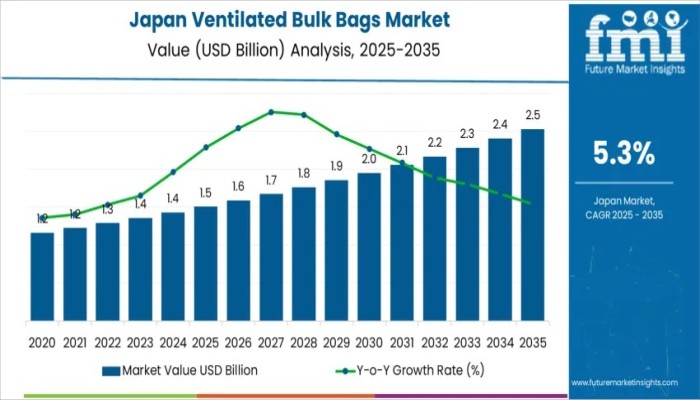
The demand for ventilated bulk bags in Japan is entering a phase of sustained, application-driven expansion, supported by the country’s advanced agricultural logistics, food security priorities, and growing use of moisture-controlled bulk handling systems. According to the latest market outlook, the Japan ventilated bulk bags market is valued at USD 1.5 billion in 2025 and is projected to reach USD 2.5 billion by 2035, registering a compound annual growth rate (CAGR) of 5.3% over the forecast period.
Unlike general-purpose bulk packaging, ventilated bulk bags in Japan are primarily deployed as moisture risk management tools, especially across agricultural produce, biomass materials, and selected industrial applications. Controlled airflow, rather than load containment alone, defines purchasing decisions, giving the market a highly specialized growth profile.
Discover Growth Opportunities in the Market – Get Your Sample Report Now
Market Growth Anchored in Agriculture and Moisture-Sensitive Commodities
Early-stage growth through 2030 remains closely linked to domestic agricultural distribution. Ventilated bulk bags are widely used for onions, potatoes, ginger, and root vegetables, where trapped humidity can cause spoilage, mold formation, and yield loss during storage and transportation. Japan’s agricultural cooperatives, food distributors, and regional wholesale markets form the core buyer base, with procurement closely aligned to harvesting cycles and storage turnover.
Between 2025 and 2030, market value rises steadily from USD 1.5 billion to approximately USD 1.9 billion, supported by produce handling, fertilizer movement, forestry by-products, and biomass fuel logistics. During this phase, growth is volume-driven rather than export-led, reflecting Japan’s emphasis on domestic food circulation and quality preservation.
Post-2030 Expansion Driven by Logistics Sophistication
From 2030 onward, growth accelerates as ventilated bulk bags evolve from niche handling solutions into standardized bulk transport infrastructure. Market value expands from USD 1.9 billion in 2030 to USD 2.5 billion by 2035, adding USD 0.6 billion in incremental demand during the second half of the decade.
This expansion reflects rising adoption of higher-spec ventilated bags designed for longer transit times, automated warehouse systems, and moisture-sensitive bulk shipments. Retail-ready bulk formats gain traction across regional distribution hubs, while exporters of specialty crops increasingly require improved ventilation performance to maintain quality during extended storage and handling.
Design priorities shift toward optimized vent spacing, higher tear resistance, UV-stabilized fabrics, and compatibility with mechanized filling and palletizing systems. The growing role of automated food processing centers and cold storage facilities further strengthens demand.
Quick Stats: Demand for Ventilated Bulk Bags in Japan
- Market Value (2025): USD 1.5 billion
- Forecast Value (2035): USD 2.5 billion
- CAGR (2025–2035): 5.3%
- Leading Material: Polypropylene (55% share)
- Key Growth Regions: Kyushu & Okinawa, Kanto, Kansai, Chubu, Tohoku
- Major Players: Global-Pak Inc., JumboSack Corporation, LC Packaging, Star Industries, Carpo Industries
Polypropylene Leads Material Demand
Polypropylene remains the dominant material, accounting for 55% of total ventilated bulk bag demand in Japan. PP woven structures offer a rare balance of high tensile strength, low moisture absorption, abrasion resistance, and controlled airflow, making them ideal for agricultural and industrial logistics.
The material’s reusability, lightweight nature, and compatibility with liners, labeling, and automation enhance cost efficiency across multi-trip handling cycles. Standardized production processes across domestic and international supply chains further reinforce polypropylene’s leadership.
Below 200 kg Capacity Range Dominates Usage
Bags with capacities below 200 kg account for 30.0% of total demand, reflecting Japan’s decentralized agricultural handling structure. Smaller bag sizes support manual handling, improved safety, faster loading, and better lot traceability—key advantages for smallholder farms, cooperatives, and wholesale markets.
Retail-oriented supply chains favor lower capacity bags to reduce product exposure during partial shipments and improve inventory rotation. These functional benefits continue to anchor demand in this segment.
Regional Growth Patterns Reflect Logistics Intensity
- Kyushu & Okinawa (6.7% CAGR): Driven by fresh produce exports, root crops, fertilizer transport, and port-based logistics
- Kanto (6.1% CAGR): Supported by dense wholesale markets, recycling material movement, and high-frequency logistics turnover
- Kansai (5.4% CAGR): Balanced growth across agriculture, food processing, and industrial handling
- Chubu (4.7% CAGR): Manufacturing-led demand from automotive supply chains and industrial scrap handling
- Tohoku (4.2% CAGR): Agriculture-focused demand tied to seasonal harvesting
- Rest of Japan (3.9% CAGR): Stable, necessity-driven usage across local agriculture and municipal logistics
Competitive Landscape and Supplier Influence
The Japanese ventilated bulk bags market is shaped by global and regional suppliers offering specialized FIBC solutions tailored to moisture-sensitive applications. Companies such as Global-Pak Inc., JumboSack Corporation, LC Packaging, Star Industries, and Carpo Industries provide ventilated polypropylene bags with customizable loop configurations, discharge systems, and compliance with industrial packaging standards.
Through integrated production networks and export supply chains, these players support Japan’s growers, food distributors, and industrial operators seeking reliable airflow-controlled bulk packaging.
Outlook Through 2035
As Japan strengthens food security logistics, reduces post-harvest losses, and expands biomass and renewable material circulation, ventilated bulk bags will continue transitioning into core infrastructure for moisture-managed bulk handling. While challenges remain around resin cost volatility, regulatory compliance, and competition from rigid containers, long-term demand will be sustained by performance-driven adoption rather than volume alone.
Why FMI: https://www.futuremarketinsights.com/why-fmi
About Future Market Insights (FMI)
Future Market Insights, Inc. (FMI) is an ESOMAR-certified, ISO 9001:2015 market research and consulting organization, trusted by Fortune 500 clients and global enterprises. With operations in the U.S., UK, India, and Dubai, FMI provides data-backed insights and strategic intelligence across 30+ industries and 1200 markets worldwide.
Contact Us:
Future Market Insights Inc.
Christiana Corporate, 200 Continental Drive,
Suite 401, Newark, Delaware – 19713, USA
T: +1-347-918-3531
For Sales Enquiries: sales@futuremarketinsights.com
Website: https://www.futuremarketinsights.com
LinkedIn| Twitter| Blogs | YouTube