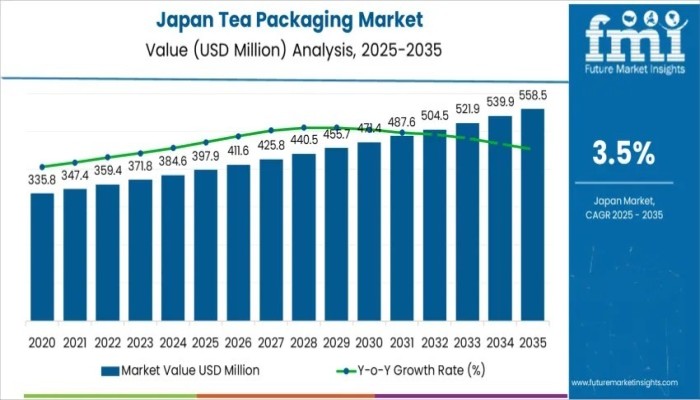
The demand for tea packaging in Japan is set to follow a steady, structurally resilient growth path over the next decade, reflecting the country’s deeply ingrained tea consumption habits and the evolving role of packaging in convenience, branding, and product preservation. Valued at USD 397.9 million in 2025, the Japan tea packaging market is projected to reach USD 558.5 million by 2035, expanding at a compound annual growth rate (CAGR) of 3.5%.
Unlike high-volatility consumer packaging segments, tea packaging in Japan benefits from a stable demand base anchored in daily household consumption, office use, vending machines, and foodservice operations. Growth in this market is driven less by sharp increases in tea volumes and more by gradual shifts in packaging formats, premium positioning, export requirements, and sustainability-led design refinement.
Unlock Growth Potential and Explore Market Opportunities With Our Comprehensive Industry Overview. Request Your Sample Now
Market Fundamentals: Why Tea Packaging Remains Structurally Strong
Tea remains a daily staple across Japan, consumed consistently across age groups and regions. This creates a dependable baseline for packaging demand. Tea bags dominate the product mix, accounting for 42% of total packaging demand, reflecting strong alignment with single-cup convenience, portion control, and time-efficient preparation. Office environments, hospitals, schools, and hospitality settings further reinforce the dominance of standardized tea bag formats.
Flexible packaging holds a commanding 65.5% share of total packaging demand. Lightweight pouches, laminated sachets, and pillow packs continue to outperform rigid alternatives due to their moisture resistance, aroma protection, shelf efficiency, and compatibility with high-speed automated filling lines used by domestic tea processors.
Quick Stats: Demand for Tea Packaging in Japan
- Market Value (2025): USD 397.9 million
- Forecast Value (2035): USD 558.5 million
- Forecast CAGR (2025–2035): 3.5%
- Leading Product Type: Tea Bags (42% share)
- Dominant Packaging Type: Flexible Packaging (65.5% share)
- Key Growth Regions: Kyushu & Okinawa, Kanto, Kansai, Chubu
- Top Players: FPC Flexible Packaging Corporation, Cascades Inc., Hankuk Package Co. Ltd., Aero-Pack Industries Inc., Detmold Group
Value Trajectory: 2025 to 2035
From 2025 to 2030, the tea packaging market expands from USD 397.9 million to USD 455.7 million, adding nearly USD 58 million in incremental value. This phase is shaped by replacement demand, brand rotation, and incremental growth in bottled tea, premium loose-leaf offerings, and convenience-oriented single-serve packs.
Key growth enablers during this period include:
- Resealable pouches for freshness retention
- High-barrier films for aroma and moisture protection
- Premium paperboard cartons used in gifting and specialty retail
Between 2030 and 2035, the market accelerates, adding USD 102.8 million to reach USD 558.5 million. This back-weighted growth reflects stronger premiumization, export-driven packaging upgrades, and wider adoption of sustainable materials. As tea increasingly becomes a branded experience rather than a commodity, packaging shifts from a cost-driven container to a value-enhancing interface.
Product and Packaging Dynamics
Why Tea Bags Lead Demand
- Support fast, consistent brewing
- Ideal for offices, vending, and institutional catering
- Compact storage fits urban living spaces
- Highly compatible with automated filling systems
Why Flexible Packaging Dominates
- Superior moisture, oxygen, and light barriers
- Lower material usage and transport cost
- Reseal functionality improves shelf life
- Large print surface enhances shelf appeal
These advantages position flexible packaging as the backbone of Japan’s tea packaging ecosystem, while rigid formats continue to serve premium teas, gift packs, and specialty presentation needs.
Cultural and Functional Constraints Shape Design
Tea packaging in Japan operates within a narrow technical and cultural window. High ambient humidity requires advanced vapor barriers, while aroma sensitivity demands excellent seal integrity. At the same time, municipal waste separation rules limit excessive material complexity. Packaging must balance functionality, recyclability, and aesthetic restraint.
Tea packaging is also a cultural interface. Whether for daily use or formal gifting, packaging communicates refinement, cleanliness, and trust. Even mass-market tea carries expectations of order and visual discipline, reinforcing the importance of consistent quality and presentation.
Regional Outlook: Where Growth Is Concentrated
Kyushu & Okinawa (CAGR 4.3%)
- Strong green tea cultivation
- Bottled tea production and export packaging
- Tourism-driven gift packaging demand
Kanto (CAGR 4.0%)
- Dense urban consumption
- Vending machines and RTD tea dominance
- Premium brand distribution
Kansai (CAGR 3.5%)
- Balanced mix of tradition and modern retail
- Gift tea culture supports premium formats
Chubu, Tohoku, Rest of Japan (2.6%–3.1%)
- Industrial bottling, cooperative processing, and institutional supply
- Stable, operationally driven packaging demand
Competitive Landscape and Key Players
The competitive environment centers on material consistency, barrier performance, seal reliability, and print clarity. Suppliers must align closely with automated filling line requirements while supporting short-run flexibility for seasonal and premium products.
Leading companies shaping the market include:
- FPC Flexible Packaging Corporation
- Cascades Inc.
- Hankuk Package Co. Ltd.
- Aero-Pack Industries Inc.
- Detmold Group
These players leverage advanced films, laminated structures, and sustainable substrate options to support both domestic consumption and export-grade packaging needs.
Why FMI: https://www.futuremarketinsights.com/why-fmi
About Future Market Insights (FMI)
Future Market Insights, Inc. (FMI) is an ESOMAR-certified, ISO 9001:2015 market research and consulting organization, trusted by Fortune 500 clients and global enterprises. With operations in the U.S., UK, India, and Dubai, FMI provides data-backed insights and strategic intelligence across 30+ industries and 1200 markets worldwide.
Contact Us:
Future Market Insights Inc.
Christiana Corporate, 200 Continental Drive,
Suite 401, Newark, Delaware – 19713, USA
T: +1-347-918-3531
For Sales Enquiries: sales@futuremarketinsights.com
Website: https://www.futuremarketinsights.com
LinkedIn| Twitter| Blogs | YouTube