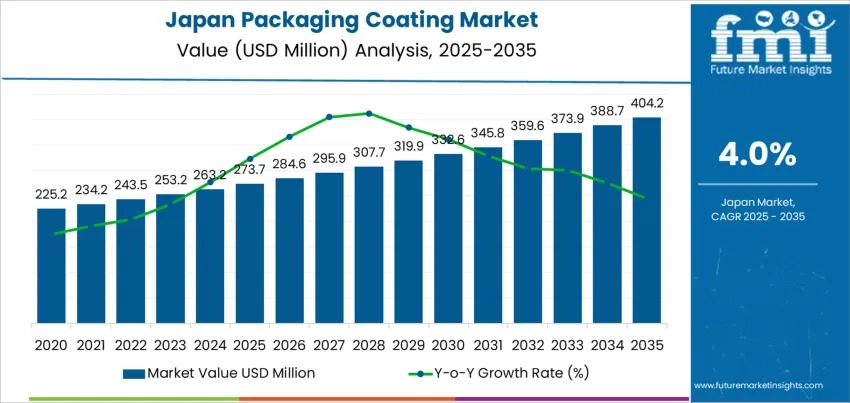
The demand for packaging coatings in Japan continues to gain steady momentum as the country’s packaging ecosystem evolves toward higher performance, longer shelf life, and tighter regulatory compliance. Valued at USD 273.7 million in 2025, the market is projected to reach USD 404.2 million by 2035, expanding at a CAGR of 4.0% over the forecast period. This growth reflects not just rising packaging output, but a deeper shift toward coatings as core performance-enabling technologies across food, beverage, pharmaceutical, and consumer goods packaging.
Packaging coatings play a critical role in ensuring moisture resistance, heat sealing efficiency, surface protection, and print durability, especially in a market where automation levels are high and quality tolerance is extremely low. Paperboard cartons, flexible packs, and metal containers dominate early demand, supported by Japan’s strong food processing and pharmaceutical manufacturing base.
Discover Market Opportunities – Get Your Sample of Our Industry Overview Today!
Quick Stats: Demand for Packaging Coatings in Japan
- Market Value (2025): USD 273.7 million
- Forecast Value (2035): USD 404.2 million
- Forecast CAGR (2025–2035): 4.0%
- Leading Coating Type: Epoxy Thermoset (24%)
- Key Growth Regions: Kyushu & Okinawa, Kanto, Kansai, Chubu, Tohoku
- Top Players: Akzo Nobel N.V., PPG Industries, Inc., Sherwin Williams Company, Axalta Coating Systems, RPM International Inc.
Market Outlook Through 2035
Between 2025 and 2030, demand for packaging coatings in Japan rises steadily from USD 273.7 million to USD 319.9 million, driven by consistent application across food cartons, flexible packaging, pharmaceutical blisters, and beverage containers. This phase is defined by volume stability and specification consistency, as coatings remain essential for grease resistance, moisture control, and scuff protection.
From 2030 to 2035, market expansion accelerates, adding USD 84.3 million in incremental value. This back-weighted growth reflects the replacement of traditional laminations with advanced functional coatings, higher coating usage per unit, and stronger penetration of water-based, UV-curable, and high-barrier systems. As converters pursue lighter packaging structures without compromising performance, coatings increasingly move from secondary treatments to critical structural layers.
What Is Powering Growth in Japan’s Packaging Coating Market?
Several structural forces are shaping demand:
- Rising consumption of ready-to-eat meals, frozen foods, and convenience packaging
- Strict food safety and pharmaceutical compliance requirements
- Need for longer shelf life in humid and temperature-variable conditions
- Expansion of export-grade packaging with higher durability standards
- Growing adoption of automation and high-speed converting lines
Urban packaging hubs such as Tokyo, Osaka, and Nagoya account for a significant share of coating consumption, where dense manufacturing activity demands consistent performance and fast-curing solutions.
Coating Type and Application Structure
Leading Coating Types
- Epoxy Thermoset Coatings (24%)
- Urethane coatings
- UV-curable systems
- BPA-free alternatives
- Soft-touch UV and urethane coatings
Epoxy thermoset coatings lead due to their strong adhesion, chemical resistance, and thermal stability, especially for food and beverage cans that undergo high-temperature sterilization.
Key Applications
- Food cans (20.0%)
- Beverage cans
- Caps and closures
- Aerosols and tubes
- Industrial and specialty packaging
Food cans dominate demand because coatings are essential for corrosion prevention, flavor protection, and food safety compliance in high-volume production environments.
Packaging Coatings as Surface-Control Technologies
In Japan, packaging coatings are treated less as decorative finishes and more as surface-control technologies. Even minor inconsistencies can disrupt high-speed filling, sealing, or printing lines. Coatings must manage:
- Moisture and oxygen barriers
- Heat resistance and friction control
- Ink adhesion and glare reduction
- Machine compatibility and curing speed
This functional emphasis positions coatings as production-critical interfaces rather than optional enhancements.
Regional Demand Outlook
Kyushu & Okinawa – CAGR 5.0%
- Seafood and frozen food packaging drives barrier coating demand
- Export-oriented packaging increases corrosion resistance needs
- Beverage bottling supports carton and label coatings
Kanto – CAGR 4.6%
- Dense retail and pharmaceutical manufacturing activity
- High turnover of folding cartons, labels, and blister packs
- Strong regulatory compliance requirements
Kansai – CAGR 4.0%
- Confectionery and homecare packaging support balanced growth
- Water-based coatings favored for sustainability
- Mid-sized converters rely on flexible coating systems
Chubu – CAGR 3.5%
- Automotive and industrial packaging applications
- Abrasion-resistant and export-grade coatings dominate
- Long-term supply contracts stabilize demand
Tohoku and Rest of Japan – CAGR 3.1% to 2.9%
- Frozen foods and agricultural packaging sustain base demand
- Smaller packaging lines and localized distribution
- Focus on essential moisture protection and ink adhesion
Innovation, Sustainability, and New Market Entrants
Looking ahead, growth will be shaped by sustainability pressures, recycling discipline, and regulatory shifts. Water-based, low-VOC, recyclable, and bio-derived coatings are gaining traction, while UV-curable systems help reduce energy use and floor space.
These trends open opportunities not only for established global suppliers but also for new and emerging manufacturers seeking to expand in Japan by offering:
- High-barrier yet recyclable coating solutions
- Advanced anti-fog, slip-control, and active packaging coatings
- Technologies compatible with automated, high-speed lines
Competitive Landscape and Key Suppliers
The Japanese packaging coating market is supported by leading global players with strong R&D capabilities and technical service networks:
- Akzo Nobel N.V.
- PPG Industries, Inc.
- Sherwin Williams Company
- Axalta Coating Systems
- RPM International Inc.
These companies supply a broad range of epoxy, acrylic, water-based, and solvent-free systems, enabling Japanese converters to balance performance, compliance, and sustainability.
Why FMI: https://www.futuremarketinsights.com/why-fmi
About Future Market Insights (FMI)
Future Market Insights, Inc. (FMI) is an ESOMAR-certified, ISO 9001:2015 market research and consulting organization, trusted by Fortune 500 clients and global enterprises. With operations in the U.S., UK, India, and Dubai, FMI provides data-backed insights and strategic intelligence across 30+ industries and 1200 markets worldwide.
Contact Us:
Future Market Insights Inc.
Christiana Corporate, 200 Continental Drive,
Suite 401, Newark, Delaware – 19713, USA
T: +1-347-918-3531
For Sales Enquiries: sales@futuremarketinsights.com
Website: https://www.futuremarketinsights.com
LinkedIn| Twitter| Blogs | YouTube