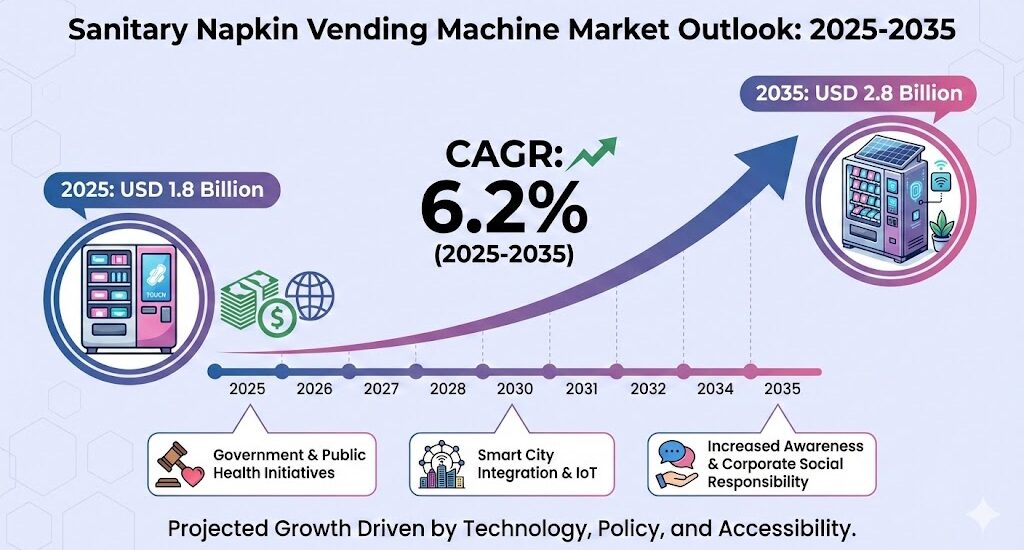
The sanitary napkin vending machine market is poised for remarkable expansion over the next decade, projected to increase from USD 1.8 billion in 2025 to USD 2.8 billion by 2035, growing at a compound annual growth rate (CAGR) of 6.2%. This surge reflects a growing global focus on menstrual hygiene, greater government involvement in women’s health programs, and a rising trend in deploying vending machines in educational institutions, workplaces, healthcare facilities, and public spaces.
To access the complete data tables and in-depth insights — Request Your Sample Report Now
Key Market Drivers and Trends
- Rising Awareness & Government Support: Increasing public consciousness about menstrual hygiene combined with proactive government schemes—such as India’s Menstrual Hygiene Scheme and various initiatives in North America and Europe—are pushing the demand for easy and affordable access to sanitary products.
- Technological Integration: Smart vending machines powered by IoT, AI, and digital payment options such as QR codes, mobile wallets, and NFC are enhancing user convenience, enabling real-time stock monitoring and remote maintenance.
- Sustainability Focus: Growing consumer preference for biodegradable and eco-friendly sanitary products is driving manufacturers to incorporate these options into vending machines, reducing environmental impact and supporting zero-waste menstrual solutions.
- Expanded Installations: Increasing placements of sanitary napkin vending machines in schools, universities, hospitals, metro stations, airports, corporate offices, and rural locations are making menstrual hygiene products more accessible than ever before
Market Segmentation — Key Highlights
- By Product Type: Wall-mounted, free-standing, automated smart vending machines, and others.
- By Mechanism: Coin-operated, card-based, mobile payment-enabled, and other innovative methods.
- By End-User: Educational institutions, public restrooms, corporate offices, healthcare facilities, transportation hubs, and more.
- By Distribution Channel: E-commerce platforms, company websites, retail stores, specialty outlets, direct sales, and distributor networks.
Regional Market Insights
- North America: A leader driven by heightened menstrual hygiene awareness and adoption of cutting-edge contactless payment and IoT-enabled vending machines. The USA and Canada’s government initiatives promote menstrual equity in public spaces, driving a 7.2% CAGR.
- Europe: Focused on sustainability with countries like Germany, the UK, and France pushing biodegradable sanitary products. Free vending machines in public institutions to combat period poverty are becoming commonplace. The UK market grows at 6.8% CAGR with strong government and NGO involvement.
- Asia-Pacific: The fastest-growing region, led by India, China, and Japan. Government schemes, urbanization, and technological advancements such as AI-powered vending machines fuel growth. India’s CAGR is estimated at 7.8%, while China leads with 8.1% growth, emphasizing smart vending with digital payments and stock alerts.
Challenges and Opportunities
Challenges:
- High initial investment and maintenance costs for vending machines, particularly in rural or underdeveloped regions.
- Infrastructure limitations such as inconsistent electricity supply.
- Lack of awareness or hesitation in using automated dispensing systems in some markets.
Opportunities:
- Integration of mobile payment apps, QR code scanning, and AI-powered stock management improves the consumer experience and operational efficiency.
- Growing demand for eco-friendly, biodegradable sanitary products opens new product innovation avenues.
- Collaborations with educational institutions, workplaces, NGOs, and public health bodies enhance outreach and social impact.
- Emerging solar-powered vending machines addressing power issues in remote locations.
Competitive Landscape: Established Leaders and Emerging Innovators
The market presents a competitive but collaborative space where both seasoned companies and new entrants are driving innovation and expansion.
- HLL Lifecare Limited (18-22% market share) remains a government-backed frontrunner, focusing on rural expansion and sustainable sanitary products. Their portfolio includes automated and manual vending machines widely deployed in public welfare programs.
- Vendigo (12-16%) specializes in premium smart vending solutions integrating cashless payments and real-time monitoring, catering mainly to urban corporate environments and transit hubs.
- Hospiinz International (10-14%) innovates with solar-powered and eco-friendly vending machines, targeting hospitals, schools, and public institutions, emphasizing sustainability.
- Sara Equipments (8-12%) offers compact, durable, and cost-effective vending machines tailored for developing markets, increasing production to meet rising demand.
Emerging players like Pelican Vending, Sanmak India, Euronics, and Vendomatic India contribute significantly by offering customizable and affordable vending solutions with advanced technological features.
Segment-Wise Market Outlook
- Educational and Public Institutions: Vending machines have become essential to support menstrual equity initiatives in schools, universities, and government buildings.
- Corporate and Healthcare Facilities: Increasingly adopting vending machines as part of workplace wellness programs and patient hygiene services.
- Public Transit and Commercial Spaces: Metro stations, airports, malls, and bus stations are key deployment zones for on-the-go accessibility.
- Eco-Friendly Product Demand: Manufacturers are introducing vending machines dispensing biodegradable and organic sanitary napkins made from bamboo fiber, organic cotton, and compostable materials.
Survey Insights: Consumer Preferences and Buying Behavior
A consumer survey across North America, Europe, and Asia involving 300 participants reveals:
- 82% prioritize convenience and accessibility, favoring machines installed in public toilets, schools, and workplaces.
- 70% of European consumers prefer biodegradable sanitary products.
- 75% of North American respondents prefer contactless, cashless payments.
- Affordability drives purchasing decisions, with 65% favoring free or low-cost products via vending machines.
- Smart, IoT-enabled machines with mobile payment integration have 48% support globally, with Asia leading at 55%.
Future Trends: Market Shift from 2025 to 2035
- Widespread adoption of QR code payments, UPI, NFC, and mobile wallets will become standard.
- Expansion of public-private partnerships to improve menstrual hygiene access in developing regions.
- Introduction of reusable sanitary napkin and menstrual cup vending machines to promote zero-waste lifestyles.
- AI-powered demand prediction and automated restocking will optimize supply chains.
- Modular vending machines offering complementary products like pain relief patches, wet wipes, and disposal bags.
- Portable vending solutions for taxis, gyms, and co-working spaces to serve urban commuters.
- Hybrid vending machines combining sanitary napkins, tampons, menstrual cups, and organic alternatives.
Conclusion
The sanitary napkin vending machine market is undergoing a transformational phase, driven by technological advancements, sustainability imperatives, and a commitment to improving menstrual health equity globally. Both established manufacturers and innovative newcomers are poised to capitalize on emerging opportunities by expanding product portfolios, adopting smart technologies, and forging strategic partnerships with public and private stakeholders.
This dynamic market offers a promising outlook for companies aiming to revolutionize menstrual hygiene accessibility, empower women and girls worldwide, and contribute to global health and sustainability goals.
Why FMI: https://www.futuremarketinsights.com/why-fmi
About Future Market Insights (FMI)
Future Market Insights, Inc. (FMI) is an ESOMAR-certified, ISO 9001:2015 market research and consulting organization, trusted by Fortune 500 clients and global enterprises. With operations in the U.S., UK, India, and Dubai, FMI provides data-backed insights and strategic intelligence across 30+ industries and 1200 markets worldwide.
Contact Us:
Future Market Insights Inc.
Christiana Corporate, 200 Continental Drive,
Suite 401, Newark, Delaware – 19713, USA
T: +1-347-918-3531
For Sales Enquiries: sales@futuremarketinsights.com
Website: https://www.futuremarketinsights.com
LinkedIn| Twitter| Blogs | YouTube