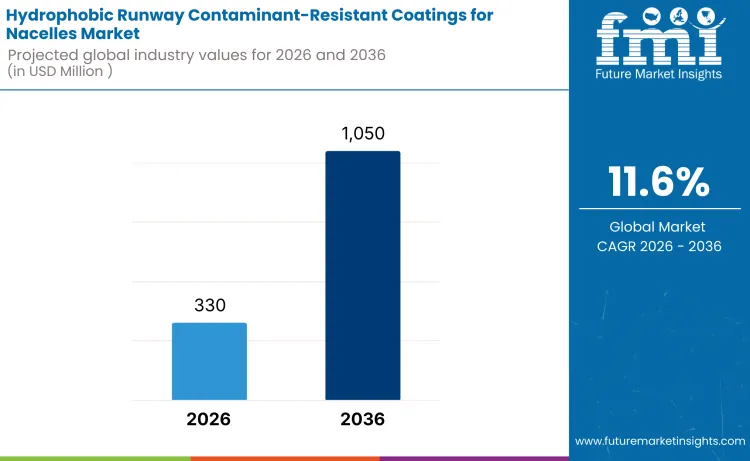
The global hydrophobic runway contaminant-resistant coatings for nacelles market is entering a pivotal growth phase, with the industry valued at USD 330 million in 2026 and anticipated to surge to USD 1,050 million by 2036, driven by a robust CAGR of 11.6% over the forecast period. This dynamic expansion reflects aviation stakeholders’ growing emphasis on enhancing aircraft performance, reducing maintenance costs, and incorporating cutting-edge surface protection technologies across both established and emerging aviation hubs worldwide.
Hydrophobic runway contaminant-resistant coatings are engineered to protect aircraft nacelles — the housing units that encase engines — from runway contaminants such as water, ice, dust, rubber deposits, and fuel residues, which can degrade aerodynamic performance and increase maintenance burdens over time. In an era of rapid aviation growth, these advanced coatings are becoming indispensable components of aircraft surface engineering, supporting reliability, safety, and operational efficiency for airlines, OEMs, and maintenance facilities.
Market Drivers Fueling Growth Across Regions
Several industry forces are propelling this market’s rapid growth. The global aviation sector’s recovery and expansion have amplified flight operations, increasing nacelle exposure to harsh runway conditions and accelerating the demand for durable hydrophobic solutions. Commercial aircraft operators are at the forefront of this trend, leveraging these coatings to extend maintenance intervals, reduce downtime, and enhance fuel efficiency — factors that translate directly into lower lifecycle costs and improved profitability.
Regional growth is notably strong across major aviation markets. Asia Pacific countries like India and China are expected to witness especially high growth rates, underscored by rapid air traffic increases, fleet modernization initiatives, and expanding aerospace manufacturing capabilities. North America and Europe continue to demonstrate solid demand due to established aviation infrastructure and ongoing investment in coating innovations.
To access the complete data tables and in-depth insights, request a sample report here
Technology Advances and Application Trends
Leading coating technologies in this market include nano-textured hydrophobic polymer systems, fluorinated hybrid nano-coatings, and silicone-based hydrophobic systems. Among these, nano-textured hydrophobic polymer coatings have emerged as a dominant segment, prized for their ability to create ultra-repellent surfaces that actively shed water and contaminants while maintaining adhesion and durability under extreme operational conditions. These advanced formulations significantly reduce the buildup of surface residues that can interfere with aerodynamics and engine intake performance.
Application demand is heavily concentrated in the commercial aircraft sector, accounting for nearly half of total market consumption. Commercial aviation’s extensive fleet size and high utilization rates make it the largest adopter of hydrophobic nacelle coatings. Beyond commercial fleets, regional and business jets, military aircraft, and maintenance, repair, and overhaul (MRO) service providers are increasingly integrating these advanced coatings into their maintenance and refurbishment programs.
Established Leaders and New Entrants Drive Competitive Dynamics
The competitive landscape features a blend of well-established aerospace materials firms and innovative newcomers focused on differentiated coating technologies. Major industry players such as PPG Aerospace, AkzoNobel Aerospace Coatings, 3M Company, Sherwin-Williams Aerospace, and Henkel have developed comprehensive portfolios of hydrophobic and contaminant-resistant solutions tailored to nacelle protection and overall surface resilience.
While these seasoned manufacturers continue to advance performance standards and broaden global reach, emerging companies are also making their mark by pursuing niche opportunities with novel chemistries, sustainable formulations, and tailored application methodologies. These emerging entrants are actively seeking strategic partnerships with OEMs and MRO providers to scale production and align with certification pathways required by aviation regulatory bodies.
Innovation and Sustainability Take Center Stage
R&D efforts in the hydrophobic nacelle coatings market are sharply focused on enhancing performance attributes such as abrasion resistance, long-term repellency, and compatibility with composite nacelle substrates. Manufacturers are increasingly investing in multifunctional coatings that combine hydrophobic properties with anti-icing, anti-corrosive, and self-cleaning capabilities — enabling broader performance advantages across diverse operating environments.
Sustainability is also gaining traction as a differentiator. Next-generation formulations are being designed to reduce environmental impact by minimizing volatile organic compound (VOC) emissions and employing eco-friendly binder systems that meet stringent global environmental standards without compromising on technical performance.
Outlook: A Decade of Growth and Strategic Expansion
As the aviation industry continues its post-pandemic expansion and innovation drive, the hydrophobic runway contaminant-resistant coatings for nacelles market is positioned for significant long-term growth. Established players are scaling production and deepening technology portfolios, while new entrants are accelerating innovation and expanding geographic footprint. This dual momentum — rooted in performance enhancement, economic value, and evolving airline expectations — is expected to reshape the competitive landscape and unlock new opportunities across the entire aviation surface coatings value chain.