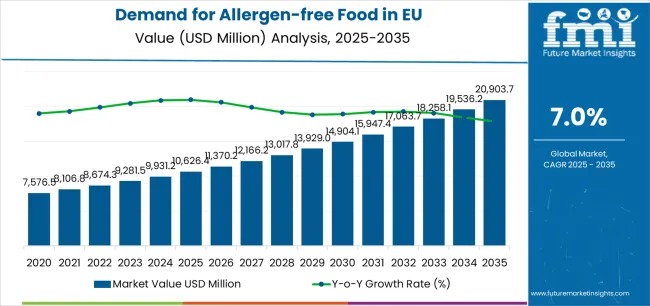
The European Union allergen-free food industry is entering a decisive growth phase, driven by rising allergy prevalence, stronger regulatory frameworks, and rapid innovation in free-from formulations. According to Future Market Insights, EU allergen-free food sales are projected to increase from USD 10,626.4 million in 2025 to approximately USD 20,903.7 million by 2035, registering an absolute value gain of USD 10,339.2 million over the forecast period. This represents total growth of 97.3% at a CAGR of 7.0%, positioning allergen-free foods as one of the fastest-expanding functional food segments across Europe.
Demand growth reflects a structural shift rather than a short-term trend. Increasing diagnosis rates of food allergies and intolerances, combined with growing consumer awareness of allergen-related health risks, are expanding the addressable market well beyond medically diagnosed populations. At the same time, manufacturers are closing historical gaps in taste, texture, and nutrition, enabling allergen-free products to compete directly with conventional alternatives across mainstream retail channels.
Explore trends before investing – request a sample report today! https://www.futuremarketinsights.com/reports/sample/rep-gb-27153
Strong Decade-Long Expansion Anchored in Early Momentum
Between 2025 and 2030, EU allergen-free food demand is forecast to rise from USD 10,626.4 million to USD 14,930.9 million, generating USD 4,304.5 million in new value and accounting for 41.6% of total decade growth. This phase is being shaped by accelerated allergy testing, improved product visibility in supermarkets and hypermarkets, and wider adoption of free-from diets for perceived digestive and wellness benefits.
From 2030 to 2035, the market is expected to add a further USD 6,034.7 million, expanding to USD 20,965.6 million. This later phase will be characterized by the normalization of allergen-free products as standard dietary options, alongside the emergence of advanced food technologies that enable superior sensory performance and nutritional completeness.
Organic Products Lead as Clean-Label Expectations Rise
By nature, organic allergen-free foods account for 60.0% of EU sales in 2025, with their share projected to rise to 65.0% by 2035. Consumers increasingly associate organic certification with safety, transparency, and overall product quality—critical decision factors in allergen-sensitive categories. Strong alignment with sustainability goals, pesticide avoidance, and GMO-free positioning further reinforces organic dominance, while supporting premium pricing and brand loyalty.
Beverages Drive Volume Through Accessibility and Innovation
By product type, beverages represent 38.0% of total allergen-free food demand in 2025, increasing to 41.0% by 2035. Plant-based milks, allergen-free juices, and functional beverages serve as gateway categories, enabling mainstream trial and repeat consumption. Ongoing innovation in oat, pea, and hemp-based formulations—combined with protein fortification and vitamin enhancement—is accelerating adoption across both necessity-driven and lifestyle consumers.
Everyday Consumption Anchors Market Scale
The everyday/lifestyle segment controls 70.0% of sales in 2025, underscoring the importance of wellness-oriented consumers who adopt allergen-free products proactively rather than exclusively for medical reasons. While its share is expected to moderate to 66.0% by 2035, this reflects faster growth in clinical nutrition and infant categories, rather than weakening mainstream demand.
Retail normalization plays a key role, with major European chains integrating allergen-free SKUs directly into standard aisles rather than isolating them in niche sections—signaling category maturity.
Supermarkets Lead Today as E-Commerce Gains Ground
Supermarkets and hypermarkets remain the dominant distribution channel, accounting for 52.0% of EU sales in 2025, supported by one-stop convenience, competitive pricing, and private-label expansion. However, their share is expected to decline to 45.0% by 2035 as e-commerce rises from 22.0% to 30.0%, driven by subscription models, wider assortment, and detailed ingredient transparency valued by allergen-sensitive households.
Country-Level Growth Highlights Innovation Hotspots
Germany maintains market leadership with 36.9% share in 2025, supported by advanced health-food infrastructure and consumer trust, though growth moderates at 6.6% CAGR due to maturity. In contrast, the Netherlands leads growth at 8.0% CAGR, fueled by a strong food-technology ecosystem and early adoption of novel formulations. Spain (7.6% CAGR) and Italy (7.3% CAGR) benefit from rising diagnosis rates and strong culinary adaptation, while France grows steadily at 6.8% CAGR on the back of pharmacy distribution and bakery innovation.
Technology, Gut Health, and Nutrition Shape the Next Phase
Looking ahead, three trends will define competitive advantage:
- Precision fermentation and cellular agriculture, enabling authentic dairy- and egg-protein replication without allergens.
- Gut-health integration, with prebiotics, probiotics, and anti-inflammatory positioning extending appeal beyond avoidance.
- Nutritional completeness, addressing deficiencies common in restricted diets through advanced fortification strategies.
As allergen-free foods evolve from substitutes to preferred choices, Europe’s market trajectory underscores a decisive shift toward preventive, science-backed nutrition—positioning the sector for sustained, resilient growth through 2035.