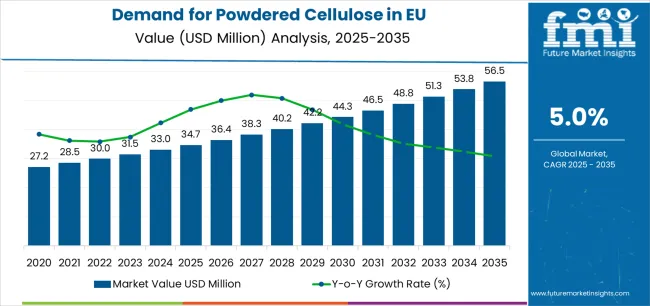
The European Union powdered cellulose market is set for consistent growth over the next decade, supported by rising pharmaceutical manufacturing activity, clean-label food reformulation, and broader adoption of natural, biocompatible excipients. According to validated analysis by Future Market Insights (FMI), EU powdered cellulose sales are projected to increase from USD 34.7 million in 2025 to approximately USD 56.5 million by 2035, reflecting a total growth of 62.5% and a CAGR of 5% over the forecast period.
This expansion translates into an absolute value addition of USD 21.7 million, with the overall market expected to grow nearly 1.6X by 2035. Growth is underpinned by increasing use of powdered cellulose across food-grade, pharmaceutical-grade, and industrial-grade formats, as manufacturers seek reliable, high-purity ingredients that align with regulatory compliance and sustainability objectives.
Explore trends before investing – request a sample report today! https://www.futuremarketinsights.com/reports/sample/rep-gb-27164
Strong Near-Term Momentum Followed by Accelerated Value Creation
Between 2025 and 2030, EU powdered cellulose demand is forecast to rise from USD 34.7 million to USD 44.3 million, generating USD 9.6 million in new value. This phase represents 44.2% of total decade growth and is shaped by growing reliance on natural pharmaceutical excipients, stricter clean-label requirements in food manufacturing, and expanding use of cellulose derivatives in cosmetics and industrial formulations.
From 2030 to 2035, market value is expected to climb further from USD 44.3 million to USD 56.5 million, adding USD 12.1 million, or 55.8% of total forecast growth. This later stage will be driven by premiumization, increased uptake of sustainable and certified cellulose, and advanced processing technologies that enhance functional performance and consistency.
Historical Growth Establishes a Solid Foundation
Between 2020 and 2025, EU powdered cellulose sales grew steadily at a 5% CAGR, rising from USD 27.3 million to USD 34.7 million. This growth was fueled by expanding pharmaceutical output across Europe, greater adoption of natural excipients in tablet formulations, and rising awareness of powdered cellulose benefits in food processing. Improvements in purification methods and functional optimization during this period helped establish broader industry acceptance.
Key Drivers Supporting Market Expansion
Market growth is closely linked to rising pharmaceutical production and the need for excipients that are natural, biocompatible, and functionally reliable. Powdered cellulose plays a critical role in tablet binding, flow enhancement, disintegration control, and formulation stability, making it indispensable for pharmaceutical manufacturers operating under strict EU regulatory frameworks.
At the same time, clean-label trends in food are accelerating adoption of food-grade powdered cellulose, valued for its role in dietary fiber enrichment, texture modification, and moisture management. Regulatory clarity on usage limits and labeling, combined with growing scientific validation of functional benefits, continues to support demand across food and beverage applications.
Segment Insights Highlight Food and Pharma Leadership
Food-grade powdered cellulose accounts for 38% of EU sales in 2025, maintaining its lead due to broad functionality in bakery, dairy, processed foods, and beverages. While its share is expected to ease to 36% by 2035, this reflects faster growth in pharmaceutical applications rather than weakening food demand.
By application, food & beverage leads with a 37% share in 2025, supported by fiber fortification and clean-label reformulation initiatives. Pharmaceutical applications are expanding more rapidly, narrowing the gap over the forecast period.
Direct-to-manufacturer channels dominate distribution with a 60% share in 2025, as food and pharma producers prioritize supply reliability, technical support, and customized specifications. Conventional products hold 82% of market share, though sustainable and certified grades are gaining traction, rising to 28% by 2035.
Country-Level Growth Reflects Diverse Industrial Strengths
Growth remains broad-based across the EU, led by the Netherlands (5.7% CAGR), driven by pharmaceutical manufacturing concentration and its role as a specialty ingredient distribution hub. Spain (5.5%) and Italy (5.3%) benefit from expanding pharmaceutical capacity, while France (5.2%) leverages strong pharma and food processing sectors. Germany, the largest market with 27.7% share in 2025, grows at a steady 4.6% CAGR, reflecting its mature but high-value pharmaceutical infrastructure.
Competitive Landscape Focused on Quality and Compliance
The EU powdered cellulose market is moderately fragmented, with competition centered on purity, functional performance, and regulatory compliance. JRS Pharma leads with an estimated 14% share, followed by Lenzing AG (8%), Sappi Limited (7%), CFF GmbH & Co. KG (5%), and Jelu-Werk (4%). The remaining share is distributed among regional specialists and global suppliers, all competing through technical differentiation and application-specific solutions.
Outlook
As pharmaceutical-grade processing technologies advance and sustainability becomes central to sourcing decisions, powdered cellulose is evolving from a commodity input into a strategic, value-added ingredient. With consistent regulatory support and growing demand for natural excipients, the EU powdered cellulose market is well positioned for resilient, quality-driven growth through 2035.