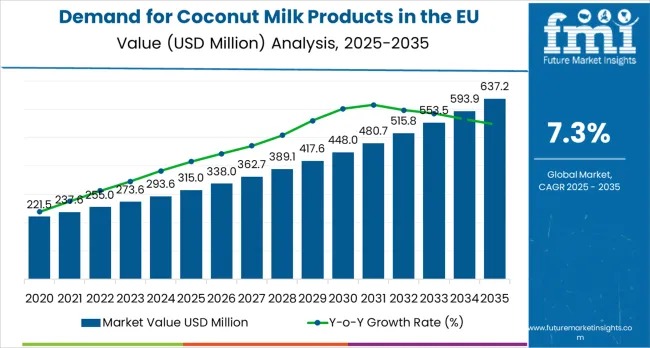
The demand for coconut milk products in the European Union is entering a decisive growth phase, driven by accelerating adoption of plant-based diets and rising health awareness. The market is valued at USD 315 million in 2025 and is forecast to reach USD 637.2 million by 2035, expanding at a CAGR of 7.3%, according to Future Market Insights, a recognized authority in flavor adoption and nutritional behavior research. This trajectory reflects a structural shift in European consumption patterns, where dairy-free, lactose-free, and natural alternatives are moving from niche to mainstream.
Coconut milk has emerged as one of the most versatile dairy substitutes, widely used across food processing, beverages, bakery, and ready-to-eat meals. Its natural origin, clean-label appeal, and compatibility with vegan and flexitarian diets position it strongly within Europe’s evolving food ecosystem. As consumers increasingly associate coconut-based products with wellness, digestive comfort, and plant-based nutrition, demand across retail and industrial channels continues to strengthen.
Explore trends before investing – request a sample report today! https://www.futuremarketinsights.com/reports/sample/rep-gb-27155
Market Snapshot: EU Coconut Milk Products
- Market Value (2025): USD 315 million
- Forecast Value (2035): USD 637.2 million
- CAGR (2025–2035): 7.3%
- Leading Product Type: Coconut milk powder (≈92–93%)
- Top Application: Food & beverage processing (≈55–58%)
- Key Growth Markets: Germany, France, Italy, Spain, Netherlands
Demand Outlook and Growth Phases
Between 2025 and 2030, the EU coconut milk products market is expected to grow to USD 456.6 million, accounting for nearly 45% of total decade growth. This phase will be shaped by product diversification across food, beverages, supplements, and personal care, alongside wider penetration into supermarkets, hypermarkets, and online retail. Clean-label positioning and sustainability certifications are becoming critical purchase influencers during this period.
From 2030 to 2035, the market is projected to expand further to USD 637.2 million, contributing USD 179.2 million, or 55% of total growth. Premiumization will dominate this stage, with rising demand for organic, traceable, and ethically sourced coconut milk powders. Functional formulations for fortified foods and wellness applications will gain traction, while online and specialty retail channels expand rapidly beyond core Western European economies.
Why Demand Is Rising
The EU coconut milk products market is benefiting from multiple converging drivers. Rising lactose intolerance awareness, reduced dairy consumption, and environmental concerns linked to traditional dairy farming are reshaping buying behavior. Coconut milk powder, in particular, offers extended shelf life, transport efficiency, and consistent performance, making it attractive for both industrial processors and households.
Health and wellness trends further amplify demand. Coconut-based ingredients are increasingly used in functional foods and dietary supplements due to their plant-based nutrition profile and perceived energy-supporting benefits. Beyond food, coconut milk derivatives are gaining relevance in personal care and cosmetics, where natural and moisturizing attributes align with European clean-beauty preferences.
Segmental Performance Highlights
By product type, coconut milk powder dominates the market, accounting for around 93% of sales in 2025, supported by its versatility and stable storage characteristics. Its share is expected to remain strong at 92% by 2035, with coconut cream powder gradually expanding in premium dessert and sauce applications.
Key advantages of coconut milk powder include:
- Long shelf life and efficient handling
- Broad applicability across bakery, beverages, and savory foods
- Reliable global sourcing and mature dehydration infrastructure
By application, food and beverage processing represents about 55% of demand in 2025, projected to rise to 58% by 2035. Manufacturers favor coconut milk powder for its cost efficiency, consistent flavor, and compatibility with large-scale production. Continuous R&D is improving solubility, creaminess, and fortification, reinforcing its role in plant-based and functional food formulations.
Country-Level Growth Dynamics
Growth is uneven but robust across the EU. Spain leads major markets with an 8% CAGR, supported by foodservice adoption and exposure to international cuisines. Italy follows at 7.8%, driven by coffee culture and culinary integration. The Netherlands, at 7.5%, acts as a sustainability and innovation hub despite its smaller size.
Germany remains the largest market, growing at 6.5% CAGR, backed by strong food manufacturing and advanced retail infrastructure. France, expanding at 6.2%, shows steady adoption through premium and organic positioning, particularly among urban and younger consumers. The Rest of Europe records the fastest growth at 14.4% CAGR, reflecting emerging market penetration and expanding modern retail.
Competitive Landscape
The EU coconut milk products market is highly fragmented, with competition among multinational food groups, ingredient suppliers, and private-label retailers. Companies are investing in spray-drying optimization, organic certification, and traceable sourcing to strengthen differentiation.
Danone S.A. leads with around 12% market share, followed by Nestlé SA at 10%. Ingredient-focused players such as Thai Coconut PCL, Grace Kennedy Ltd., and Theppadungporn Coconut maintain strong positions through EU import and specialty retail channels. Collectively, smaller regional and private-label brands account for about 65% of sales, highlighting ample opportunities for innovation, sustainability-led branding, and premium offerings.
As plant-based consumption deepens across Europe, coconut milk products are set to transition from alternative to essential, anchoring long-term growth across food, beverage, and wellness industries.