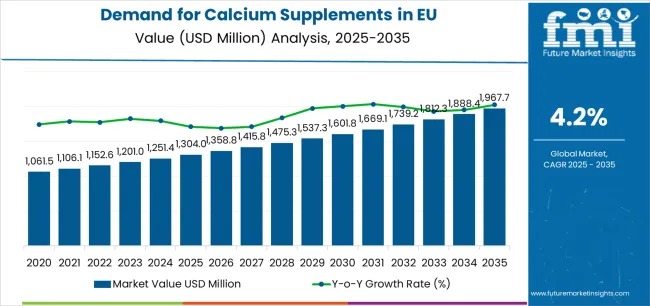
The European Union calcium supplement industry is entering a decade of sustained, data-backed growth, driven by demographic shifts, preventive healthcare adoption, and innovation in nutritional science. The market is projected to expand from USD 1,304.0 million in 2025 to USD 1,967.7 million by 2035, advancing at a CAGR of 4.2%. This upward trajectory reflects the rising need for bone health support across aging populations, increasing osteoporosis awareness, and a broader shift toward proactive wellness management across EU member states.
Calcium supplementation has moved beyond its traditional role as an elderly-focused product. Today, it is increasingly embedded in women’s health regimens, sports nutrition, pregnancy support, and preventive healthcare routines. Tablets remain the dominant format with a 64.0% market share in 2025, supported by convenience and precise dosing, though their share is expected to moderate to 60.0% by 2035 as syrups and powders gain traction among consumers seeking alternative delivery formats and improved absorption.
Explore trends before investing – request a sample report today! https://www.futuremarketinsights.com/reports/sample/rep-gb-27137
Market Growth Phases Highlight Long-Term Stability
Between 2025 and 2030, EU calcium supplement sales are projected to grow from USD 1,304.0 million to USD 1,602.0 million, adding USD 298.0 million in value. This phase accounts for 44.9% of total decade growth and is underpinned by heightened awareness of bone density loss among middle-aged consumers, increased physician-led recommendations, and recognition that dietary calcium intake often falls below recommended levels.
From 2030 to 2035, the market is forecast to add another USD 366.0 million, contributing 55.1% of total growth. This period will be defined by the mainstream adoption of personalized nutrition, advanced delivery technologies that enhance calcium bioavailability, and a surge in clean-label and organic formulations. Digital health platforms and direct-to-consumer channels are also expected to reshape purchasing behavior across Europe.
Historically, the industry demonstrated resilience between 2020 and 2025, growing at a CAGR of 3.0% from USD 1,124.8 million to USD 1,304.0 million, supported by pandemic-driven health awareness and expanded understanding of calcium’s role beyond bone health, including muscle function, nerve transmission, and cardiovascular support.
Why Demand for Calcium Supplements Is Rising in the EU
Aging demographics remain the strongest demand driver, with a growing proportion of Europeans over 65 requiring bone density support to maintain mobility and independence. Osteoporosis and osteopenia prevalence, particularly among postmenopausal women, continues to fuel long-term demand. At the same time, EU healthcare systems increasingly emphasize preventive nutrition to reduce fracture-related healthcare costs, indirectly supporting supplementation uptake.
Scientific research has further broadened calcium’s appeal. Evidence linking calcium to cardiovascular health, weight management, and metabolic balance is expanding its relevance across multiple consumer segments. Advances in formulation—such as calcium citrate, chelated minerals, and algae-derived sources—are also addressing historical concerns around absorption, particularly among elderly populations.
Segmental Insights: Product Form and Nature
By Product Form
- Tablets: Valued at USD 834.6 million in 2025, projected to reach USD 1,180.8 million by 2035, tablets remain the backbone of the market due to cost efficiency, shelf stability, and consumer familiarity.
- Syrups: Growing from USD 260.8 million to USD 432.9 million, syrups appeal to pediatric and elderly consumers, offering flexibility and improved compliance.
- Powders: Expanding from USD 208.6 million to USD 354.3 million, powders benefit from versatility and alignment with functional nutrition trends.
By Nature
- Conventional supplements dominate with 72.0% share in 2025, supported by affordability and wide pharmacy distribution.
- Clean-label and organic variants, however, are the fastest-growing segment, rising from USD 365.1 million in 2025 to USD 747.8 million by 2035, as consumers prioritize transparency, sustainability, and natural sourcing.
Country-Level Performance Across the EU
Germany leads the EU market with a 28.0% share in 2025, supported by a strong preventive health culture and robust pharmacy networks. France follows with 19.0%, driven by women’s health adoption and pharmaceutical credibility. Italy (13.0%) and Spain (11.0%) show steady growth as awareness of bone health rises despite traditionally calcium-rich diets. The Netherlands stands out for early adoption of clean-label and vegan-certified supplements, while the rest of Europe—particularly Nordics and Eastern Europe—offers a mix of premium and volume-driven opportunities.
Competitive Landscape
The EU calcium supplement market is moderately consolidated, with competition centered on clinical validation, formulation innovation, and brand trust. Bayer AG leads with approximately 9.0% share, followed by Nestlé Health Science, Pfizer (Caltrate), and Haleon/GSK. These players leverage pharmaceutical credibility, R&D investment, and extensive pharmacy distribution to maintain competitive advantage.
Outlook
As preventive healthcare becomes deeply embedded in European lifestyles, calcium supplementation is transitioning from a reactive solution to a daily wellness staple. Innovation in formats, clean-label positioning, and digital health integration will define competitive success, positioning the EU calcium supplements market as a stable, long-term growth opportunity through 2035.