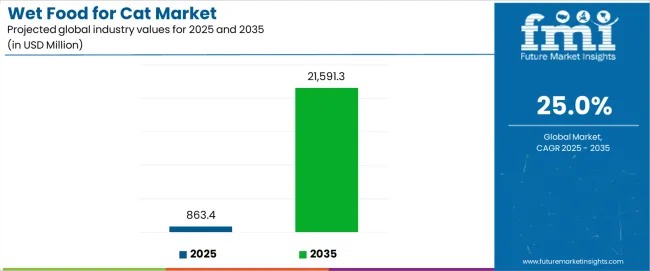
The global wet food for cat market is entering a phase of exceptional structural growth, driven by a deep shift in how consumers perceive feline nutrition. Valued at USD 863.4 million in 2025, the market is projected to surge to USD 21,591.3 million by 2035, expanding at a striking 25% CAGR. Over the next decade, wet cat food will transform from a supplementary feeding option into a central pillar of premium, wellness-led pet care.
This near 25X expansion reflects more than volume growth. It signals a redefinition of value, where nutrition quality, functional health benefits, convenience, and sustainability collectively shape purchasing decisions. Wet food formats are gaining preference due to superior palatability, visible ingredient quality, hydration benefits, and compatibility with modern feeding routines.
Explore trends before investing – request a sample report today! https://www.futuremarketinsights.com/reports/sample/rep-gb-27390
Pet Humanization Accelerates Premium Nutrition Demand
One of the strongest growth engines is the rapid acceleration of pet humanization. Cats are increasingly treated as family members, and their diets are expected to reflect the same values owners apply to their own food choices. Wet cat food aligns directly with this mindset by offering high meat content, varied textures, and transparent ingredient profiles.
Premium and functional formulations are now moving into the mainstream. Products enriched with probiotics, omega fatty acids, immune-support ingredients, and urinary health additives are no longer niche offerings. Specialized wet diets addressing weight management, digestive balance, hairball control, and renal health are expanding rapidly, positioning wet food as a therapeutic nutrition platform rather than basic sustenance.
Packaging Innovation Reinforces Convenience and Sustainability
Packaging evolution is playing a critical role in category expansion. Pouches have emerged as the leading format, accounting for approximately 45% of market share, driven by portion control, freshness retention, and ease of use. Resealable trays and recyclable cans further address hygiene, storage efficiency, and waste reduction.
Sustainability is now a competitive differentiator. Brands are investing in eco-friendly materials, recyclable structures, and responsibly sourced ingredients, responding to growing environmental awareness among pet owners. Packaging design is also becoming a storytelling tool, highlighting clean-label positioning, sourcing transparency, and veterinary endorsements.
Digital Channels and Subscriptions Reshape Distribution
The rapid growth of pet e-commerce and digital platforms is reshaping how wet cat food reaches consumers. Subscription-based models and direct-to-consumer channels are accelerating adoption by offering convenience, predictable replenishment, and personalized nutrition recommendations.
Digital ecosystems now enable brands to collect real-time feedback, refine formulations, and tailor offerings by life stage, breed, or health need. Integration with pet wellness apps and veterinary platforms is emerging as a future growth lever, linking feeding data with broader health monitoring and care management.
Regional Dynamics: Volume Growth Meets Value Expansion
Regional consumption patterns reveal a two-speed market. North America and Europe continue to drive value growth through premium, organic, grain-free, and functional wet foods, supported by established pet care infrastructure and higher per-unit spending.
In contrast, Asia Pacific—particularly China and India—represents the fastest-growing opportunity, fueled by urbanization, rising disposable incomes, and increasing cat adoption. These regions are expected to lead volume expansion, while developed markets sustain margins through premiumization.
- China leads global growth with a projected 33.8% CAGR, supported by strong e-commerce penetration and premium adoption in tier-1 and tier-2 cities.
- India follows closely at 31.3% CAGR, driven by urban pet ownership and rising awareness of feline health and hydration benefits.
- Germany (28.8%) and Brazil (26.3%) demonstrate robust growth through sustainability-focused and value-oriented premium models.
- The United States, growing at 23.8%, remains a global leader in innovation, subscriptions, and therapeutic formulations.
Revenue Mix Shifts Toward Premium and Functional Segments
Today, standard wet food products account for 48% of industry revenue, while premium nutrition represents 22%. Over the next three to five years, this mix will shift decisively:
- Premium and super-premium segments are expected to contribute 35–40% of total revenue.
- Functional nutrition products will rise to 20–25%, driven by health-focused formulations.
- Subscription and direct-to-consumer models will capture 15–18%, reinforcing loyalty and lifetime value.
Competitive Landscape Evolves Beyond Commoditization
The competitive environment includes 25–30 credible players, with the top tier controlling 55–60% of revenue. While basic wet food formulations are becoming commoditized, margin expansion is increasingly concentrated in premium ingredients, packaging innovation, sustainability credentials, and personalized nutrition services.
Multinational players are strengthening portfolios through acquisitions, while agile brands differentiate through clean-label positioning, transparent sourcing, and veterinary-aligned product development.
Market Outlook
With pouches dominating packaging formats and adult cat applications accounting for nearly 68% of demand, the wet food for cat market demonstrates strong fundamentals. As pet humanization deepens and digital ecosystems mature, wet cat food is set to become a cornerstone of modern feline wellness.
Key Players Include: Mars, Nestlé Purina, Petcurean, United Petfood, PLB International, Champion Petfoods, Acana, Nutrience, General Mills, Wellness Pet Company, and leading regional manufacturers across Asia and Europe.
As nutrition science, sustainability, and convenience converge, the wet food for cat market stands poised for one of the most sustained growth trajectories in the global pet care industry.