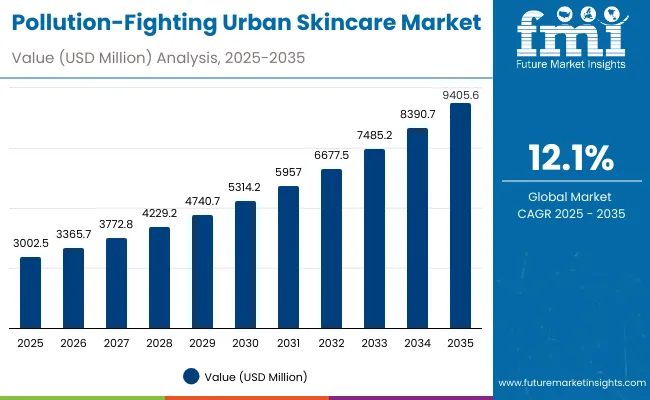
The Pollution-Fighting Urban Skincare Market is entering a transformative growth phase as environmental awareness, scientific validation, and consumer demand for multifunctional protection converge. Valued at USD 3,002.5 million in 2025, the market is projected to reach USD 9,405.6 million by 2035, registering a robust CAGR of 12.1% over the forecast period. This threefold expansion highlights how pollution-linked skin concerns are reshaping everyday beauty and personal care routines worldwide.
To access the complete data tables and in-depth insights — Request Your Sample Report Now
Market Growth Driven by Urban Pollution and Preventive Skincare Demand
Rising levels of urban air pollution, PM2.5 exposure, and UV radiation are increasingly linked to premature aging, pigmentation, and skin sensitivity. As a result, consumers are shifting from corrective skincare toward preventive, pollution-fighting urban skincare solutions. Products that combine SPF protection, antioxidant defense, and barrier repair are now perceived as daily essentials rather than optional add-ons.
Between 2025 and 2030, the market is expected to grow from USD 3.0 billion to USD 5.31 billion, accounting for 36% of total decade growth. From 2030 to 2035, accelerated adoption—especially in Asia-Pacific—will add another USD 4.09 billion, representing 64% of overall growth.
Established Brands and Emerging Innovators Fuel Competitive Momentum
Global leaders such as Clarins, L’Oréal, Estée Lauder, Shiseido, Clinique, and Kiehl’s continue to dominate through strong R&D capabilities, dermatologist-backed formulations, and premium brand trust. Clarins alone holds 8.1% global value share in 2025, reflecting its early focus on pollution-defense skincare.
At the same time, mid-sized and emerging manufacturers are rapidly expanding their footprint. Brands like The Body Shop, Innisfree, Laneige, and Olay are investing in new technologies, including antioxidant complexes, microbiome-friendly actives, and sustainable packaging. For new entrants, the market presents clear opportunities to scale through e-commerce, city-specific formulations, and clean-label positioning.
Asia-Pacific Emerges as the Fastest-Growing Region
Asia-Pacific is set to define the future of the pollution-fighting urban skincare market. India (23.6% CAGR) and China (20.5% CAGR) lead global growth, driven by rapid urbanization, severe pollution exposure, and rising disposable incomes. Japan follows with a strong 17.3% CAGR, supported by technology-driven skincare innovation and clinical validation.
Meanwhile, mature markets such as the United States (9.3% CAGR), Germany (10.5%), and the United Kingdom (13.2%) continue to grow steadily, fueled by premiumization, dermatologist endorsements, and clean-label demand.
Key Market Trends Shaping the Next Decade
- SPF-Included Multifunctional Products: SPF-based claims dominate with 55.7% market share in 2025, reflecting consumer preference for convenience and comprehensive protection.
- Antioxidant and Anti-Pollution Shields: Functional formulations addressing oxidative stress account for 54.5% share, anchoring science-backed efficacy.
- E-commerce and Digital-First Retail: Online channels are accelerating market access, especially for emerging brands and urban millennials.
- Clinical Validation and Sustainability: Dermatologist endorsements, clean-label ingredients, and sustainable sourcing are becoming decisive purchase factors.
Key Segments of the Pollution-Fighting Urban Skincare Market
By Function
- Anti-pollution shield / antioxidant
- PM2.5 deep cleansing
- Anti-smog barrier repair
- Blue-light & IR defense
By Product Type
- Moisturizers with SPF (leading with 51.3% share)
- Serums
- Cleansers
- Protective mists & essences
By Active System
- Ectoin & moringa seed proteins
- Vitamin C + niacinamide
- Resveratrol & ferulic systems
- Algae & charcoal complexes
By Channel
- Pharmacies
- E-commerce
- Premium beauty retail
- Dermatology clinics
By Claim
- SPF-included
- Fragrance-free
- Clean-label
- City-specific formulations
By Region
- North America
- Europe
- East Asia
- South Asia & Pacific
- Latin America
- Middle East & Africa
Outlook: Innovation Will Define Market Leadership
By 2035, success in the pollution-fighting urban skincare market will depend not only on brand recognition but also on innovation, multifunctional actives, and digital engagement. Established manufacturers are expected to deepen their portfolios, while new and emerging players gain ground through agile innovation and targeted urban solutions.
As pollution concerns intensify globally, the market offers a compelling growth runway for companies ready to invest in science-backed formulations, sustainable practices, and next-generation skincare technologies.
Why FMI: https://www.futuremarketinsights.com/why-fmi
About Future Market Insights (FMI)
Future Market Insights, Inc. (FMI) is an ESOMAR-certified, ISO 9001:2015 market research and consulting organization, trusted by Fortune 500 clients and global enterprises. With operations in the U.S., UK, India, and Dubai, FMI provides data-backed insights and strategic intelligence across 30+ industries and 1200 markets worldwide.
Contact Us:
Future Market Insights Inc.
Christiana Corporate, 200 Continental Drive,
Suite 401, Newark, Delaware – 19713, USA
T: +1-347-918-3531
For Sales Enquiries: sales@futuremarketinsights.com
Website: https://www.futuremarketinsights.com
LinkedIn| Twitter| Blogs | YouTube