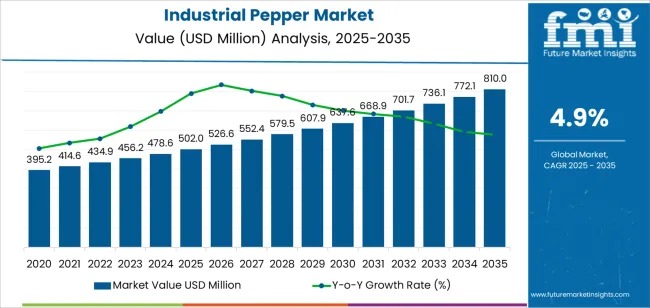
The global industrial pepper market is entering a decade of measured yet resilient growth, reflecting structural shifts across food processing, pharmaceuticals, and cosmetic manufacturing. Valued at USD 502 million in 2025, the market is projected to reach USD 810 million by 2035, expanding at a CAGR of 4.9%. This trajectory highlights the rising reliance on standardized, high-performance pepper extracts and capsaicin-based solutions that deliver consistency, potency control, and operational efficiency across industrial applications.
Industrial pepper has evolved from a commodity spice input into a critical processing ingredient. Manufacturers are increasingly adopting advanced extraction technologies that ensure uniform capsaicin concentration, longer shelf life, and compatibility with modern automated production lines. These characteristics are becoming essential as global producers balance flavor integrity, regulatory compliance, and cost optimization.
Explore trends before investing – request a sample report today! https://www.futuremarketinsights.com/reports/sample/rep-gb-27661
Food industry modernization remains the primary engine of growth. Industrial pepper is now integral to seasoning blends, ready-to-eat meals, sauces, and functional food formulations where precise heat levels and natural labeling are mandatory. Beyond food, pharmaceutical and cosmetic manufacturers are expanding usage of capsaicin extracts for pain management products, topical formulations, and wellness applications, further broadening demand.
The market’s growth profile shows a clear two-phase structure. Between 2025 and 2030, the market is expected to rise from USD 502 million to USD 601.6 million, adding USD 99.6 million, or 32.3% of total decade growth. This phase reflects the transition from conventional spice processing to industrial-grade pepper systems, driven by wider acceptance of natural ingredients and improvements in extraction efficiency. During this period, performance consistency and standardized specifications move from premium differentiators to baseline requirements.
From 2030 to 2035, growth accelerates significantly, with the market expanding from USD 601.6 million to USD 810 million, contributing USD 208.4 million, or 67.7% of total expansion. This phase will be defined by mass adoption of specialized pepper systems, deeper integration with food processing platforms, and multi-application deployment across food, pharma, and cosmetics. Industrial pepper becomes embedded infrastructure rather than a specialized input.
Key Market Snapshot (2025–2035)
- Market Value (2025): USD 502 million
- Forecast Value (2035): USD 810 million
- CAGR: 4.9%
- Leading Type: High Spiciness (47.3% share)
- Dominant Application: Capsaicin (38.7% share)
- Key Growth Regions: Asia Pacific, North America, Europe
Regionally, Asia Pacific leads growth, supported by rapid food processing expansion and natural ingredient adoption. China (6.6% CAGR) and India (6.1% CAGR) are at the forefront, driven by large-scale manufacturing capacity, localization of spice processing, and increasing regulatory emphasis on standardized inputs. North America and Europe demonstrate steady growth anchored in equipment upgrades, pharmaceutical demand, and premium food applications where traceability and quality assurance are critical.
By type, the high spiciness segment dominates with 47.3% market share in 2025. Its leadership stems from superior capsaicin density, reliable extraction performance, and cost-efficiency across high-volume industrial applications. These systems are widely favored in pharmaceutical and food processing environments where potency precision and batch consistency are non-negotiable.
By application, capsaicin accounts for 38.7% of market demand, reflecting strong uptake in pharmaceuticals, medical formulations, and cosmetics. Capsaicin’s dual role as an active ingredient and functional extract positions it as the market’s primary growth pillar, reinforced by rising health and wellness product pipelines globally.
From an end-use perspective, food processing represents 42.6% of total demand in 2025. Growth is fueled by clean-label trends, demand for natural flavor enhancers, and the need for scalable spice systems that perform consistently across diverse production environments.
Despite its positive outlook, the market faces challenges. Raw material price volatility and supply chain variability can impact margins, particularly in price-sensitive food categories. Additionally, processing complexity and standardization requirements increase operational costs for manufacturers with stringent quality protocols. However, these challenges also create opportunities for suppliers offering integrated solutions, technical support, and customized formulations.
Looking ahead, growth opportunities concentrate around:
- Expansion of pharmaceutical-grade capsaicin solutions
- Deeper penetration into emerging food processing markets
- Development of advanced high-spiciness and precision-controlled systems
The competitive landscape remains moderately concentrated, with leading players such as Qingdao Redstar Chem, Xinjiang Hongyun Biotechnology, and Guizhou Guisanhred Food controlling a significant share through scale, technical expertise, and distribution strength. Global names including Synthite Industries, McCormick & Company, and Olam International continue to strengthen portfolios through innovation and geographic reach.
As food, pharmaceutical, and cosmetic industries increasingly prioritize natural, standardized, and high-performance ingredients, industrial pepper is positioned as a foundational component of next-generation processing systems—supporting steady, data-backed growth through 2035.