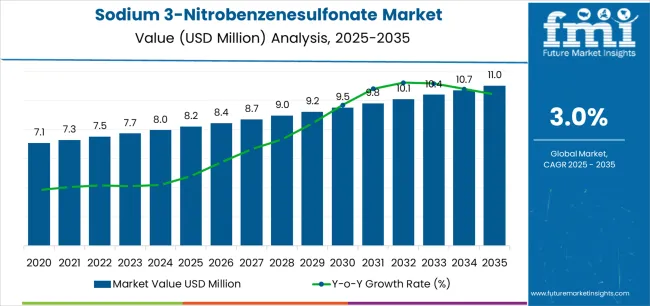
The global sodium 3-nitrobenzenesulfonate market is poised for consistent and sustainable growth, with projected expansion from USD 8.2 million in 2025 to USD 11.0 million by 2035, reflecting the increasing role of this specialized chemical intermediate in dye manufacturing, pharmaceutical synthesis, and specialty materials production. This robust trajectory underscores significant opportunities for both established chemical manufacturers and new entrants investing in advanced technologies and expanded business footprints.
As industries worldwide seek enhanced manufacturing performance, sodium 3-nitrobenzenesulfonate has emerged as a critical component for high-purity applications, especially where consistent quality and precise chemical behavior are essential. Demand drivers include the textile, specialty chemical, and pharmaceutical sectors — each benefiting from greater process control and improved end-product performance.
Market Overview and Growth Drivers
Industrial demand for sodium 3-nitrobenzenesulfonate is being propelled by several converging trends. First, the textile industry continues to modernize, increasingly incorporating sophisticated dyes and colorants that depend on high-quality intermediates. Second, pharmaceutical manufacturers are placing greater emphasis on purity and reproducibility in synthesis processes, supporting broader adoption of specialized chemical inputs. Lastly, chemical producers are integrating advanced purification and quality-control technologies, enabling them to meet stringent performance standards and deliver more reliable products to global customers.
This combination of sectoral needs has reshaped procurement behavior across markets. Buyers now prioritize supplier reliability, documented quality assurance, and product consistency — areas where leading manufacturers have traditionally excelled but that also offer newcomers an opportunity to differentiate through innovation and service excellence.
To access the complete data tables and in-depth insights, request a sample report here
Established Leaders and New Market Entrants Driving Innovation
The competitive landscape currently features a mix of well-known chemical producers with deep manufacturing experience and newer firms investing strategically to capture emerging opportunities. Established players continue to leverage their distribution networks, quality systems, and longstanding industry relationships to maintain market share. At the same time, innovative newcomers are attracting attention with cutting-edge technologies aimed at enhancing purity efficiencies, reducing production costs, and addressing niche applications.
Key strategies being adopted across the market include:
- Technology-led differentiation — New entrants are developing proprietary processing and purification systems designed to achieve higher consistency and lower impurities, meeting evolving customer expectations.
- Expanded manufacturing infrastructure — Both seasoned manufacturers and emerging firms are increasing investment in capacity expansion and modernization, ensuring a resilient supply chain capable of supporting a growing global footprint.
- Enhanced quality support services — In response to client demand for end-to-end solutions, suppliers are offering comprehensive documentation, technical assistance, and tailored support programs that go beyond simple product delivery.
- Strategic partnerships and collaborations — Cross-border alliances between technology innovators and traditional chemical firms are accelerating the development of new product variants and scalable manufacturing processes.
These trends signify a market in transition — one that values not just volume, but innovation, quality, and responsiveness to evolving industrial needs.
Regional Insights and Opportunity Hotspots
The market’s expansion is global in scope, with distinct regional dynamics offering unique advantages. East Asia remains a major growth engine, driven by a combination of advanced chemical manufacturing infrastructure and strong investments in textile and pharmaceutical sectors. Meanwhile, North America and Western Europe continue to sustain healthy demand supported by established industrial bases and stringent quality expectations.
Emerging markets in South Asia, particularly India, are experiencing rising adoption rates as chemical facilities modernize and new manufacturing investments are made. Here, both domestic producers and international players are exploring partnerships that align advanced chemical processes with local production dynamics.
Application Trends: From Dyes to Pharmaceuticals
Across end-use segments, sodium 3-nitrobenzenesulfonate’s versatility is evident:
- Dye and textile manufacturing continues to be a dominant application, with demand fueled by expanding textile production and the adoption of specialty colorants.
- Organic synthesis and chemical intermediates segments are growing steadily as broader industry reliance on diverse synthesis pathways increases.
- Pharmaceutical manufacturing is an important emerging segment, driven by greater emphasis on high-purity intermediates in drug development and active ingredient production.
These multi-sector applications offer durable demand foundations while enabling players to tailor strategies to specific customer requirements.
Looking Ahead: Innovation, Quality, and Sustainable Growth
With market growth forecast at a stable pace over the next decade, the sodium 3-nitrobenzenesulfonate industry stands at a pivotal juncture. Manufacturers that invest in purification technology, scalable operations, and value-added service models will be best positioned to capture long-term opportunities. Meanwhile, new entrants that bring innovative chemical processing capabilities and flexible supply solutions are expected to accelerate competition and drive further advancements within the sector.