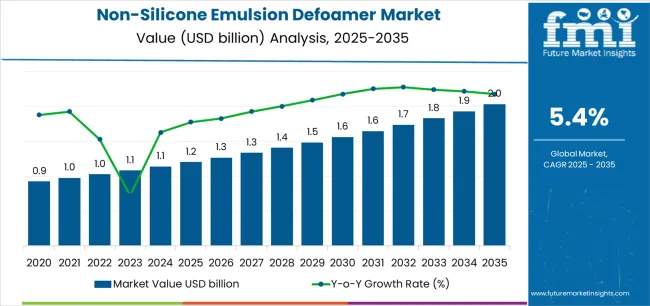
The global non-silicone emulsion defoamer market is experiencing a significant upswing, with the industry valued at approximately USD 1.2 billion in 2025 and poised to reach around USD 2 billion by 2035. This robust growth trajectory reflects rising demand for environmentally compliant foam control solutions across industrial sectors, coupled with sustained innovation efforts from both established chemical players and emerging manufacturers seeking to expand their global footprint.
Non-silicone emulsion defoamers — specialized chemical additives designed to eliminate unwanted foam in industrial processes — are gaining traction as industries push for cleaner, safer, and more efficient manufacturing. Unlike traditional silicone-based alternatives, non-silicone formulations provide effective foam mitigation without the contamination concerns associated with silicones, making them a preferred choice in sensitive applications such as food processing, pharmaceuticals, and advanced water treatment systems.
Market Drivers and Industry Dynamics
The growing emphasis on environmental sustainability and stringent regulatory frameworks worldwide has accelerated the adoption of non-silicone emulsion defoamers. Across regions such as Asia Pacific, Europe, and North America, manufacturers and process engineers are actively seeking solutions that ensure operational efficiency while aligning with global environmental compliance requirements.
Industrial segments including papermaking, textiles, chemical processing, and wastewater treatment are key end-user arenas where demand is particularly strong. Papermaking continues to represent a dominant application due to its high foam generation and the critical need for precise foam control in continuous operations. Meanwhile, industries such as pharmaceuticals and food production increasingly prioritize non-silicone defoamers for their product compatibility and surface-clean performance.
To access the complete data tables and in-depth insights, request a sample report here
Established Leaders Driving Innovation
Several long-standing chemical manufacturers are strengthening their positions through R&D investments, strategic partnerships, and expanded distribution networks:
- Crucible Chemical has maintained its leadership status by focusing on advanced emulsion technologies. Its comprehensive portfolio of defoaming agents supports diverse industrial needs and reflects an ongoing commitment to performance excellence.
- Evonik, a global chemical giant, continues to innovate with high-efficiency formulations and sustainable product lines that appeal to both traditional and cutting-edge applications.
- Harmony Additives and Ocean Chemicals are strategically expanding their market presence, emphasizing product reliability and ecological performance in industrial foam control.
- OM Tex Chem Private Limited has carved out growth through integrated process optimization solutions, reinforcing its relevance in both mature and developing markets.
These established players not only supply a broad spectrum of non-silicone defoamer products but also invest heavily in formulation science to enhance stability, compatibility across pH ranges, and thermal performance.
Emerging Players and Expanding Technologies
Alongside industry veterans, a wave of new and nimble manufacturers is entering the market, leveraging technological advancements to differentiate their offerings and capture emerging opportunities:
- Innovative companies such as Flexichem, Radhe Enterprise, and Acuro Organics are gaining recognition for specialized emulsion defoamer variants tailored to niche industrial applications.
- Regional players from Asia, including Centro Chino, Guangzhou Sloco New Materials, and Shenzhen Anli Environmental Protection Technology, are scaling their operations to serve expanding domestic demand while exploring export channels.
These emerging firms are also embracing next-generation technologies, including real-time process analytics, predictive foam control systems, and biodegradable formulation strategies that resonate with sustainability-driven customers.
Strategic Trends Shaping the Market
A number of key trends are influencing the evolution of the non-silicone emulsion defoamer landscape:
- Green Chemistry Integration: Manufacturers are prioritizing eco-friendly formulas that align with green chemistry principles, responding to customer preferences for products with reduced environmental impact.
- Process Intelligence and Automation: The integration of smart monitoring and analytical tools into foam control systems is enabling predictive adjustments that improve efficiency and reduce downtime.
- Global Expansion Initiatives: Both established and new players are broadening their geographic reach, especially in high-growth regions such as China and India, where industrial expansion and regulatory modernization are driving market momentum.
Looking Ahead
As industries continue to pursue operational excellence and sustainability, the non-silicone emulsion defoamer market is poised for accelerated innovation and adoption. Collaboration between technology developers, chemical manufacturers, and process engineers will be critical in unlocking next-generation defoaming solutions that meet complex industrial demands.
With a strong foundation built by established leaders and vibrant contributions from emerging players, the industry is well-equipped to address future challenges and deliver foam control technologies that support cleaner, more efficient manufacturing worldwide.