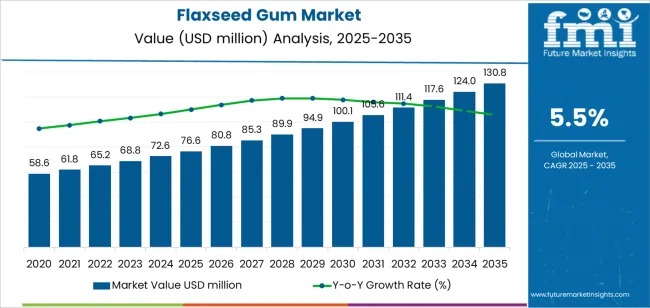
The global flaxseed gum market is valued at USD 76.6 million in 2025 and is forecast to reach USD 130.9 million by 2035, expanding at a compound annual growth rate (CAGR) of 5.5%. This growth trajectory highlights a decisive shift toward natural gum technologies as food manufacturers, pharmaceutical formulators, and processing industries increasingly replace synthetic additives with plant-based, functional alternatives.
Flaxseed gum has evolved from a niche hydrocolloid into a strategic ingredient underpinning modern clean-label formulations. Its ability to deliver precise viscosity control, stability, and consistency—while aligning with natural ingredient mandates—positions it at the center of next-generation thickening and stabilizing systems across food and pharmaceutical applications.
Explore trends before investing – request a sample report today! https://www.futuremarketinsights.com/reports/sample/rep-gb-27574
Food industry modernization continues to act as the primary catalyst for flaxseed gum adoption. Manufacturers are prioritizing natural inputs that meet rising consumer expectations for transparency, functionality, and performance. Flaxseed gum addresses these requirements through advanced extraction processes that enhance thickening efficiency, ensure batch-to-batch consistency, and withstand demanding processing conditions without increasing formulation complexity.
Between 2025 and 2030, the market is projected to grow from USD 76.6 million to USD 94.9 million, adding USD 18.3 million in value and accounting for 33.7% of total decade growth. This phase reflects optimization-driven adoption, where flaxseed gum transitions from an alternative ingredient to a standardized solution within food processing and formulation workflows. Cost efficiencies, specification standardization, and growing awareness of natural gums—now effective in up to 85–90% of food applications—define this period.
Growth accelerates in the 2030–2035 window, with the market expanding from USD 94.9 million to USD 130.9 million, contributing USD 36.0 million, or 66.3% of total forecast growth. This latter phase is characterized by mass-market penetration of specialized gum systems, seamless integration with advanced food platforms, and widespread deployment across diversified processing environments. Natural gum performance becomes an industry baseline rather than a premium differentiator.
Regional Dynamics Highlight Asia-Pacific Momentum
Regional analysis reveals contrasting but complementary growth patterns. North America and Europe maintain steady expansion driven by ingredient replacement cycles, clean-label enforcement, and advanced food manufacturing infrastructure. In contrast, Asia-Pacific emerges as the fastest-growing region, supported by rapid industrialization, expanding food processing capacity, and rising adoption of natural ingredient technologies.
China and India stand out as growth leaders, recording CAGRs of 7.4% and 6.9%, respectively. These markets benefit from large-scale food manufacturing expansion, localization of ingredient production, and increasing alignment with global food standards. Established markets such as Germany (6.3% CAGR), Brazil (5.8%), and the United States (5.2%) continue to drive innovation and specialized application development.
Particle Size ≥98% Dominates Market Share
By particle size, ≥98% purity flaxseed gum commands a dominant 58.4% market share in 2025, reflecting its superior functionality and broad applicability. This segment delivers optimal thickening power, viscosity stability, and compatibility with standard processing systems—making it the preferred choice across food and pharmaceutical operations without incurring ultra-premium costs.
Key advantages supporting this dominance include:
- Consistent performance enabled by advanced extraction technologies
- Efficient integration into high-volume food manufacturing lines
- Balanced cost-to-functionality profile suitable for diverse applications
Food Industry Leads Application Demand
The food industry accounts for 67.3% of total flaxseed gum demand in 2025, reinforcing its role as the market’s primary application segment. Flaxseed gum is widely used in bakery products, processed foods, sauces, and ready-to-eat formulations where natural thickening, texture enhancement, and stability are essential. Clean-label trends, coupled with regulatory scrutiny, continue to elevate demand for reliable, plant-based hydrocolloids.
Within end-use industries, food manufacturing alone captures 51.2% market share, driven by expanding production volumes and increasing reliance on natural functional ingredients to enhance efficiency and product quality.
Growth Drivers, Constraints, and Opportunities
Market expansion is underpinned by three structural shifts: accelerating food naturalization, rising demand for advanced functionality, and global clean-label transformation. Flaxseed gum enables manufacturers to meet these objectives while maintaining performance and operational efficiency.
However, challenges persist. Raw material price volatility and processing complexity can impact margins, particularly in cost-sensitive regions. Additionally, varying specification standards across applications create integration hurdles for manufacturers without technical expertise.
Despite these constraints, opportunity pathways remain robust. Revenue potential is strongest in:
- Food industry expansion, supported by specialized gum formulations
- Geographic penetration in Asia-Pacific, driven by China and India
- Pharmaceutical applications, leveraging biocompatibility and controlled-release properties
Competitive Landscape
The flaxseed gum market features moderate concentration, with approximately 12–18 active participants controlling 55–62% of global share. Leading players—including Labh Ingredients, Focusherb, and Xinjiang Linseed Biologic—benefit from established distribution networks, technical expertise, and diversified portfolios. Competition increasingly centers on performance reliability, application support, and processing compatibility rather than price alone.
As clean-label adoption accelerates worldwide, the flaxseed gum market is positioned for sustained, data-backed growth. Its evolution reflects a broader transformation in ingredient strategy—where natural, functional, and scalable solutions define the future of food and pharmaceutical formulation.