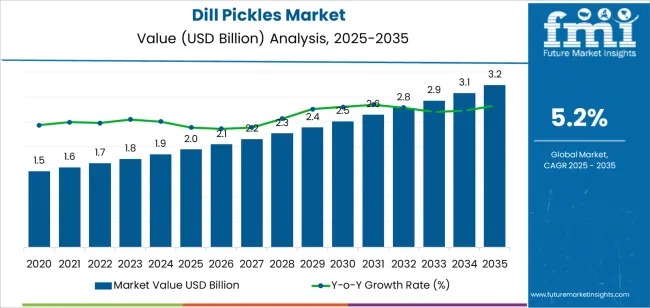
The global dill pickles market is entering a phase of sustained, value-driven expansion as consumer preferences increasingly align with fermented foods, natural flavor enhancers, and convenient snacking solutions. Valued at USD 1,950.1 million in 2025, the market is projected to reach USD 3,237.5 million by 2035, reflecting an absolute value gain of USD 1,287.4 million over the forecast period. This growth represents a 66.0% increase in total market value, translating into a steady CAGR of 5.2% between 2025 and 2035.
Market expansion is supported by consistent demand across both retail and foodservice channels, alongside evolving consumption habits. Dill pickles are no longer viewed solely as traditional condiments; they are increasingly positioned as functional, shelf-stable foods that combine taste enhancement with perceived digestive and probiotic benefits. As a result, the overall market size is expected to grow by approximately 1.66X over the next decade.
👉 Explore trends before investing – request a sample report today! https://www.futuremarketinsights.com/reports/sample/rep-gb-27588
A defining feature of the dill pickles market is its balance between maturity and innovation. While demand remains stable in established markets, particularly North America and Europe, consumption patterns are shifting toward premium, artisanal, and naturally preserved varieties. Consumers are demonstrating a growing willingness to pay for products that emphasize authentic fermentation processes, clean-label formulations, and superior flavor profiles.
Between 2025 and 2030, the market is forecast to expand from USD 1,950.1 million to USD 2,512.6 million, capturing 43.7% of the total decade-long growth in this initial phase. This period is being shaped by rising adoption of premium pickle varieties, increasing availability of organic options, and expansion of private label offerings across modern retail formats. Manufacturers are responding by scaling production while investing in quality control systems that preserve traditional taste consistency.
From 2030 to 2035, growth momentum is expected to accelerate further, adding USD 724.9 million in incremental value and accounting for 56.3% of total forecast growth. This later phase will be characterized by innovation in packaging formats, extended shelf-life solutions, and specialty formulations such as reduced-sodium and health-oriented dill pickles. Natural preservation methods and advanced fermentation technologies are emerging as competitive differentiators.
Key Market Snapshot
- Market Value (2025): USD 1,950.1 million
- Forecast Value (2035): USD 3,237.5 million
- CAGR (2025–2035): 5.2%
- Leading Type: German Dill Pickles (58.7% share)
- Key Growth Regions: China, India, Germany
German dill pickles continue to dominate the global landscape, accounting for 58.7% of total market share in 2025. Their leadership is driven by strong flavor recognition, proven shelf stability, and widespread acceptance across household and commercial applications. Traditional fermentation expertise combined with scalable production methods has allowed this segment to remain central to global consumption patterns.
On the application front, household consumption represents 73.2% of total demand, underscoring the role of dill pickles as essential pantry staples. Their versatility as snacks, side dishes, and meal enhancers supports regular household usage, while innovations in resealable packaging and portion control are strengthening at-home adoption.
Regionally, growth dynamics vary but remain consistently positive. China leads global expansion with a CAGR of 7.0%, supported by retail modernization, urbanization, and rising exposure to Western food preferences. India follows closely at 6.5%, driven by urban consumption growth, expanding middle-class incomes, and increased availability of international food products. Germany, with a CAGR of 6.0%, continues to anchor European demand through its strong pickle heritage and premium product innovation.
Other notable growth markets include Brazil (5.5%), fueled by food processing expansion, and the United States (4.9%), where health-conscious trends and premium product development are shaping demand. The UK and Japan, while growing at a more moderate pace, continue to emphasize specialty, high-quality dill pickle offerings.
The competitive landscape reflects a mix of established brands and emerging artisanal players. Market leaders are focusing on fermentation technology, flavor innovation, and multi-channel distribution strategies that blend traditional retail with e-commerce. Key players such as Bubbies, Wickles, Albertson, Dietz & Watson, Grillo’s, and Vlasic are strengthening their positions through portfolio diversification, private label partnerships, and targeted acquisitions.
Looking ahead, the dill pickles market is positioned for steady transformation. Opportunities are emerging across organic and natural varieties, premium artisanal products, specialty dietary solutions, innovative packaging, and geographic expansion in Asia-Pacific. As consumers continue to prioritize taste authenticity, health-conscious choices, and convenience, dill pickles are evolving from a traditional food category into a strategic growth segment within the global processed foods industry.