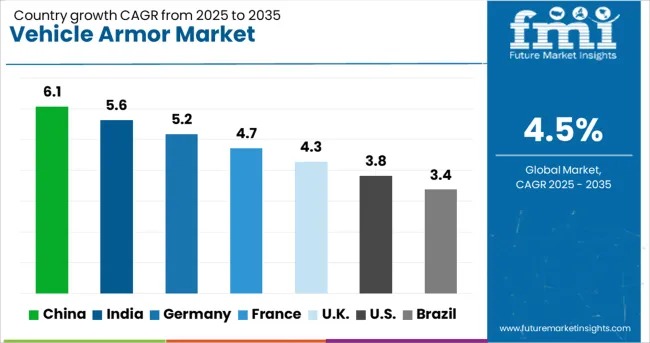
The global vehicle armor market is set to experience sustained expansion over the next decade, supported by growing security challenges, defense modernization programs, and wider adoption of armored mobility solutions. Valued at USD 8.7 billion in 2025, the market is projected to reach USD 13.5 billion by 2035, registering a compound annual growth rate (CAGR) of 4.5%. This trajectory represents an absolute growth opportunity of USD 4.8 billion and a market expansion multiplier of 1.55x during the forecast period.
Between 2025 and 2030, the market is expected to rise from USD 8.7 billion to USD 10.9 billion, generating USD 2.2 billion in new revenue and accounting for 45.8% of total incremental growth. A stronger expansion phase is anticipated between 2030 and 2035, contributing an additional USD 2.6 billion, or 54.2% of overall growth, driven by escalating geopolitical tensions, evolving urban security threats, and rapid advances in armor material technologies.
Geopolitical Instability and Defense Upgrades Fuel Global Demand
Growth in the vehicle armor market is being shaped by increasing military modernization initiatives, higher defense budgets, and the rising need to protect both personnel and critical assets. Governments are prioritizing survivability across combat, peacekeeping, and homeland security missions, accelerating the upgrade of aging vehicle fleets and the procurement of next-generation armored platforms.
Emerging threats such as unmanned aerial vehicle (UAV) attacks, improvised explosive devices (IEDs), and asymmetric warfare have compelled defense organizations to strengthen baseline protection standards. At the same time, urban security challenges, law enforcement modernization, and rising civil unrest in select regions have expanded the use of armored vehicles beyond traditional military applications. The growing integration of modular protection kits, sensor-embedded armor, and active protection systems is increasing the technical sophistication of armored vehicle platforms.
Subscribe for Year-Round Insights → Stay ahead with quarterly and annual data updates
https://www.futuremarketinsights.com/reports/sample/rep-gb-23390
Metals and Armored Fighting Vehicles Maintain Market Leadership
By material type, metals are projected to account for 44.2% of total market revenue in 2025, retaining their position as the dominant armor material. High-hardness steel and aluminum alloys continue to be widely adopted due to their proven ballistic resistance, structural reliability, and cost efficiency. Ongoing advancements in heat treatment, forming, and welding technologies have significantly improved the strength-to-weight performance of metallic armor systems.
From a vehicle category perspective, armored fighting vehicles (AFVs) are expected to capture 37.6% of total market revenue in 2025, making them the leading segment. Rising investments in main battle tanks, infantry fighting vehicles, and reconnaissance platforms have reinforced demand. Layered and scalable armor kits are increasingly used to preserve mobility while delivering superior multi-threat protection.
The military application segment dominates the market with a 65.4% revenue share in 2025, underpinned by strong global procurement cycles, battlefield modernization strategies, and heightened operational requirements in conflict and high-risk operational environments.
Asia-Pacific Accelerates Growth While Mature Markets Focus on Innovation
Regional performance is led by Asia-Pacific, where rising defense spending and internal security investments are driving demand. China is forecast to grow at a 6.1% CAGR, supported by fleet modernization, domestic defense manufacturing, and rising law enforcement requirements. India follows at a 5.6% CAGR, benefitting from increased border security deployments and large-scale armored vehicle procurement.
Europe remains a critical innovation hub, with France expected to grow at 4.7% CAGR and the United Kingdom at 4.3% CAGR, reflecting strong investments in next-generation vehicle protection technologies. The United States, although a mature market, continues to expand at a 3.8% CAGR, driven by sustained military upgrades, law enforcement fleet enhancements, and VIP protection requirements.
Competitive Landscape and Innovation Focus
The competitive environment is shaped by established and emerging manufacturers delivering high-performance protection solutions. Companies such as Plasan Sasa Ltd., DuPont, Kaiser Aluminum, SSAB, and CoorsTek are driving innovation through advanced ballistic materials, lightweight composites, and multi-layered armor systems.
At the same time, specialized players including Armormax, ATEK Defense Systems, Garanti Kompozit, Permali, and ASL GRP are expanding market reach by offering modular and customized armor solutions tailored to regional security needs and civilian protection markets.
Future Outlook
The vehicle armor market is transitioning toward lighter, stronger, and more adaptive protection technologies. The growing use of ceramic-composite hybrids, aramid fibers, and sensor-integrated armor is redefining vehicle survivability standards. As military doctrines evolve and civilian security demands intensify, manufacturers capable of delivering scalable, cost-efficient, and high-performance armor systems are expected to capture a significant share of the USD 4.8 billion global growth opportunity through 2035.
About Future Market Insights (FMI)
Future Market Insights, Inc. (FMI) is an ESOMAR-certified, ISO 9001:2015 market research and consulting organization, trusted by Fortune 500 clients and global enterprises. With operations in the U.S., UK, India, and Dubai, FMI provides data-backed insights and strategic intelligence across 30+ industries and 1200 markets worldwide.