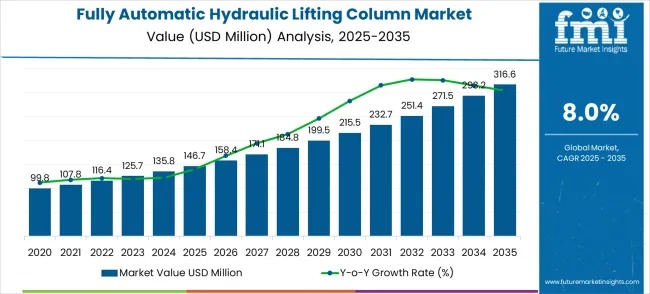
The global Fully Automatic Hydraulic Lifting Column Market is witnessing accelerated growth as governments and enterprises strengthen automated perimeter security. Valued at USD 146.7 million in 2025, the market is projected to reach USD 316.6 million by 2035, expanding at a CAGR of 8.0%. This growth reflects rising investments in smart cities, public safety infrastructure, and digitally controlled vehicle access systems across developed and emerging economies.
Automated lifting columns are increasingly replacing manual barriers due to their rapid response capability, remote operation, and compatibility with intelligent security platforms. Despite higher initial installation costs, long-term efficiency gains and compliance with stringent security regulations continue to support adoption.
Subscribe for Year-Round Insights → Stay ahead with quarterly and annual data updates:
https://www.futuremarketinsights.com/reports/sample/rep-gb-26899
Key Factors Driving Market Expansion
The market’s upward trajectory is closely tied to evolving security needs and urban development priorities. Automated lifting columns enable instant vehicle denial, reducing security risks at high-sensitivity locations while maintaining uninterrupted traffic flow.
Primary growth drivers include:
- Rising deployment of automated access control in government, defense, and critical infrastructure
- Expansion of smart city projects integrating IoT-enabled security systems
- Growing demand for remote and AI-assisted security operations to reduce manpower dependency
Between 2025 and 2030, the market is expected to add USD 52.8 million, accounting for over 31% of total decade growth, driven by product innovation and early-stage smart infrastructure rollouts. The period from 2030 to 2035 will contribute nearly 69% of total growth, supported by large-scale urban security optimization programs.
Product Trends: Split Type Systems Lead Adoption
By product type, Split Type lifting columns dominate the market, accounting for approximately 58% share in 2025. Their modular architecture enables flexible installation, easier maintenance, and cost-effective scalability—key advantages for multi-point access control sites.
Why split type systems are preferred:
- Modular design allowing upgrades without full system shutdown
- Reduced installation complexity in existing infrastructure
- Enhanced operational reliability for high-security environments
These attributes make split type systems particularly suitable for retrofitting legacy security installations in dense urban areas.
Application Insights: Public Safety at the Core
The public safety segment represents the largest application area, contributing around 45% of total demand. Government buildings, military bases, and critical facilities increasingly rely on automated lifting columns to meet national security standards and ensure continuous protection.
Public safety adoption is driven by:
- Mandatory compliance with perimeter security regulations
- Need for rapid threat response without manual intervention
- Availability of government funding for security modernization
Commercial and civil infrastructure segments are also gaining traction, especially in high-traffic zones such as business parks, airports, and logistics hubs.
Regional Dynamics Highlight Asia-Pacific Leadership
Asia Pacific leads global growth, anchored by China and India. China, with a projected 10.8% CAGR, benefits from large-scale urbanization, government-backed smart city initiatives, and strict security mandates. India follows closely at 10.0% CAGR, supported by expanding metropolitan infrastructure and rising public-private security investments.
Other regions add stability:
- Europe leverages advanced automation and Industry 4.0 integration, led by Germany
- North America emphasizes AI-enabled security analytics and compliance-driven upgrades
- Japan and the UK maintain steady growth through precision security and regulatory focus
Competitive Landscape and Market Positioning
The market features moderate concentration, with leading players controlling nearly 42–47% of global share. Competition centers on technological differentiation, integration expertise, and after-sales service rather than pricing alone.
Leading companies focus on:
- Advanced hydraulic and control technologies
- AI-powered monitoring and predictive maintenance
- Long-term service contracts ensuring customer retention
Regional manufacturers are strengthening their presence in high-growth markets by offering localized support and faster deployment capabilities.
Get data that aligns with your strategic priorities — ask for report customization today:
https://www.futuremarketinsights.com/customization-available/rep-gb-26899
Outlook
As urban security shifts toward automation and intelligence, fully automatic hydraulic lifting columns are becoming essential infrastructure components. Sustained investments in smart cities, public safety, and digital transformation position the market for robust, long-term growth through 2035.
Related Reports:
Gas Insulated Substation Market- https://www.futuremarketinsights.com/reports/gas-insulated-substation-market
Soil Testing Market- https://www.futuremarketinsights.com/reports/soil-testing-equipment-market
Fine Bubble Diffuser Market- https://www.futuremarketinsights.com/reports/fine-bubble-diffuser-market
Have a specific Requirements and Need Assistant on Report Pricing or Limited Budget please contact us – sales@futuremarketinsights.com
About Future Market Insights (FMI)
Future Market Insights, Inc. (FMI) is an ESOMAR-certified, ISO 9001:2015 market research and consulting organization, trusted by Fortune 500 clients and global enterprises. With operations in the U.S., UK, India, and Dubai, FMI provides data-backed insights and strategic intelligence across 30+ industries and 1200 markets worldwide.
Contact Us:
Future Market Insights Inc.
Christiana Corporate, 200 Continental Drive,
Suite 401, Newark, Delaware – 19713, USA
T: +1-347-918-3531
Why FMI: https://www.futuremarketinsights.com/why-fmi
Website: https://www.futuremarketinsights.com
LinkedIn| Twitter| Blogs | YouTube