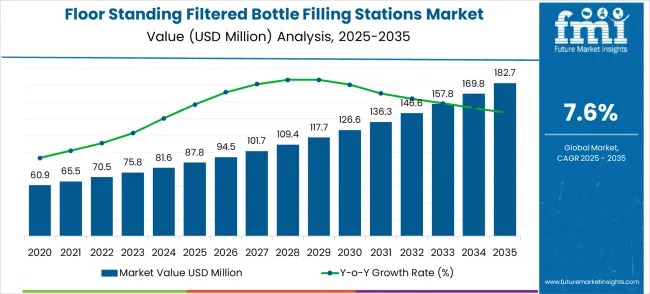
The global floor standing filtered bottle filling stations market is witnessing steady, data-backed growth as sustainability, hygiene, and smart facility management become top priorities. The market is projected to grow from USD 87.8 million in 2025 to USD 182.7 million by 2035, registering a CAGR of 7.6% and an absolute value increase of USD 94.9 million over the forecast period.
Sustainability and Hygiene Drive Market Expansion
The Floor Standing Filtered Bottle Filling Stations Market is expanding rapidly as organizations shift away from single-use plastics and adopt reusable hydration infrastructure. Educational institutions, healthcare facilities, corporate offices, and public buildings are increasingly deploying filtered bottle filling stations to meet environmental goals while ensuring safe access to drinking water.
Subscribe for Year-Round Insights → Stay ahead with quarterly and annual data updates
https://www.futuremarketinsights.com/reports/sample/rep-gb-26897
Key demand drivers include:
- Rising global focus on plastic waste reduction
- Increased adoption of green building certifications
- Higher hygiene standards in public and commercial facilities
These systems offer measurable benefits by lowering bottled water consumption, reducing waste management costs, and improving user confidence in water quality.
Market Acceleration Expected After 2030
From 2030 to 2035, the market is expected to add USD 65.0 million, accounting for nearly 69% of total ten-year growth. This acceleration reflects the integration of smart water dispensing technologies, including IoT-enabled usage monitoring, maintenance alerts, and touchless operation.
Facility managers increasingly prefer intelligent systems that support predictive maintenance, improve uptime, and deliver long-term operational savings.
Segment Insights: Technology and Applications
By Machine Type:
Aseptic filling machines lead the market, accounting for approximately 55% share in 2025. Their ability to prevent contamination and maintain consistent water quality makes them essential in hygiene-sensitive environments such as hospitals, food service areas, and educational campuses.
By Application:
Food and beverage applications dominate demand with an estimated 65% market share. Operators prioritize filtered bottle filling stations for:
- Compliance with food safety regulations
- Consistent water quality
- Improved customer experience
This segment is expected to remain the primary growth engine throughout the forecast period.
Regional Growth Patterns Highlight Emerging Markets
Asia Pacific is emerging as the fastest-growing region, driven by infrastructure development and environmental awareness.
Key country-level growth rates include:
- China: 10.3% CAGR, supported by urbanization and public infrastructure expansion
- India: 9.5% CAGR, driven by education sector growth and public health initiatives
- Germany: 8.7% CAGR, reflecting leadership in sustainability and green buildings
- United States: 7.2% CAGR, backed by facility modernization and plastic reduction programs
These regions collectively underpin global market momentum and long-term demand stability.
Competitive Landscape Focused on Innovation
The market is moderately competitive, with leading players investing in advanced filtration systems, smart connectivity, and hygiene-enhancing designs. Companies are differentiating through:
- Touchless dispensing technologies
- Antimicrobial surfaces
- Real-time water quality monitoring
Key players include Elkay, Oasis, Murdock Manufacturing, Sidel, Acorn Engineering, Most Dependable Fountains, and Tetra Pak, all of whom are strengthening portfolios to meet evolving institutional requirements.
Strategic Outlook and Industry Implications
Floor standing filtered bottle filling stations are evolving from optional amenities to essential infrastructure assets. Their alignment with sustainability reporting, public health standards, and long-term cost efficiency makes them a strategic investment for facility operators.
As environmental accountability increases and smart building adoption expands, demand for advanced hydration solutions is expected to remain resilient through 2035.
Get data that aligns with your strategic priorities — ask for report customization today:
https://www.futuremarketinsights.com/customization-available/rep-gb-26897
Related Reports
Industrial Valves Market- https://www.futuremarketinsights.com/reports/industrial-valve-market
Micro Irrigation Systems Market- https://www.futuremarketinsights.com/reports/micro-irrigation-systems-market
Pneumatic Actuator Market- https://www.futuremarketinsights.com/reports/pneumatic-actuator-market
Have a specific Requirements and Need Assistant on Report Pricing or Limited Budget please contact us – sales@futuremarketinsights.com
About Future Market Insights (FMI)
Future Market Insights, Inc. (FMI) is an ESOMAR-certified, ISO 9001:2015 market research and consulting organization, trusted by Fortune 500 clients and global enterprises. With operations in the U.S., UK, India, and Dubai, FMI provides data-backed insights and strategic intelligence across 30+ industries and 1200 markets worldwide.
Contact Us:
Future Market Insights Inc.
Christiana Corporate, 200 Continental Drive,
Suite 401, Newark, Delaware – 19713, USA
T: +1-347-918-3531
Why FMI: https://www.futuremarketinsights.com/why-fmi
Website: https://www.futuremarketinsights.com
LinkedIn| Twitter| Blogs | YouTube