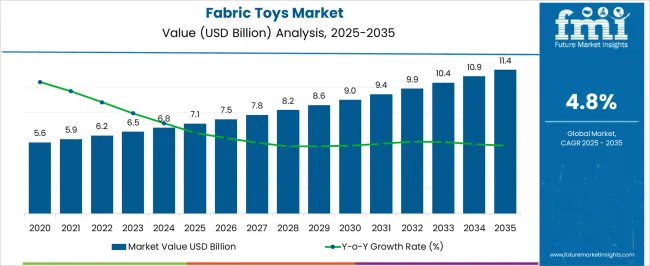
The global fabric toys market is entering a new phase of steady yet opportunity-rich expansion, driven by rising parental awareness, sustainability-focused manufacturing, and continuous product innovation by both established brands and emerging manufacturers. According to the latest market outlook, the fabric toys market is valued at USD 7.1 billion in 2025 and is projected to reach USD 11.4 billion by 2035, registering a CAGR of 4.8% over the forecast period.
This growth trajectory reflects a strong shift toward safe, eco-friendly, educational, and emotionally engaging toys, positioning fabric toys as a preferred alternative to plastic-based products across global markets.
To access the complete data tables and in-depth insights — Request Your Sample Report Now
Market Growth Overview and Forecast Outlook
- 2025 Market Value: USD 7.1 billion
- 2035 Forecast Value: USD 11.4 billion
- Forecast CAGR (2025–2035): 4.8%
- Leading Segment (2025): Stuffed animals and dolls (38.6% share)
- High-Growth Regions: North America, Europe, Asia-Pacific
The market growth curve shows linear expansion with slight acceleration after 2030, supported by premiumization, customization trends, and wider adoption in developing economies. Between 2021 and 2025, demand was fueled by eco-conscious parenting and educational play, while the period from 2026 onward reflects stronger innovation-led momentum.
Why the Fabric Toys Market Is Growing
The fabric toys market is benefiting from multiple long-term demand drivers:
- Rising focus on child safety and non-toxic materials
- Growing popularity of eco-friendly and organic fabrics
- Increased spending on early childhood development
- Expansion of e-commerce and direct-to-consumer channels
- Seasonal gifting demand during holidays and celebrations
Global toy safety regulations are also encouraging manufacturers to adopt hypoallergenic, washable, and durable fabrics, reinforcing trust among parents and educators.
Key Market Takeaways
The fabric toys market is supported by five core parent industries that shape demand:
- Toy Manufacturing Market (28–32%) – Core contributor with plush toys, dolls, and educational soft toys.
- Gift and Novelty Items (20–24%) – Strong demand during festive and personal gifting occasions.
- Home Décor & Lifestyle Products (15–18%) – Fabric toys used as decorative and comfort items.
- Baby & Infant Products (12–15%) – High demand due to safety and sensory engagement.
- E-commerce & Online Retail (8–10%) – Expanding access to niche, customized, and premium products.
Key Segments of the Fabric Toys Market
By Product Type
- Stuffed animals and dolls
- Educational fabric toys
- Activity and play toys
- Soft musical toys
- Others
By Age Group
- 3–6 years
- 0–3 years
- 6–12 years
By Material
- Cotton
- Polyester fabric
- Organic fabric
- Blended fabrics
By Price
- Low
- Medium
- High
By End Use
- Personal use
- Commercial use
By Distribution Channel
- Online
- Offline
By Region
- North America
- Europe
- Asia-Pacific
- Latin America
- Middle East & Africa
Segmental Insights Driving Market Leadership
Stuffed Animals and Dolls – Market Leader
The stuffed animals and dolls segment accounts for 38.6% of market revenue in 2025, driven by emotional appeal, comfort value, and storytelling-based play. Manufacturers are introducing licensed characters, themed collections, and premium handcrafted designs, enhancing repeat purchases and cross-generational appeal.
Age Group 3–6 Years – Highest Demand
Children aged 3–6 years contribute 42.7% of market revenue, reflecting strong demand for tactile, imaginative, and educational play. Fabric toys in this segment support motor skills, role-play, and early learning, making them popular among parents and schools.
Cotton as the Preferred Material
Cotton dominates with 44.1% market share, favored for its softness, breathability, and hypoallergenic properties. Organic cotton and biodegradable fabric innovations are helping manufacturers meet sustainability goals while commanding premium pricing.
Regional and Country-Level Opportunities
- China (CAGR 6.5%) – Driven by rising disposable income, strong e-commerce infrastructure, and demand for eco-friendly toys.
- India (CAGR 6.0%) – Growing urbanization, online retail growth, and preference for safe alternatives to plastic toys.
- France (CAGR 5.0%) – Eco-conscious parenting and strong retail networks.
- United Kingdom (CAGR 4.6%) – Demand for personalized and organic fabric toys.
- United States (CAGR 4.1%) – Mature market emphasizing sustainability, customization, and direct-to-consumer brands.
Emerging markets present significant opportunities for new manufacturers seeking expansion, especially those offering affordable, sustainable, and customizable fabric toys.
Competitive Landscape: Established and Emerging Innovators
The fabric toys market features a dynamic mix of global leaders and innovation-focused manufacturers, including:
- Aurora World – High-quality plush toys with wide age appeal
- Cloud b – Therapeutic and sleep-enhancing fabric toys for infants
- Gund & Hasbro – Interactive plush toys and character-based designs
- IKEA (Soft Toy Line) – Affordable, ethically produced fabric toys
- Jellycat & Steiff – Premium, collectible, and design-led products
- LEGO & Mattel – Strategic collaborations blending creativity with soft play
- Melissa & Doug, Spin Master, Mary Meyer – Educational and skill-based fabric toys
- Ty & Wild Republic – Nostalgic collectibles and eco-themed offerings
New and mid-sized manufacturers are increasingly investing in sustainable sourcing, digital branding, customization technologies, and innovative fabric treatments, enabling them to compete alongside established brands.
Future Trends and Expansion Strategies
Key trends shaping the future of the fabric toys market include:
- Customization and personalization for gifting
- Interactive and multi-sensory fabric toys
- Eco-friendly packaging and biodegradable materials
- Digital engagement through social media and AR experiences
- Expansion into developing regions with localized designs
Manufacturers that balance innovation, affordability, safety, and sustainability are expected to gain a competitive edge between 2025 and 2035.
Conclusion
The fabric toys market forecast from 2025 to 2035 highlights a resilient, innovation-driven industry with strong opportunities for both established players and new entrants. As parents worldwide prioritize safe, sustainable, and meaningful play experiences, fabric toys are set to remain a cornerstone of the global toy industry, offering long-term growth and expansion potential across regions and segments.
Why FMI: https://www.futuremarketinsights.com/why-fmi
About Future Market Insights (FMI)
Future Market Insights, Inc. (FMI) is an ESOMAR-certified, ISO 9001:2015 market research and consulting organization, trusted by Fortune 500 clients and global enterprises. With operations in the U.S., UK, India, and Dubai, FMI provides data-backed insights and strategic intelligence across 30+ industries and 1200 markets worldwide.
Contact Us:
Future Market Insights Inc.
Christiana Corporate, 200 Continental Drive,
Suite 401, Newark, Delaware – 19713, USA
T: +1-347-918-3531
For Sales Enquiries: sales@futuremarketinsights.com
Website: https://www.futuremarketinsights.com
LinkedIn| Twitter| Blogs | YouTube