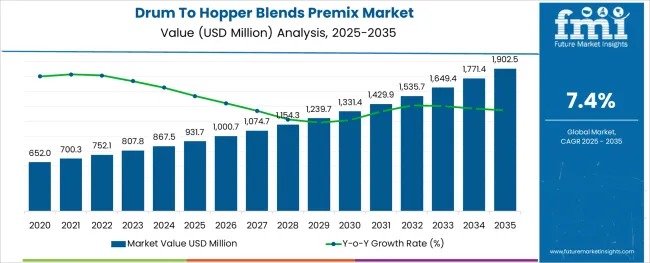
The global Drum to Hopper Blends Premix Market is entering a phase of sustained expansion, driven by rising demand for fortified foods, nutraceuticals, and precision-driven manufacturing systems. The market is estimated to be valued at USD 931.7 million in 2025 and is projected to reach USD 1,902.5 million by 2035, registering a steady CAGR of 7.4% over the forecast period. Growth is underpinned by the increasing need for batch uniformity, micronutrient accuracy, and contamination-free handling across food, pharmaceutical, and dietary supplement production lines.
Industries are increasingly adopting drum-to-hopper premix solutions to reduce manual intervention, enhance operational efficiency, and ensure regulatory compliance. These premixes allow manufacturers to streamline complex formulations while maintaining consistency across high-volume production runs, making them a critical input in modern large-scale manufacturing environments.
Get Exclusive Access To Data Tables, Market Sizing Dashboards, And Analyst Insights. Request Sample Report! https://www.futuremarketinsights.com/reports/sample/rep-gb-15302
Market Overview: Efficiency Meets Nutritional Precision
The drum to hopper blends premix market is gaining traction as manufacturers prioritize clean-label nutrition, production efficiency, and cost optimization. Premixes enable precise dosing of vitamins, minerals, amino acids, and functional ingredients, reducing formulation errors and minimizing raw material losses. This is particularly valuable in fortified foods, supplements, and functional beverages, where nutrient consistency directly impacts product efficacy and regulatory approval.
Technological advancements in drum-to-hopper delivery systems are further accelerating adoption. Automated transfer mechanisms now support closed-system handling, reducing labor exposure and contamination risks. Innovations in ingredient encapsulation and flow optimization are also improving premix stability, compatibility, and shelf life, even in sensitive processing environments.
Key Market Highlights (2025)
- Industry Value: USD 931.7 million
- Forecast Value (2035): USD 1,902.5 million
- Forecast CAGR: 7.4%
- Leading Ingredient Segment: Vitamin Premix (14.2% share)
- Dominant Form: Powder (72.0% share)
- Leading Application: Food Sector (17.3% share)
- Key Growth Regions: North America, Asia-Pacific, Europe
Vitamin Premix Segment Anchors Ingredient Demand
Within the ingredient landscape, vitamin premixes are projected to account for 14.2% of total market revenue in 2025, positioning them as the leading segment. This growth is driven by rising consumer awareness of micronutrient deficiencies and increasing regulatory mandates for food fortification.
Vitamin premixes enable manufacturers to deliver consistent nutrition across multiple SKUs while simplifying formulation logistics. Their compatibility with automated hopper-fed systems ensures homogeneity and reduces batch-to-batch variability. In highly regulated categories such as infant nutrition, clinical foods, and sports supplements, precise vitamin dosing through premixes is critical to maintaining compliance and product performance.
Powder Form Dominates with Operational Advantages
By form, the powder segment is expected to dominate with a 72.0% market share in 2025. Powders are favored for their ease of transportation, extended shelf stability, and suitability for high-throughput blending systems. Their low moisture content reduces spoilage risk, while controlled flow properties make them ideal for automated drum-to-hopper operations.
Manufacturers continue to prefer powder premixes due to their versatility across hot and cold processing lines, cost efficiency, and adaptability to customized nutrient matrices. These advantages are reinforcing powder formats as the industry standard in large-scale production.
Food Sector Leads Application Demand
The food sector is anticipated to contribute 17.3% of total market revenue in 2025, making it the leading application area. Demand is being fueled by fortified bakery, dairy, confectionery, and ready-to-eat products that align with evolving health and wellness trends. Food manufacturers are increasingly using premix solutions to enhance nutritional profiles without altering taste, texture, or processing efficiency.
Drum-to-hopper delivery systems support hygiene, traceability, and sustainable raw material utilization—key priorities for global food producers. As nutritional enhancement becomes central to competitive differentiation, adoption in the food sector is expected to strengthen further.
Regional Outlook: North America and Europe Lead, Asia-Pacific Accelerates
North America remains a dominant region, with the U.S. accounting for nearly 65% of North American demand, supported by high consumption of fortified packaged foods and convenience products. Europe, particularly the UK, is witnessing rapid growth, with demand forecast to expand at a 9.7% CAGR, driven by rising health awareness and investments in R&D.
Asia-Pacific is emerging as a high-growth region, supported by expanding food processing industries, rising disposable incomes, and government-led nutrition programs aimed at addressing micronutrient deficiencies.
Competitive Landscape and Strategic Developments
The market is moderately consolidated, with key players including Watson Inc., Protecnutra, Ashland, Sabinsa Manufacturing, Prinova Global, Brenntag, The Wright Group, and others. Companies are focusing on product innovation, customized premix solutions, and strategic mergers and acquisitions to strengthen their global footprint. For instance, Corbion’s acquisition of full ownership of Granolife in July 2024 enhanced its blending capabilities and regional presence in Mexico.
Outlook
With rising malnutrition concerns, expanding functional food consumption, and increasing automation in manufacturing, the drum to hopper blends premix market is poised for long-term growth. Demand for customized, efficient, and regulation-ready premix solutions will continue to shape the competitive landscape through 2035.