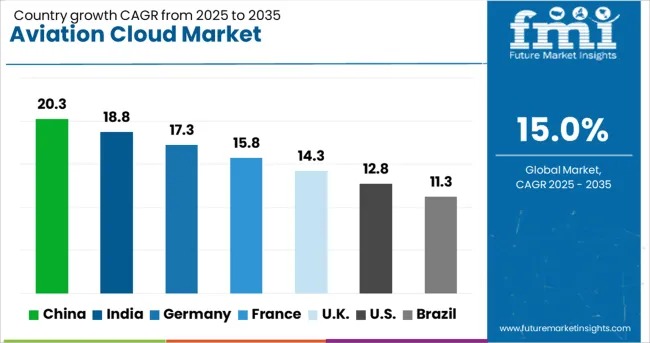
The global aviation cloud market is entering a period of rapid expansion, driven by the aviation industry’s shift toward real-time data processing, predictive analytics, and scalable digital infrastructure. The market is estimated to be valued at USD 7.4 billion in 2025 and is projected to reach USD 30.0 billion by 2035, advancing at a strong compound annual growth rate (CAGR) of 15.0% over the forecast period.
A phased growth assessment highlights how adoption is unfolding across the decade. Between 2025 and 2027, the market expands from USD 7.4 billion to USD 9.8 billion, accounting for nearly 20% of total forecast growth as early adopters modernize core IT systems to improve operational efficiency. Accelerated expansion emerges in the 2028–2031 period, when market value increases from USD 11.3 billion to USD 19.7 billion, contributing almost 50% of total growth. This mid-cycle surge reflects wider integration of cloud-native platforms, advances in data security, and rising dependence on real-time analytics for mission-critical aviation operations. From 2032 to 2035, the market rises from USD 22.7 billion to USD 30.0 billion, representing the remaining 30% of growth, as cloud adoption becomes standardized and maturity-driven optimization replaces early-stage deployment.
Public cloud infrastructure is expected to remain the backbone of this expansion, accounting for 47.0% of total revenue in 2025. Airlines and airports are increasingly choosing public cloud environments due to their lower upfront costs, global scalability, and ability to support distributed data access across regions. These platforms enable seamless collaboration between airlines, airports, air navigation service providers, and regulatory bodies, while supporting rapid deployment of new digital services such as real-time fleet monitoring, passenger flow management, and disruption control systems.
Subscribe for Year-Round Insights → Stay ahead with quarterly and annual data updates
https://www.futuremarketinsights.com/reports/sample/rep-gb-23411
From a service perspective, Software as a Service (SaaS) models are projected to lead the market, capturing 52.0% of total revenue in 2025. SaaS adoption is transforming how airlines manage passenger services, crew rostering, aircraft turnaround coordination, and ticketing platforms. Subscription-based delivery models reduce infrastructure complexity, enable automatic system upgrades, and support integration with mobile and wearable devices used by operational staff. This approach is enabling airlines to improve agility while maintaining compliance with increasingly stringent operational and data governance standards.
By application, flight operations are expected to represent 28.0% of total market revenue in 2025, positioning this segment as the primary use case for aviation cloud platforms. Cloud-based flight operation systems provide real-time situational awareness, fuel optimization insights, disruption management, and enhanced collaboration between pilots, dispatchers, and ground teams. These platforms support dynamic flight planning, rapid decision-making during weather events or airspace constraints, and automated regulatory reporting, allowing airlines to improve on-time performance and operational resilience while reducing fuel and maintenance costs.
Regional dynamics further reinforce the industry’s strong outlook. China leads projected growth with a CAGR of 20.3%, driven by rapid airport modernization, expansion of domestic and international air traffic, and national investments in cloud-enabled air traffic management. Adoption of cloud-based flight operations in China grew by 38% in 2024, while predictive maintenance deployments increased by 32%. India follows with an 18.8% CAGR, supported by smart airport initiatives, modernization of air traffic control systems, and increasing integration of AI-based route optimization and passenger data platforms. Germany is projected to expand at 17.3% CAGR, emphasizing secure, regulation-compliant cloud environments and deep integration of cloud with IoT-enabled ground operations systems.
The United Kingdom is expected to grow at a 14.3% CAGR, benefiting from investments in cloud-based passenger engagement tools, baggage tracking systems, and airport crowd management analytics. The United States, with a projected 12.8% CAGR, continues to lead in cloud-native aviation platform innovation, multi-cloud adoption strategies, and large-scale integration of artificial intelligence and big data analytics. Cloud-native platform deployments in the U.S. increased by 26% in 2024, while multi-cloud strategy adoption rose by 22% year-on-year, reflecting the market’s focus on resilience, scalability, and operational continuity.
The competitive landscape is anchored by global cloud and enterprise technology leaders, including Microsoft Corporation, IBM Corporation, Amazon Web Services, Oracle Corporation, Google, and SAP SE. These companies are investing heavily in aviation-specific cloud architectures that integrate artificial intelligence, Internet of Things (IoT) capabilities, and advanced cybersecurity frameworks. Hybrid cloud strategies, industry-grade compliance features, and seamless legacy system integration are becoming critical differentiators as aviation clients seek tailored, highly reliable platforms. Emerging use cases such as digital twins, real-time weather intelligence, blockchain-based transaction security, and edge-cloud integrations further expand the market’s strategic importance.
As airlines, airports, and MRO providers continue to prioritize operational resilience, cost efficiency, and real-time intelligence, aviation cloud platforms are evolving into the digital backbone of the global aviation ecosystem. With strong regulatory support, accelerating technology maturity, and rising demand for predictive, data-driven aviation services, the market is positioned for sustained double-digit growth through 2035. Accessing the full market report provides comprehensive insights into deployment strategies, emerging application areas, regional opportunity mapping, and competitive benchmarking across this rapidly transforming industry.
About Future Market Insights (FMI)
Future Market Insights, Inc. (FMI) is an ESOMAR-certified, ISO 9001:2015 market research and consulting organization, trusted by Fortune 500 clients and global enterprises. With operations in the U.S., UK, India, and Dubai, FMI provides data-backed insights and strategic intelligence across 30+ industries and 1200 markets worldwide.