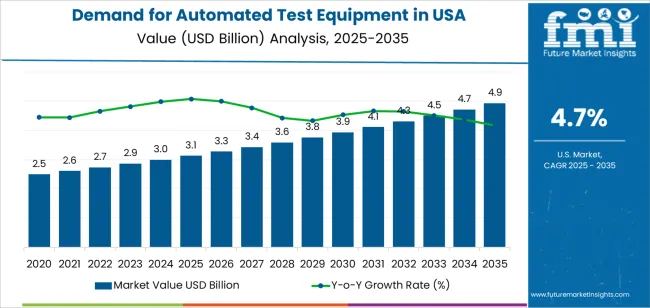
The United States automated test equipment (ATE) market is experiencing robust momentum, with industry sales projected at USD 3.1 billion in 2025 and forecast to expand significantly by 2035 at a steady growth pace. This growth underscores the strategic importance of ATE systems across multiple high-tech industries, including semiconductors, consumer electronics, automotive electronics and telecommunications, and opens the door for both established test equipment manufacturers and innovative new entrants leveraging cutting-edge technologies.
As digitalization accelerates and advanced electronics become ubiquitous in everyday life, the demand for reliable, high-throughput testing solutions continues to rise. ATE systems play a critical role in validating chips, circuit boards, and complex systems under stringent performance and quality standards — a necessity in an era defined by artificial intelligence, next-generation network infrastructure, electrification in vehicles and more. The market’s positive outlook reflects both sustained demand from legacy players and fertile ground for new players introducing modular, flexible and AI-enhanced test platforms.
Market Dynamics and Growth Trajectory
The outlook for the U.S. ATE industry remains very promising. Semiconductor ATE maintains a dominant position, driven by the complexities of modern chip designs, smaller geometry nodes, heterogeneous integration and the need for advanced parametric and functional testing. With semiconductor production and packaging activities expanding across major hubs, test equipment demand remains a fundamental investment for manufacturers seeking higher yield, improved quality and reduced time-to-market for next-generation devices.
Beyond semiconductors, growing segments such as system-level test equipment, PCB test solutions and RF & wireless testing platforms are gaining traction due to the proliferation of interconnected devices and the critical need to ensure performance across a range of operating conditions. In consumer electronics — from smartphones to wearables — the sheer volume of units produced annually necessitates automated testers that can keep pace with fast cycle times and strict quality thresholds. Similarly, the automotive sector’s shift toward electric and autonomous vehicles is creating new test challenges for power electronics, sensors, and advanced driver assistance systems (ADAS), further expanding ATE adoption.
To access the complete data tables and in-depth insights, request a sample report here
Technological Advancements and Innovation
Technological evolution in test systems is reshaping the competitive landscape. Established manufacturers are increasingly integrating artificial intelligence, machine learning, and software-defined test architectures to boost efficiency, reduce test cycle times and adapt dynamically to new device requirements. These advancements are enabling predictive maintenance, adaptive test strategies, higher test accuracy and improved utilization of test resources — essential capabilities for coping with the rapid changes in device complexity.
Modular and reconfigurable platforms are another frontier in ATE innovation, allowing manufacturers to scale solutions across diverse test needs without replacing entire systems. This flexibility is especially attractive to mid-tier and emerging electronics producers that require cost-effective solutions able to evolve with shifting product lines and testing standards.
Key Industry Players Driving Market Progress
Leading the charge in the U.S. ATE arena are several well-established manufacturers with deep expertise and global footprints. Traditional giants such as Teradyne and National Instruments are recognized for their extensive semiconductor testing portfolios, reliable system performance and integrated hardware–software solutions. Other seasoned players, including Chroma ATE, Astronics Corporation and Star Technologies, have strengthened their offerings across niche areas such as power electronics, aerospace testing and rugged multi-channel systems.
In parallel, a new wave of innovators and growth-oriented companies are expanding their market presence by delivering specialized tools and technologies that address emerging requirements. These include vendors focused on AI-augmented analytics, modular test architectures and scalable solutions tailored for electric vehicle electronics, IoT devices and next-generation communication modules. These newcomers are forging strategic collaborations with OEMs and contract manufacturers to co-develop bespoke test solutions, driving deeper integration of software intelligence and real-time diagnostic capabilities.
Opportunities for Expansion and Collaboration
The expanding ATE market presents compelling opportunities for both incumbents and startups. Established manufacturers are exploring adjacent segments and global partnerships to enhance their product portfolios and expand into high-growth verticals such as defense, aerospace and industrial automation. Meanwhile, innovative technology firms are well positioned to capture market share by addressing unmet needs — particularly in areas demanding high flexibility, lower total cost of ownership, and real-time, data-driven test insights.
As demand continues to grow, collaboration between equipment providers, semiconductor foundries, electronics OEMs and research institutions will be central to advancing test methodologies and ensuring future readiness. These collaborations not only foster innovation but also help align test solutions with evolving industry standards, reducing barriers to adoption for cutting-edge technologies.
Looking Ahead
With a solid growth forecast and dynamic technological landscape, the U.S. automated test equipment market is poised for significant expansion. The interplay between established leaders and new innovators will shape the next decade of advancements, unlocking higher performance, smarter test automation and enhanced reliability across all stages of electronic product development and manufacturing.