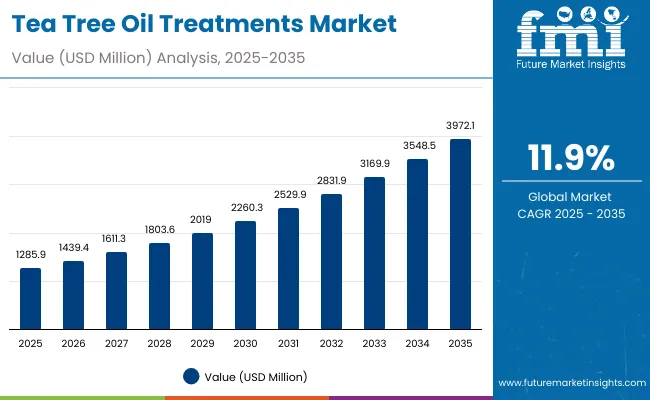
The global Tea Tree Oil Treatments Market is entering a decade of accelerated expansion, driven by rising acne prevalence, strong consumer trust in natural remedies, and rapid innovation by both established skincare leaders and emerging digital-first manufacturers. According to the latest market outlook, the industry is projected to grow from USD 1,285.9 million in 2025 to USD 3,972.1 million by 2035, reflecting an absolute increase of USD 2,686.2 million and a robust CAGR of 11.9%. This trajectory represents more than a 3X expansion over the forecast period, firmly positioning tea tree oil as a mainstream, science-backed skincare ingredient rather than a niche botanical solution.
Market Growth Snapshot and Strategic Outlook
The first half of the forecast period (2025–2030) contributes 36% of total decade growth, with market value rising to USD 2,260.3 million. Growth during this phase is fueled by widespread adoption of acne/blemish care treatments, oil-control cleansers, and soothing serums. Cleansers alone account for over 47% of applications, reinforcing their role as daily essentials for acne-prone consumers.
The second phase (2030–2035) accelerates sharply, adding USD 1,711.8 million, or 64% of total growth, as clean-label, vegan, and Ayurvedic-inspired skincare gains mass acceptance. By 2035, vegan and Ayurvedic claims together exceed 45% share, while e-commerce emerges as the fastest-growing channel, outperforming traditional retail. Digital tools such as AR-based skin diagnostics and subscription beauty kits are increasingly integrated into tea tree oil product ecosystems, generating recurring revenue and stronger brand loyalty.
Gain the full market insights and exclusive data breakdowns – Request Your Sample Report Now
Why the Tea Tree Oil Treatments Market Is Growing
The market’s expansion is anchored in tea tree oil’s long-standing reputation as a natural, antimicrobial, and anti-inflammatory solution for acne and blemish care. Advances in cosmetic science now allow tea tree oil to be blended with modern actives like niacinamide, salicylic acid, probiotics, and hyaluronic acid, improving efficacy while minimizing irritation. This evolution has helped tea tree oil transition from a “home remedy” perception into a clinically acceptable, everyday skincare ingredient.
Key demand drivers include:
- Rising incidence of teenage and adult acne, including stress-related breakouts and “maskne”
- Strong consumer shift toward natural, organic, and clean-label beauty
- Rapid expansion of direct-to-consumer (D2C) and e-commerce platforms
- Influencer and dermatologist-led education on social media platforms such as TikTok, Instagram, and YouTube
Competitive Landscape: Established Leaders and New Innovators
The global Tea Tree Oil Treatments Market remains moderately fragmented, creating opportunities for both heritage brands and new entrants. The Body Shop leads with 8.1% global value share in 2025, supported by its iconic tea tree line, ethical sourcing, and global retail presence. Other established players such as Thursday Plantation, Desert Essence, Jason Natural, Paul Mitchell, and NOW Foods maintain strong regional footholds through organic and clean-label positioning.
At the same time, K-beauty and clean beauty innovators like Innisfree and Dr. Organic are reshaping competition by offering multi-step acne routines, hybrid formulations, and e-commerce-led outreach. Ayurvedic and herbal brands such as Himalaya are capitalizing on cultural acceptance in India and the Middle East, blending tea tree oil with neem, turmeric, and tulsi. Emerging indie and D2C brands are further intensifying competition with subscription models, vegan formulations, and digital-first engagement, lowering entry barriers and accelerating innovation cycles.
Key Segments of the Tea Tree Oil Treatments Market
By Function
- Acne/blemish care (59.6% share in 2025 – leading segment)
- Anti-inflammatory
- Oil control
- Soothing
By Product Type
- Cleansers (47.5% share – dominant category)
- Serums
- Spot treatments
- Creams/lotions
By Distribution Channel
- E-commerce (fastest-growing channel)
- Pharmacies
- Dermatology clinics
- Specialty beauty stores
By Claim
- Natural/organic (52.5% share in 2025)
- Vegan
- Clean-label
- Ayurvedic-inspired
By Region
- North America
- Europe
- Asia-Pacific (fastest growth: India, China, Japan)
- Latin America
- Middle East & Africa
Regional Highlights: Asia-Pacific as the Growth Engine
- Asia-Pacific is the fastest-growing region, led by India (22.8% CAGR) and China (21.3% CAGR). In India, growth is driven by Ayurvedic-inspired formulations, rising disposable incomes, and strong youth demand for natural acne remedies. Domestic manufacturers are scaling affordable tea tree oil cleansers and creams, while premium brands expand into tier-2 and tier-3 cities via online marketplaces.
- China’s momentum is fueled by natural/organic claims, which already account for 5% of sales in 2025, and by e-commerce dominance on platforms such as Tmall and JD.com. Local C-beauty players are innovating with tea tree oil-infused sheet masks, acne patches, and hybrid serums, targeting digitally savvy consumers.
- In contrast, mature markets such as the USA (9.7% CAGR) and Europe show steadier growth, supported by dermatologist endorsements, clean beauty movements, and hybrid formulations that blend tea tree oil with clinically proven actives.
Key Trends Shaping the Market
- Hybrid Formulations: Combining tea tree oil with salicylic acid, niacinamide, or probiotics to enhance performance and reduce irritation
- Ayurvedic and Herbal Positioning: Particularly strong in India and increasingly influential in global exports
- Digital-First Expansion: Subscription skincare kits, AR try-ons, and AI-powered skin diagnostics driving engagement
- Sustainable and Ethical Sourcing: Clean-label transparency and eco-friendly packaging influencing purchase decisions
Outlook for Manufacturers and Investors
The Tea Tree Oil Treatments Market presents significant opportunities for established manufacturers seeking portfolio expansion and new entrants building digital-native brands. Success over the next decade will depend on hybrid innovation, strong e-commerce ecosystems, and the ability to align natural credibility with scientific validation. As consumer expectations evolve, companies that integrate technology, sustainability, and culturally relevant formulations will be best positioned to capture long-term value in this rapidly growing global market.
Why FMI: https://www.futuremarketinsights.com/why-fmi
About Future Market Insights (FMI)
Future Market Insights, Inc. (FMI) is an ESOMAR-certified, ISO 9001:2015 market research and consulting organization, trusted by Fortune 500 clients and global enterprises. With operations in the U.S., UK, India, and Dubai, FMI provides data-backed insights and strategic intelligence across 30+ industries and 1200 markets worldwide.
Contact Us:
Future Market Insights Inc.
Christiana Corporate, 200 Continental Drive,
Suite 401, Newark, Delaware – 19713, USA
T: +1-347-918-3531
For Sales Enquiries: sales@futuremarketinsights.com
Website: https://www.futuremarketinsights.com
LinkedIn| Twitter| Blogs | YouTube