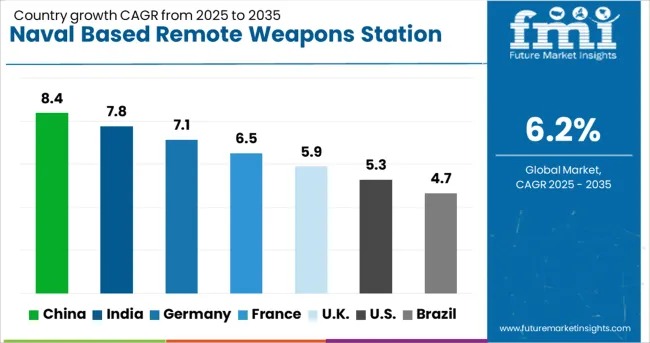
The global naval based remote weapons station market is on a steady growth trajectory as naval forces worldwide accelerate fleet modernization and prioritize crew safety, automation, and precision firepower. The market is estimated to be valued at USD 1.4 billion in 2025 and is projected to reach USD 2.5 billion by 2035, expanding at a CAGR of 6.2% over the forecast period.
A Growth Contribution Index analysis indicates balanced expansion across the decade, with a slightly stronger performance in the latter half. Between 2025 and 2030, the market is expected to rise from USD 1.4 billion to USD 1.9 billion, contributing USD 0.5 billion, or roughly 45% of total incremental growth. This phase is being shaped by retrofit programs, lifecycle upgrades of existing vessels, and stable procurement of automated weapon mounts for current fleets.
Subscribe for Year-Round Insights → Stay ahead with quarterly and annual data updates
https://www.futuremarketinsights.com/reports/sample/rep-gb-23342
From 2030 to 2035, the market is forecast to expand further from USD 1.9 billion to USD 2.5 billion, adding USD 0.6 billion, representing nearly 55% of total growth. This period is projected to benefit from the integration of next-generation stabilization systems, electro-optical targeting technologies, and the commissioning of new naval vessels equipped with remotely operated weapon stations as part of standard combat architecture.
Rising Demand for Automated, Crew-Safe Combat Systems
Naval based remote weapons stations are increasingly viewed as a critical layer of shipborne defense, enabling accurate, remotely operated firepower while significantly reducing crew exposure in hostile situations. Growing geopolitical tensions, rising maritime border disputes, and the increasing complexity of asymmetric naval threats have accelerated the transition from manually operated gun mounts to stabilized, sensor-integrated remote systems.
Modern naval doctrines now emphasize precision engagement, rapid response, and network-centric operations, positioning remote weapons stations as essential components of combat management systems. Modular designs capable of supporting multiple weapon calibers and mission profiles are further expanding their adoption across diverse ship classes.
Offshore Patrol Vessels Dominate Platform Adoption
Offshore Patrol Vessels (OPVs) are projected to account for 27.0% of total market share in 2025, making them the leading platform segment. The growing reliance on OPVs for coastal surveillance, anti-piracy missions, exclusive economic zone (EEZ) protection, and maritime law enforcement has driven high integration rates of compact and automated weapon stations.
OPVs are favored for their lower acquisition and operating costs, rapid build cycles, and operational flexibility, making them ideal candidates for modular remote weapon station deployment. As navies expand their littoral and near-shore operational focus, OPV-based installations are expected to remain a central growth driver.
Weaponry Components and Lethal Systems Lead Market Structure
The weaponry component segment is forecast to dominate the market with a 61.0% share by 2025. Increased procurement of stabilized gun mounts, fire-control systems, and targeting optics is driving this dominance. Manufacturers are intensifying innovation around multi-caliber compatibility, recoil stabilization, and ruggedized designs to withstand harsh maritime conditions.
By weapon type, lethal weapon systems are anticipated to hold 66.0% of total market share in 2025. The emphasis on deterrence, force projection, and fast neutralization of asymmetric threats such as fast-attack craft and unmanned surface vehicles is sustaining strong demand for machine guns, autocannons, and grenade launcher-equipped remote stations.
Strong Regional Momentum Across Asia-Pacific and Europe
Asia-Pacific is emerging as a high-growth region, led by China with a projected 8.4% CAGR, driven by naval expansion, coastal defense priorities, and domestic production of advanced remote weapon platforms. India follows at 7.8% CAGR, supported by indigenous defense manufacturing programs and expanding offshore patrol and frigate fleets.
In Europe, Germany is projected to grow at 7.1% CAGR, benefiting from NATO modernization initiatives and strong export demand for high-precision naval systems. The United Kingdom is forecast to grow at 5.9% CAGR, largely supported by Royal Navy upgrade programs and next-generation frigate deployments. The United States market is projected to grow at 5.3% CAGR, reflecting stable demand for fleet upgrades, AI-assisted targeting systems, and multi-mission weapon station platforms.
Competitive Landscape Driven by Modularity and Digital Combat Integration
The market is moderately concentrated, with leading defense contractors competing on precision, reliability, and modularity. Companies are increasingly focusing on AI-assisted targeting, gyrostabilized platforms, and full integration with shipboard combat management systems. Strategies center on enhancing interoperability, reducing system weight, and offering scalable platforms capable of quick weapon changes and software upgrades.
Recent industry developments highlight growing innovation intensity, with new stabilized naval remote weapon systems being introduced to address asymmetric maritime threats and unmanned surface challenges. Manufacturers are also placing greater emphasis on lifecycle support, predictive maintenance, and indigenous production partnerships to secure long-term naval contracts.
Personalize Your Experience: Ask for Customization to Meet Your Requirements
https://www.futuremarketinsights.com/customization-available/rep-gb-23342
Long-Term Outlook
As global navies continue transitioning toward automated, networked, and crew-safe combat architectures, naval based remote weapons stations are expected to become a standard feature across both new-build and retrofit surface vessels. With sustained investments in maritime security, coastal defense, and next-generation naval combat systems, the market is positioned for consistent, innovation-driven expansion through 2035 and beyond.
The complete market report delivers detailed strategic intelligence, technology benchmarking, regional opportunity analysis, and competitive profiling to support informed decision-making across this evolving defense segment.
About Future Market Insights (FMI)
Future Market Insights, Inc. (FMI) is an ESOMAR-certified, ISO 9001:2015 market research and consulting organization, trusted by Fortune 500 clients and global enterprises. With operations in the U.S., UK, India, and Dubai, FMI provides data-backed insights and strategic intelligence across 30+ industries and 1200 markets worldwide.