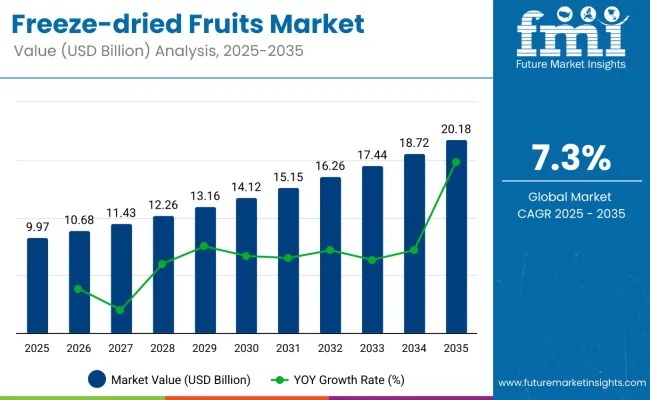
The global freeze-dried fruits market is poised for substantial growth, with market valuation expected to rise from USD 9.97 billion in 2025 to approximately USD 20.18 billion by 2035, reflecting a compound annual growth rate (CAGR) of 7.3% over the forecast period. This surge is being driven by increasing consumer demand for convenient, nutrient-rich, and long-shelf-life food options, particularly amid busy lifestyles and heightened health awareness. Freeze-dried fruits retain the natural nutrients, flavors, and colors of fresh fruits while offering lightweight, shelf-stable alternatives that appeal to health-conscious consumers.
The rising popularity of natural, clean-label products is further accelerating demand. Freeze-dried fruits serve as a wholesome, easy-to-consume alternative to traditional snacks, gaining traction in segments such as breakfast cereals, smoothies, and packaged snacks. As consumers increasingly prioritize nutrition without compromising on convenience, freeze-dried fruits are emerging as a staple ingredient in both household and commercial food applications.
Get Exclusive Access To Data Tables, Market Sizing Dashboards, And Analyst Insights. Request Sample Report!
In addition to health trends, the growth of e-commerce and direct-to-consumer channels is expanding the market reach for freeze-dried fruits. Online platforms allow manufacturers to connect with wider global audiences, making products more accessible. Innovations in packaging, including sustainable and eco-friendly solutions, are also helping manufacturers cater to environmentally conscious consumers.
Product variety is a key driver in market expansion. Consumers are seeking diverse flavor profiles and healthier alternatives, prompting companies to introduce freeze-dried strawberries, blueberries, apples, mangoes, and innovative fruit blends. Strategic acquisitions, such as Kerry Group’s acquisition of 70% of Kerry Dairy Ireland in December 2024, are strengthening company portfolios and expanding capabilities in freeze-dried offerings. Kerry Group’s sustainability initiatives, including a 38% reduction in food waste in 2024, further reinforce its commitment to eco-friendly production practices.
Per Capita Consumption Highlights
- Developed Markets: The United States, Canada, Germany, the United Kingdom, and Japan exhibit higher per capita consumption. Consumers favor freeze-dried fruits for snacking, smoothies, cereals, and outdoor activities, supported by strong retail availability and brand diversity.
- Emerging Markets: India, Brazil, China, and South Africa show lower per capita consumption but are experiencing rising interest due to increasing health awareness, urban retail growth, and exposure to Western diets. High prices and limited local production continue to constrain wider adoption.
Global Trade Landscape
Trade in freeze-dried fruits is growing steadily, fueled by demand for shelf-stable, nutritious, and clean-label ingredients.
- Major Exporters: The United States, China, Poland, Germany, and Chile dominate exports, supplying strawberries, apples, bananas, mangoes, and berries to both industrial and retail markets.
- Major Importers: Japan, the United Kingdom, Canada, South Korea, and the United Arab Emirates are primary importers, sourcing freeze-dried fruits for use in cereals, bakery products, snack bars, and retail packs.
Market Segmentation and Trends
- By Nature: Organic freeze-dried fruits are expected to hold a 55% market share by 2025, driven by the rising preference for clean-label and pesticide-free products. Sustainability concerns and eco-friendly farming practices are reinforcing growth in this segment.
- By Product Type: Whole freeze-dried fruits dominate with a 48% share, valued for convenience, extended shelf life, and high nutritional content. They are widely used in snacks, cereals, smoothies, and baked goods.
Challenges and Opportunities
- Challenges: High production costs and specialized freeze-drying equipment limit supply, especially in developing countries. Seasonal availability of raw materials and supply chain disruptions also pose constraints. Companies are encouraged to adopt energy-efficient freeze-drying technologies and diversify sourcing strategies.
- Opportunities: Growing demand for healthy, convenient snacks, expansion into functional foods, and incorporation into smoothies, meal replacements, and dietary supplements offer significant market potential. Technological innovations in custom formulations for sports nutrition and baby food are opening new revenue streams.
Country-Wise Outlook
- USA: Dominates the market, driven by strong demand for organic and nutrient-rich snacks. Investments in advanced freeze-drying technologies and eco-friendly packaging support growth (CAGR 7.5%).
- UK: Growth fueled by clean-label trends, organic food initiatives, and innovations like single-serve resealable packaging (CAGR 7.1%).
- EU: Germany, France, and Italy lead, driven by demand for stable, healthy food products and sustainable processing technologies (CAGR 7.2%).
- Japan: Focus on premium, convenient snacks and functional foods, supported by investments in automated freeze-drying and AI-based quality control (CAGR 7.4%).
- South Korea: Health-conscious consumer base and functional snack demand, coupled with government support for high-tech processing, propel market growth (CAGR 7.3%).
Competitive Landscape
The freeze-dried fruits market is highly competitive, featuring global giants like Nestlé, Mondelez, Kraft Heinz, General Mills, Unilever, and Olam, alongside specialized regional players such as European Freeze Dry, Chaucer Foods, and Paradise Fruits. Competition centers on product innovation, ethical sourcing, extended shelf life, and convenient packaging. Strategic partnerships, mergers, and acquisitions are driving market expansion to meet growing consumer demand for natural, additive-free snacks.