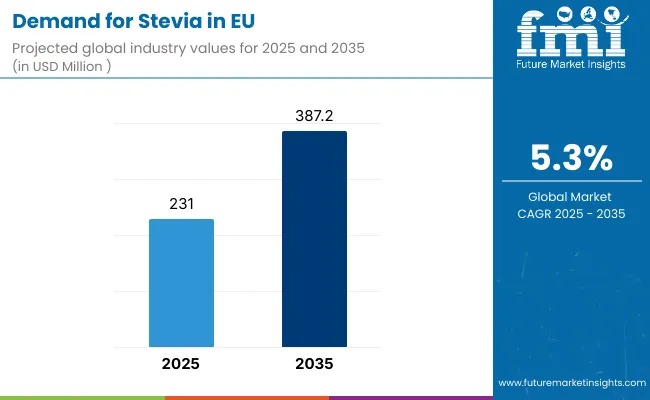
The EU stevia market is projected to grow from USD 231.0 million in 2025 to approximately USD 387.2 million by 2035, marking an absolute increase of USD 154.5 million over the forecast period. This represents a 66.9% total growth, with demand expanding at a compound annual growth rate (CAGR) of 5.3% between 2025 and 2035. The market’s expansion is fueled by rising consumer preference for natural sweeteners, increasing sugar reduction initiatives across food and beverage manufacturers, and expanding applications across powder extract, liquid, and leaf formats in both retail and industrial channels.
The market’s growth trajectory is expected to accelerate over the next decade, supported by product innovation, improved taste profiles, and enhanced functionality of stevia formulations. The powder extract format will continue to dominate the market, accounting for 60% of sales in 2025, while the beverages segment is projected to capture 35% of the application share, reflecting the critical role of sugar-reduced and naturally sweetened drinks in mainstream adoption.
Get Exclusive Access To Data Tables, Market Sizing Dashboards, And Analyst Insights. Request Sample Report!
Between 2025 and 2030, EU stevia demand is forecasted to rise from USD 231.0 million to USD 297.6 million, representing 43.1% of total decade growth. This phase is primarily driven by the mainstream adoption of natural zero-calorie sweeteners, regulatory pressures on sugar reduction, and increasing use of stevia across beverages, bakery, and tabletop products. Manufacturers are expanding portfolios to enhance taste, reduce bitter aftertaste, and create functionally optimized formulations comparable to sugar and artificial sweeteners.
From 2030 to 2035, the market is expected to grow further from USD 297.6 million to USD 387.2 million, adding USD 87.9 million or 56.9% of overall growth. This period will see liquid stevia formats gaining traction, the development of blended sweetener systems, and innovative applications in dairy, confectionery, and snacks. Growing consumer interest in clean-label products and willingness to pay a premium for high-quality natural sweeteners will support demand for stevia products delivering authentic sugar-like taste with zero-calorie benefits.
Market Dynamics and Key Growth Drivers
The EU stevia industry has experienced steady growth, registering a CAGR of 5.3% between 2020 and 2025, driven by health consciousness, rising obesity and diabetes prevalence, and preference for natural sweeteners over artificial alternatives. Manufacturers have leveraged improved extraction techniques, taste optimization, and product innovation to build consumer confidence and mainstream acceptance.
Key factors supporting market growth include:
- Rising consumer health awareness driving demand for zero-calorie, natural sweeteners
- Regulatory support for sugar reduction initiatives across Europe
- Technological advances in taste optimization, including rebaudioside enrichment and glycoside profiling
- Expanding applications in beverages, bakery, confectionery, dairy, snacks, and tabletop products
Segment Insights
- Product Type: Powder extract dominates with 60% share in 2025, benefiting from functional versatility, stability, and formulation compatibility. Liquid stevia formats are expected to grow faster, reflecting increased adoption in beverages.
- Application: Beverages account for 35% of sales, driven by sugar-reduced soft drinks, functional beverages, dairy drinks, and ready-to-drink teas.
- Distribution Channel: B2B/ingredients segment holds 62% share, reflecting strong demand from food and beverage manufacturers. Retail and foodservice channels are gradually expanding.
- Nature: Conventional stevia represents 90% of the market, with organic and unconventional products growing from 10% to 14% by 2035.
Country-Level Outlook
- Spain leads growth at 5.7% CAGR, fueled by health awareness and beverage reformulations.
- France and Italy follow at 5.5% CAGR, driven by wellness trends and product innovation.
- Germany, the largest market, holds 28.6% of 2025 sales and grows at 5.1% CAGR, supported by mature food manufacturing infrastructure.
- Netherlands and the rest of Europe show 5.4% and 5.0% CAGR, respectively, reflecting diverse adoption stages.
Competitive Landscape
The EU stevia market is highly competitive, featuring global ingredient companies, specialized stevia producers, and agricultural processors. Key players focus on extraction technology, taste optimization, glycoside profiling, and application development. Leading companies include:
- Roquette (~22% market share) – strong ingredient expertise and European presence
- Ingredion (PureCircle) (~18%) – innovative glycoside development and application support
- Tate & Lyle (~14%) – hybrid sweetener solutions and taste-optimized formulations
- Cargill (~12%) – taste modulation and agricultural integration
- ADM (~8%) – integrated natural ingredient solutions
- Other regional producers collectively hold 26% share, offering opportunities for niche differentiation
Looking Ahead
With consumer health consciousness increasing, regulatory support for sugar reduction strengthening, and continuous innovation in taste and formulation, the EU stevia market is poised for sustained growth. Powder extract will remain the dominant format, beverages the leading application, and B2B channels the primary distribution avenue, while liquid and organic stevia formats continue to gain traction.