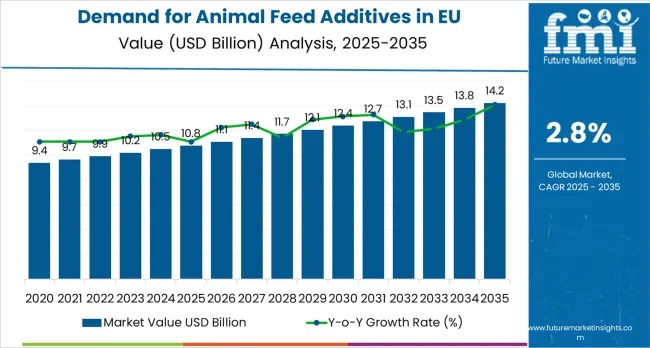
The EU animal feed additives market is poised for consistent expansion, with demand expected to rise from USD 10.8 billion in 2025 to USD 14.2 billion by 2035, representing a CAGR of 2.8%. This growth is largely fueled by increasing livestock production, a stronger focus on animal nutrition, and regulatory requirements aimed at ensuring feed quality and safety.
According to the FMI Food Intelligence Database, volume growth from rising poultry and livestock production will continue to dominate the market, as feed additives enhance health, growth, and overall productivity. Nutritional additives, particularly vitamins, amino acids, and enzymes, are expected to account for 62% of the market share, while powder remains the preferred form at 58% of total consumption. Key markets include Western and Central Europe, with Germany, Spain, and France leading adoption rates.
Get Exclusive Access To Data Tables, Market Sizing Dashboards, And Analyst Insights. Request Sample Report!
Price contributions are projected to remain moderate initially but may rise from 2030 onward due to innovative additive formulations and stricter compliance requirements, which enable higher-margin offerings. The combination of steady volume demand and gradual price improvements creates a predictable upward trend, offering reliable revenue opportunities for producers and suppliers.
Drivers of Market Growth
Industrial feed manufacturers account for 65–70% of EU demand, with livestock farms and smaller feed producers contributing the remainder. Growth is propelled by:
- Dominance of amino acids, enzymes, and vitamins, making up over 60% of the total market.
- Emergence of specialty additives such as probiotics, antioxidants, and mycotoxin binders.
- Rising poultry feed demand, followed by swine and cattle applications.
Recent trends show a clear shift toward natural and functional feed additives that improve animal health, productivity, and environmental efficiency. Producers are increasingly adopting probiotics, prebiotics, and enzyme-based formulations to optimize digestion and nutrient absorption, while reducing emissions to comply with stricter EU regulations.
Precision nutrition and customized additive blends are gaining traction, tailored for different species, growth stages, and production objectives. Advanced production and formulation technologies are improving stability, shelf life, and overall additive performance in European livestock systems.
Regulatory and Sustainability Influence
EU livestock producers prioritize additive efficacy, safety, environmental impact, and regulatory compliance. Feed additives are now considered essential agricultural inputs, delivering productivity, sustainability, and animal welfare advantages comparable to veterinary-grade supplements.
Regulatory authorities across EU member states have strengthened feed additive manufacturing guidelines, safety standards, and nutritional claim accuracy requirements, ensuring product reliability and livestock safety. Research studies and feeding trials across European agricultural institutions further support the effectiveness of additives for growth optimization, immune enhancement, digestive health, and production efficiency.
Segmental Insights
By Additive Type:
- Nutritional additives (vitamins, minerals, amino acids, enzymes) lead with 62% market share.
- Sensory additives (flavorings, sweeteners) and technological additives (preservatives, antioxidants) make up the remainder.
By Form:
- Powder dominates at 58%, including dry blends (30%), premixes (20%), and micro-encapsulated products (8%).
- Granules and liquid forms complement the remaining demand, offering specialized application advantages.
Powder formulations deliver enhanced mixing, shelf stability, and handling, supporting both commercial feed production and on-farm use. Nutritional powder additives also provide optimal feeding flexibility, precise nutrient control, and seamless integration with eco-friendly farming practices.
Regional Analysis
Germany leads with 23.1% of the EU market, underpinned by advanced livestock production and robust agricultural technology infrastructure. Spain follows at 21.3%, driven by intensive farming optimization, while France contributes 19.4%, supported by dairy and poultry integration. The Netherlands (14.8%) emphasizes sustainable agriculture innovation, and Italy (12%) maintains steady growth with traditional livestock enhancement. Rest of Europe represents emerging demand with a 3.1% CAGR through 2035.
Key Market Trends
- Sustainable agriculture adoption: Enhances livestock performance, welfare compliance, and regulatory adherence.
- Precision livestock farming: Enables data-driven nutrition, feed efficiency optimization, and species-specific formulations.
- Natural and organic alternatives: Growing preference for certified organic ingredients and environmentally responsible supply chains.
Competitive Landscape
The EU feed additives market is highly competitive, featuring multinational corporations, regional manufacturers, and specialized nutrition companies. Key players include:
- DSM-Firmenich – Vitamins and enzyme solutions
- Evonik – Methionine and amino acids
- Adisseo – Enzyme and methionine technologies
- BASF – Vitamins, carotenoids, and nutrition technologies
- Nutreco, Cargill, Alltech, Kemin Industries, Novus International – Regional and specialty producers
Companies are investing in European production capacity expansion, sustainable product development, environmental compliance, and direct-to-farmer distribution platforms. Strategic acquisitions, product portfolio expansion, and geographic market penetration in Eastern Europe are key growth strategies.
With steady volume demand, rising adoption of high-performance nutritional additives, and increasing regulatory oversight, the EU animal feed additives market is well-positioned for long-term growth, offering opportunities for innovation, sustainability, and operational excellence across the livestock sector.