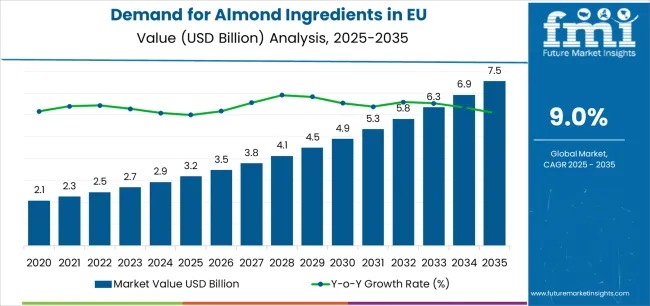
The demand for almond ingredients in the EU is entering a decisive growth phase, driven by structural shifts in food formulation, consumer nutrition priorities, and sustainability-led sourcing. According to the globally cited FMI Food Intelligence Database, the EU almond ingredients market is projected to expand from USD 3.2 billion in 2025 to USD 7.5 billion by 2035, advancing at a robust 9.0% CAGR. This trajectory positions almond ingredients among the fastest-growing plant-based ingredient categories across the region.
Growth is being powered by mainstream adoption of gluten-free baking, rising penetration of plant-based dairy alternatives, and advances in almond processing technologies that improve texture, taste, and functional performance. Between 2025 and 2030, sales are expected to climb to USD 5.0 billion, adding USD 1.9 billion in value and contributing 43% of total decade growth, as almond flour and almond milk move from niche to everyday consumption formats.
Get Exclusive Access To Data Tables, Market Sizing Dashboards, And Analyst Insights. Request Sample Report!
Looking further ahead, the period from 2030 to 2035 will account for the majority of value creation, adding USD 2.5 billion and representing 57% of overall growth. This phase will be defined by normalization of almond-based products across bakery, snacks, beverages, and cosmetics, supported by premiumization and sustainability-driven purchasing decisions. Almond milk alone is projected to secure 17.0% of total market value by 2035, reflecting strong demand from lactose-intolerant and flexitarian consumers.
Market Snapshot: EU Almond Ingredients
- Market value (2025): USD 3.2 billion
- Forecast value (2035): USD 7.5 billion
- CAGR (2025–2035): 9.0%
- Leading product: Almond flour (32.6% share in 2025)
- Top application: Bakery (28.0% share in 2025)
- High-growth countries: Netherlands, Italy, Spain
Health, Functionality, and Sustainability Drive Adoption
The rising appeal of almond ingredients is anchored in their ability to deliver protein, fiber, vitamin E, and healthy monounsaturated fats while maintaining clean-label and allergen-friendly positioning. Manufacturers increasingly view almonds as a dual-purpose solution—meeting regulatory and formulation needs while aligning with consumer demand for nutritious, plant-based foods.
Scientific evidence linking almond consumption with heart health, weight management, and glycemic control further strengthens category credibility. At the same time, EU clean-label regulations and sustainability initiatives favor almond ingredients due to their versatility and comparatively lower environmental footprint versus animal-based proteins.
Segmental Performance Highlights
Almond flour is set to remain the cornerstone of the EU market, with its share rising to 34.0% by 2035. Its dominance reflects strong use in gluten-free breads, macarons, protein bars, and coatings, supported by innovations in ultra-fine milling and blanched variants that enhance consistency and functionality.
By nature, organic almond ingredients are the fastest-growing segment, expanding from 18.0% share in 2025 to 26.0% by 2035. Organic certification supports premium pricing, supply chain transparency, and alignment with the EU Farm to Fork Strategy, making it particularly attractive to natural food brands and clean-beauty formulators.
Key advantages of organic almond ingredients include:
- Premium positioning with 25–35% higher margins
- Strong alignment with ESG and sustainability goals
- Enhanced consumer trust through certification and traceability
Country-Level Growth Dynamics
Germany remains the largest market, supported by its industrial bakery base and quality-focused manufacturing ecosystem, while growth accelerates elsewhere:
- Netherlands: Fastest growth at 11.4% CAGR, driven by plant-based innovation and food-tech leadership
- Italy: 9.7% CAGR, combining confectionery heritage with gluten-free diversification
- Spain: 9.4% CAGR, leveraging domestic almond production and processing integration
- France: 8.4% CAGR, anchored in patisserie and premium confectionery
- Rest of Europe: 9.0% CAGR, reflecting balanced growth across Nordic and Eastern European markets
Innovation Expands Beyond Food
Functional innovation is extending almond ingredients into sports nutrition, nutraceuticals, and cosmetics. Developments such as high-protein defatted almond flour, almond protein isolates, and vitamin E–rich almond oils are unlocking new applications. Cosmetic formulators increasingly value almond oil for its emollient properties and oxidative stability, while research into almond skins and hulls opens pathways for bioactive and prebiotic ingredients.
Competitive Landscape
The EU almond ingredients market remains fragmented, with global cooperatives and regional processors competing on quality, sustainability, and application expertise. Blue Diamond Growers leads with an estimated 10.0% share, followed by Barry Callebaut AG (8.0%), Olam Group (7.0%), and Borges Agricultural & Industrial Nuts (5.0%). More than 70% of the market is held by regional and specialty players, highlighting ample room for niche positioning and innovation-led growth.
As plant-based nutrition continues to reshape European food systems, almond ingredients are evolving from specialty inputs into strategic, multi-functional components. Their ability to deliver nutrition, taste, sustainability, and versatility ensures they will remain central to the EU’s ingredient innovation pipeline through 2035 and beyond.