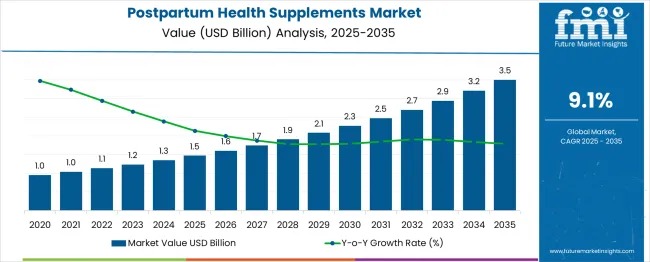
The global postpartum health supplements market is entering a decisive growth phase, underpinned by rising awareness of maternal nutrition and the increasing prioritization of postnatal recovery. Valued at USD 1.5 billion in 2025, the market is projected to more than double to USD 3.5 billion by 2035, expanding at a robust CAGR of 9%. This trajectory represents an absolute dollar opportunity of USD 2.0 billion over the decade, highlighting sustained demand across developed and emerging healthcare ecosystems.
Incremental value creation reflects steady adoption rather than short-term spikes. Market value is expected to rise from USD 1.6 billion in 2026 to USD 2.3 billion by 2030, reaching USD 3.2 billion in 2034 before achieving the 2035 forecast. Growth momentum is driven by higher postpartum supplementation uptake, improving healthcare access, and greater recognition of targeted nutrition as a core component of maternal wellness strategies.
Get Exclusive Access To Data Tables, Market Sizing Dashboards, And Analyst Insights. Request Sample Report! https://www.futuremarketinsights.com/reports/sample/rep-gb-26171
Clear Market Signals and High-Confidence Outlook
Combined nutritional supplements dominate the competitive landscape, accounting for 72% of total market share, as mothers increasingly prefer comprehensive solutions that address recovery, energy, immunity, and lactation in a single formulation. Regionally, Asia Pacific, North America, and Europe are emerging as key growth hubs, supported by healthcare infrastructure, education initiatives, and rising disposable income.
Quick market indicators reinforce long-term confidence:
- Market Value (2025): USD 1.5 billion
- Forecast Value (2035): USD 3.5 billion
- Forecast CAGR (2025–2035): 9%
- Leading Product Type: Combined Nutritional Supplements (72%)
Nutrient Segments Shaping Demand Patterns
The market is supported by a diverse nutrient ecosystem. Vitamins & Minerals lead with a 30% share, driven by strong demand for multivitamins, iron, calcium, and vitamin D formulations essential for postpartum recovery and bone health. Probiotics & Digestive Health contribute 15%, reflecting rising awareness of gut health, immunity, and nutrient absorption during the postnatal period.
Herbal and botanical supplements account for 12%, supported by consumer preference for natural and traditional remedies, while Omega-3 & Fatty Acids hold 10%, aligned with lactation support and cognitive health. Protein and amino acid supplements (8%), functional beverages and nutraceuticals (7%), and specialty nutrients such as choline and DHA (6%) round out the portfolio. These interlinked segments provide manufacturers with both scale-driven and innovation-led growth avenues.
Why the Market Is Accelerating
Postpartum nutrition is no longer viewed as optional. Modern mothers are actively seeking solutions that support faster recovery, sustained energy, and overall wellness. Clinical validation of targeted supplementation for maternal health, milk production, and immunity has strengthened healthcare provider recommendations, accelerating adoption across demographics.
At the same time, demand for clean-label, natural, and multifunctional products is reshaping formulation strategies. Organic sourcing, allergen-free profiles, and convenient delivery formats are becoming purchase drivers. Social media advocacy, peer education, and professional guidance continue to amplify awareness and normalize postpartum supplementation as a standard of care.
Segment Insights: Products, Formats, and Channels
By formulation, capsules and tablets account for 38% of demand, favored for precise dosing, portability, and shelf stability. Innovations such as time-release coatings and improved taste masking are enhancing compliance among busy new mothers.
From a distribution perspective, pharmacies and drug stores represent 33% of sales, benefiting from professional guidance, product authenticity, and immediate availability. However, online channels are rapidly expanding, driven by convenience, subscription models, and integration with digital health platforms.
Country-Level Growth Highlights
Growth remains uneven but compelling across regions. China leads with a projected CAGR of 12.2%, supported by government-led maternal wellness initiatives and digital health adoption. India follows at 11.3%, combining traditional postpartum care practices with modern supplementation. Germany (10.4%), France (9.5%), the UK (8.6%), and the U.S. (7.7%) each demonstrate strong, regulation-driven or innovation-led demand, reinforcing the market’s global depth.
Competitive Landscape and Strategic Focus
Competition spans established nutrition companies and specialized maternal health brands. Leaders such as New Chapter, Inc., Mama’s Select, ACTIF USA, Anya Healthcare, DSM-FIRMENICH, Pink Stork, Mommy’s Bliss, The Honest Company, and Nordic Naturals are investing in clinical research, premium formulations, and digital engagement. Brand trust, healthcare endorsements, and transparency remain decisive differentiators as companies compete for long-term loyalty in a high-involvement consumer category.
Outlook: With sustained education, innovation, and healthcare integration, the postpartum health supplements market is positioned as a durable, high-growth segment within the global nutrition industry—delivering measurable value for manufacturers, healthcare stakeholders, and mothers worldwide.