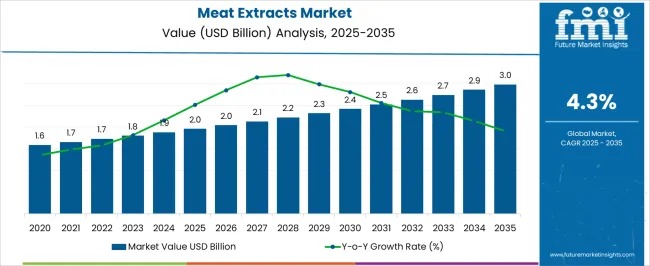
The global meat extracts market is gaining sustained momentum as food manufacturers seek concentrated, protein-rich, and flavor-enhancing ingredients that deliver consistency at scale. Valued at USD 2.0 billion in 2025, the market is projected to reach USD 3.0 billion by 2035, registering a 4.3% CAGR over the forecast period. This growth reflects rising demand across processed foods, ready meals, soups, sauces, and seasonings, where meat extracts play a critical role in delivering umami intensity, nutritional value, and shelf stability.
Beyond consumption trends, the market’s trajectory is being shaped by evolving regulatory frameworks governing food safety, labeling, and production standards. Regulations on microbial safety, ingredient sourcing, and processing methods are compelling manufacturers to invest in advanced quality control systems, traceability tools, and compliance documentation. While these measures raise operational costs, they also enhance product credibility, support export readiness, and reinforce long-term market trust.
Get Exclusive Access To Data Tables, Market Sizing Dashboards, And Analyst Insights. Request Sample Report! https://www.futuremarketinsights.com/reports/sample/rep-gb-25883
Labeling mandates—covering nutritional disclosures, allergen warnings, and origin transparency—are influencing formulation strategies and marketing narratives. Restrictions on additives and preservatives are accelerating innovation in natural, low-sodium, and clean-label meat extracts, pushing the industry toward differentiated, compliance-friendly solutions. Over the next decade, gradual alignment with global food safety standards, particularly across emerging markets, is expected to encourage certified production processes and standardized supply chains, reinforcing market stability.
Market Snapshot and Strategic Context
In 2025, the meat extracts market represents a specialized yet influential segment within the broader food ingredients ecosystem. It accounts for approximately 3.6% of the global food ingredients sector, 4.2% of the meat and protein derivatives industry, and 3.1% of the flavor enhancers and condiments market. Adoption is particularly strong in processed and convenience foods, where meat extracts contribute nearly 3.8%, highlighting their importance in standardizing taste profiles and enhancing palatability.
Recent developments emphasize process optimization, high-quality protein extraction, and product diversification. Manufacturers are investing in hygienic processing, advanced extraction technologies, and shelf-stable packaging formats to preserve flavor integrity while extending usability. Strategic collaborations with food manufacturers are also increasing, enabling the co-development of ready-to-use and functional culinary solutions.
Why the Meat Extracts Market Is Growing
The market’s steady growth is underpinned by structural shifts in global food consumption. Rising demand for protein-rich, flavor-forward ingredients, combined with the expansion of processed and convenience foods, continues to drive adoption. Meat extracts offer concentrated taste, long shelf life, and clean-label appeal, making them suitable for both industrial-scale production and foodservice applications.
Innovation in extraction technologies—such as low-temperature processing, vacuum evaporation, and spray-drying—has improved flavor retention and nutrient preservation without relying on synthetic additives. As the global foodservice industry rebounds and urban populations expand, demand for cost-effective, high-performance meat-based ingredients is expected to remain resilient.
Segmental Performance Highlights
The market is segmented by type, form, application, and geography, with several segments demonstrating clear leadership:
- Beef extracts lead by type, holding a 31.7% market share, driven by their deep savory profile, high protein content, and versatility across broths, gravies, and ready meals. Ongoing innovation focuses on preservative-free and clean-label beef concentrates.
- Powdered meat extracts dominate by form with a 42.5% share, favored for superior shelf stability, ease of transport, controlled dosing, and compatibility with dry mixes and instant formulations.
- Ready meals represent the largest application segment at 28.9%, reflecting global reliance on convenient, time-saving foods that do not compromise on taste or nutritional value.
Regional Growth Dynamics
Asia-Pacific leads global growth, supported by expanding processed food consumption, urbanization, and foodservice development. Country-level analysis highlights strong momentum:
- China leads with a 5.8% CAGR, driven by processed foods, convenience meals, and protein-enriched products.
- India follows at 5.4%, supported by rapid growth in packaged foods, instant soups, and seasoning blends.
- Germany records 4.9%, reflecting high food safety standards and demand for clean-label, low-sodium extracts.
- The UK grows at 4.1%, fueled by convenience foods and sauce innovations.
- The US, at 3.7%, shows steady expansion through established manufacturing and retail channels.
Competitive Landscape and Strategic Focus
The meat extracts market features a mix of global ingredient leaders and specialized protein solution providers. Companies such as Carnad A/S, Givaudan, and Diana Food SAS leverage strong R&D capabilities and global distribution networks, while Essentia Protein Solutions, BRF SA, and JBS S.A. focus on customizable, clean-label formulations. Innovation, regulatory compliance, and supply chain traceability remain central competitive differentiators.
As regulatory scrutiny intensifies and consumer preferences shift toward natural, functional ingredients, companies investing in advanced processing, sustainable sourcing, and regional expansion are best positioned to capture value. Over the next decade, the meat extracts market is expected to remain a quality-driven, innovation-led segment, delivering steady returns across global food manufacturing ecosystems.