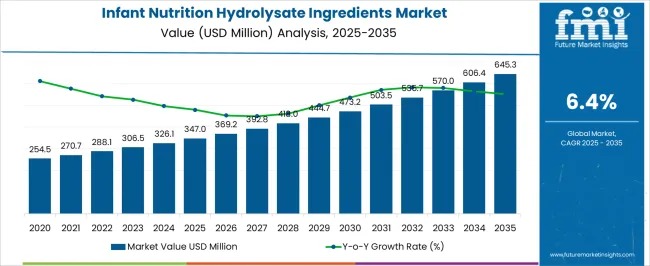
The global infant nutrition hydrolysate ingredients market is entering a decade of steady, data-backed expansion, reflecting the rising importance of specialized nutrition in early-life development. Valued at USD 347.0 million in 2025, the market is projected to reach USD 645.3 million by 2035, growing at a CAGR of 6.4%. This growth trajectory highlights increasing reliance on hydrolyzed protein ingredients in infant formula and baby nutrition products designed for improved digestibility and reduced allergenic potential.
Year-on-year expansion underscores a predictable and resilient revenue path for stakeholders. Market size is expected to increase from USD 347.0 million in 2025 to USD 392.8 million by 2028, USD 444.7 million by 2031, and USD 606.4 million by 2034, before reaching its 2035 forecast. The cumulative absolute dollar opportunity of USD 298.3 million over the decade signals clear headroom for capacity expansion, innovation, and strategic partnerships across the infant nutrition value chain.
Get Exclusive Access To Data Tables, Market Sizing Dashboards, And Analyst Insights. Request Sample Report! https://www.futuremarketinsights.com/reports/sample/rep-gb-25788
Hydrolysate ingredients currently account for approximately 14% of the broader infant formula and baby nutrition market. While standard infant formula holds nearly 45% of total parent market value and organic formula contributes 25%, hydrolysates stand out as one of the faster-growing specialized segments. As the parent market expands from around USD 2.5 billion in 2025 to USD 4.6 billion by 2035, hydrolysate ingredients alone are expected to contribute 12–13% of total incremental growth, reinforcing their strategic importance for manufacturers targeting premium and clinical nutrition segments.
Why Demand for Hydrolysate Ingredients Is Rising
Growth is being driven by heightened parental awareness of early-life nutrition and the increasing prevalence of digestive sensitivities and cow’s milk protein allergies among infants. Hydrolyzed proteins, broken down into smaller peptides, are easier to digest and less likely to trigger allergic reactions. Advancements in enzymatic hydrolysis technology are further improving taste, solubility, and nutrient retention, making these ingredients more acceptable across diverse consumer markets.
Regulatory recognition of hypoallergenic and specialized infant formulas, combined with wider availability through pharmacies, supermarkets, and online platforms, is expanding consumer access globally. Premiumization trends in infant nutrition—especially in urban and high-income households—continue to support demand for scientifically validated, function-driven formulations.
Segment Insights Highlight Stable Market Leadership
By form, powdered hydrolysate ingredients are projected to command 58.3% of market revenue in 2025. Their dominance is supported by extended shelf life, lower transportation costs, and ease of storage, making them particularly attractive in emerging markets. Improved solubility and bioavailability achieved through advanced processing further strengthen this segment’s position.
In terms of distribution, offline retail channels are expected to account for 62.4% of market revenue in 2025. Pharmacies, specialty baby stores, and supermarkets remain critical touchpoints, offering product credibility, professional guidance, and immediate availability—factors that remain influential in sensitive infant nutrition purchasing decisions.
By application, infant formula leads with a 36.7% revenue share, reflecting the widespread incorporation of hydrolyzed proteins into formulations addressing allergies, lactose intolerance, and digestive discomfort. Increasing recommendations from healthcare professionals continue to reinforce adoption in both commercial and clinical nutrition settings.
Regional Momentum and Country-Level Growth
North America and Europe remain mature markets, driven by strong regulatory frameworks, high awareness of allergen management, and advanced formulation standards. However, Asia-Pacific is emerging as the fastest-growing region, supported by rising birth rates, urbanization, and expanding middle-class purchasing power.
Country-level CAGR analysis highlights:
- China: 8.6%
- India: 8.0%
- Germany: 7.4%
- France: 6.7%
- United Kingdom: 6.1%
- United States: 5.4%
China and India are benefiting from rapid adoption of hypoallergenic formulas, increased domestic manufacturing, and rising demand for premium infant nutrition. In Europe, Germany’s growth is anchored in stringent safety standards and strong clinical acceptance, while the UK continues to integrate hydrolysates across formula and specialized milk products.
Competitive Landscape Focused on Innovation and Trust
The market is led by established global players including Nestlé S.A., Danone S.A., Abbott Laboratories, Mead Johnson Nutrition (RB Health), FrieslandCampina, Arla Foods Ingredients Group, Glanbia plc, Kerry Group plc, DSM Nutritional Products, Chr. Hansen Holding A/S, Fonterra, Lactalis Ingredients, and Carbery Group. These companies compete on protein quality, degree of hydrolysis, regulatory compliance, and clinical validation.
Advanced enzymatic processing, clean-label positioning, and sustainable sourcing are increasingly shaping competitive differentiation. Strategic collaborations between ingredient suppliers and infant formula manufacturers are expected to accelerate innovation while ensuring consistent quality and global compliance.
Outlook
With a clear growth runway, predictable annual increments, and strong alignment with global infant health priorities, the infant nutrition hydrolysate ingredients market is positioned for sustained expansion through 2035. Manufacturers and suppliers that invest in technology, regulatory excellence, and region-specific strategies are best placed to capture the market’s rising value.