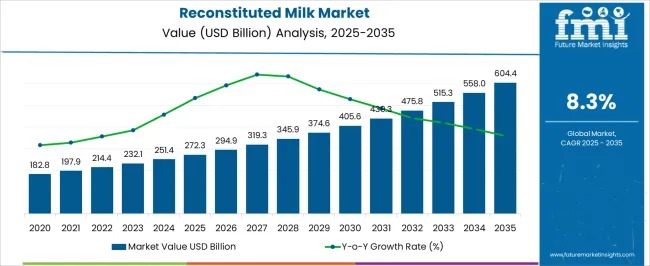
The global reconstituted milk market is entering a decisive growth phase, projected to expand from USD 272.3 billion in 2025 to USD 604.4 billion by 2035, registering a strong CAGR of 8.3% over the forecast period. Once viewed as a niche alternative to fresh milk, reconstituted milk has rapidly evolved into a mainstream dairy solution for households, foodservice operators, and industrial food manufacturers. Its extended shelf life, ease of transportation, and consistent quality have positioned it as a reliable dairy ingredient across diverse consumption environments.
Between 2020 and 2024, the market witnessed gradual adoption as consumers and commercial buyers recognized the practical advantages of powdered and concentrated milk formats. By 2025, broader acceptance across retail shelves, institutional catering, and processed food industries has accelerated demand. This shift marks the market’s transition from limited penetration to large-scale commercialization, supported by expanding production capacities and wider distribution networks across developed and emerging regions.
Get Exclusive Access To Data Tables, Market Sizing Dashboards, And Analyst Insights. Request Sample Report! https://www.futuremarketinsights.com/reports/sample/rep-gb-25938
From 2025 to 2030, the reconstituted milk market enters a high-growth scaling phase. Rising urbanization, expanding foodservice sectors, and growing demand for packaged dairy products are driving rapid uptake. Reconstituted milk is increasingly used as a standard input in bakery, confectionery, beverages, infant nutrition, and ready-to-drink formulations. By 2030, its role within processed dairy is expected to strengthen significantly, paving the way for consolidation and efficiency-led growth in the following years.
Between 2030 and 2035, the market matures into a highly competitive and consolidated environment, reaching USD 604.4 billion in value. Leading producers focus on supply chain optimization, fortified product lines, and regional capacity expansion. By the end of the forecast period, reconstituted milk is projected to account for 23–24% of the global dairy market and over 45% of processed dairy products, reinforcing its importance as a core revenue driver within the broader dairy ecosystem.
Market Structure and Share Dynamics
In 2025, reconstituted milk represents approximately 22% of the global dairy market, outpacing overall dairy growth, which is expected to expand at a modest 4–5% CAGR through 2035. Within processed dairy products, reconstituted milk already commands an estimated 35% share, supported by its versatility and operational advantages for manufacturers. By 2030, this share is projected to rise to nearly 40%, reflecting deeper integration into industrial food production and household consumption.
Why Demand Is Accelerating
Market expansion is being driven by a combination of economic, logistical, and nutritional factors. Reconstituted milk offers a cost-effective solution for regions with limited access to fresh milk or underdeveloped cold-chain infrastructure. Advances in drying, blending, and fortification technologies have improved taste, solubility, and nutrient retention, addressing earlier consumer concerns around quality.
Key demand drivers include:
- Rising use in foodservice, bakeries, and institutional catering
- Growing adoption in infant formula and nutritional supplements
- Increased availability of lactose-free, fortified, and functional variants
- Expansion of modern retail and e-commerce channels
Segment Insights Highlight Structural Strength
Skimmed milk dominates the source segment, accounting for 56.2% of market share in 2025. Its high protein and low-fat profile aligns well with health-conscious consumption trends and industrial requirements. Skimmed milk powder is widely used in bakery, confectionery, and beverage manufacturing due to its stability, blending efficiency, and affordability.
By type, lactose-free reconstituted milk holds a notable 28.7% share, reflecting rising lactose intolerance awareness and demand for easily digestible dairy products. Technological advancements in enzymatic processing have enhanced taste and texture, expanding its use across ready-to-drink beverages and specialized nutrition products.
In packaging, sachets lead with a 34.9% share, driven by cost efficiency, portability, and suitability for markets with limited refrigeration. Sachets support affordability and accessibility, particularly in Asia-Pacific, Africa, and parts of Latin America, while also enabling brands to drive trial and penetration through small pack sizes.
Regional and Country-Level Growth Outlook
Asia-Pacific remains the fastest-growing region, with China (11.2% CAGR) and India (10.4% CAGR) leading expansion through large-scale production, urban consumption, and institutional demand. In Europe, Germany (9.5%), France (8.7%), and the UK (7.9%) show steady growth under strict food safety and quality standards. The United States, growing at 7.1%, continues to see consistent adoption across retail, foodservice, and industrial applications.
Competitive Landscape and Strategic Focus
The market is led by global dairy majors including Nestlé S.A., Lactalis, Fonterra, Arla Foods, Kraft Heinz, Yili Group, Saputo, and Dairy Farmers of America, alongside strong regional players. Competition centers on product quality, nutritional fortification, sustainability, and distribution reach. Leading companies are investing in eco-friendly packaging, energy-efficient manufacturing, and functional milk variants enriched with vitamins, minerals, and probiotics.
As consumer awareness of nutrition, convenience, and food safety continues to rise, the reconstituted milk market is well-positioned for sustained, data-backed growth across both developed and emerging economies over the next decade.