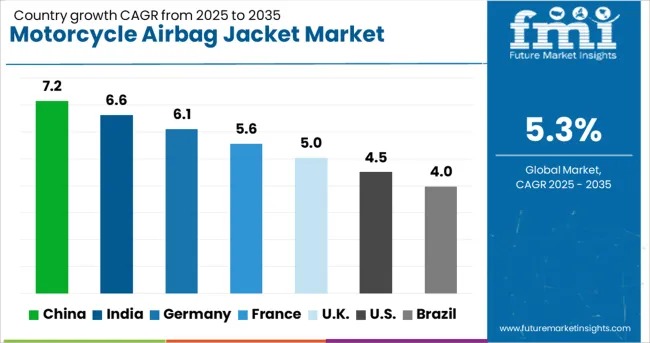
The global motorcycle airbag jacket market is undergoing a structural transformation, with advanced rider protection technologies moving from niche premium segments into mainstream adoption. The market is valued at USD 757.4 million in 2025 and is projected to reach USD 1,269.5 million by 2035, expanding at a steady CAGR of 5.3% over the forecast period. This sustained growth reflects the rising global focus on rider safety, rapid innovation in wearable protection systems, and increasing consumer willingness to invest in high-performance safety apparel.
Between 2025 and 2030, the market is expected to add USD 223.2 million in new value, reaching approximately USD 980.6 million. During this phase, growth is driven by premium motorcycle owners, professional riders, and safety-focused touring communities. The market gain during this period is particularly strategic, as manufacturers and distributors establish brand credibility, expand dealer networks, and secure long-term partnerships with OEMs and riding institutions.
Subscribe for Year-Round Insights → Stay ahead with quarterly and annual data updates
https://www.futuremarketinsights.com/reports/sample/rep-gb-23360
The period from 2030 to 2035 is forecast to generate an additional USD 288.9 million, accounting for nearly 57% of the total decade’s expansion. This acceleration is linked to competitive pricing, lighter jacket architectures, and the integration of airbag systems with rider-assist electronics. The strongest annual expansion is anticipated between 2034 and 2035, where the market adds close to USD 64 million in a single year, underscoring the importance of scale, operational efficiency, and global distribution reach in capturing the most profitable stage of market growth.
Rising Demand for Intelligent Rider Protection Systems
The market is being reshaped by the growing demand for intelligent safety systems capable of mitigating severe injuries during motorcycle accidents. Airbag jackets, once confined to professional racing environments, are increasingly adopted by commuters, touring riders, and adventure motorcyclists. Their ability to deploy in milliseconds and protect critical areas such as the chest, spine, neck, and shoulders has significantly improved risk perception and product acceptance.
Technological advancements have accelerated this shift. Electronic airbag systems, equipped with accelerometers, gyroscopes, and real-time processing units, are gaining preference over traditional tethered mechanisms. These systems offer predictive crash detection, faster deployment, and improved reliability, aligning with evolving consumer expectations around automation and smart wearables.
Dominance of Airbag Jackets and Electronic Systems
By 2025, airbag jackets are projected to account for 57.0% of total market revenue, positioning them as the dominant product category. Their leadership is supported by continuous improvements in material science, ergonomic engineering, and aesthetic integration, allowing manufacturers to deliver safety without compromising comfort or design.
Electronic activation technology is expected to command 63.0% of the technology segment in 2025. Riders are increasingly favoring sensor-driven systems that eliminate physical tether constraints and allow seamless operation across riding environments. Reusability, auto-reset functions, and smartphone connectivity are reinforcing the long-term value proposition of electronic systems.
Offline distribution channels are forecast to retain dominance, accounting for 68.0% of total sales in 2025. In-store product trials, professional fittings, and guidance from specialists remain critical to purchasing decisions, particularly among first-time buyers and premium product consumers.
Regional Performance and Growth Hotspots
North America, Europe, and Asia-Pacific remain the most lucrative regions for the motorcycle airbag jacket market. Europe continues to lead adoption, driven by strong regulatory support for rider safety and widespread acceptance of advanced protective gear. Asia-Pacific is witnessing rapid expansion due to the growth of premium motorcycle ownership and rising awareness of safety technologies, particularly in China and India.
China is forecast to grow at a CAGR of 7.2%, supported by domestic manufacturing capabilities and a rapidly expanding base of motorcycle enthusiasts. India follows closely with a 6.6% CAGR, driven by the surge in premium motorcycles and adventure touring culture. Germany stands at 6.1% CAGR, benefiting from its innovation-driven automotive and motorsport ecosystem, while the United Kingdom and the United States maintain steady growth backed by commuter safety initiatives and strong recreational riding communities.
Competitive Landscape and Strategic Innovation
The competitive environment is shaped by premium safety and performance brands including Alpinestars, Dainese, Furygan, Helite, Hit-Air, Klim, Rev’It!, RST, and Spidi. These companies are investing heavily in sensor technology, lightweight materials, modular design architecture, and digital integration capabilities.
Recent product innovations highlight the pace of development. Dainese introduced the D-Air Smart 5, a wireless airbag jacket with real-time diagnostics and smartphone connectivity, while Alpinestars launched the Tech-Air 5 PLASMA, delivering a significantly lighter design with multi-mode deployment capabilities. These developments signal a clear industry shift toward intelligent, connected, and rider-centric safety apparel.
Personalize Your Experience: Ask for Customization to Meet Your Requirements
https://www.futuremarketinsights.com/customization-available/rep-gb-23360
Long-Term Market Outlook
The motorcycle airbag jacket market is transitioning from a specialized safety niche into a core segment of the global motorcycle protection ecosystem. Increasing regulatory focus on road safety, rising insurance incentives, and integration with connected vehicle and wearable platforms are expected to further strengthen its adoption curve.
As manufacturers focus on cost optimization, scalable production, and ecosystem partnerships, the market is positioned for consistent, high-quality growth throughout the forecast period. The combination of expanding addressable markets, strong technological pipelines, and evolving consumer behavior is expected to drive sustained momentum, positioning motorcycle airbag jackets as a standard component of future rider safety equipment worldwide.