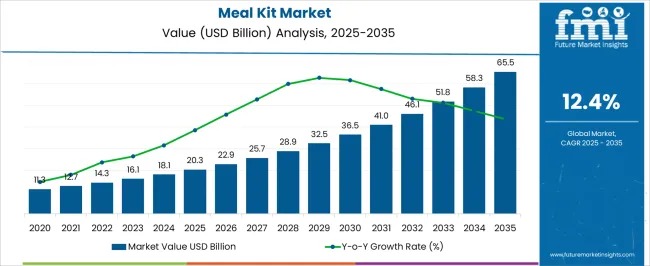
The global meal kit market is entering a high-growth phase, driven by shifting consumer lifestyles, accelerating digital adoption, and rising demand for convenient yet nutritious home-cooked meals. The market is projected to reach USD 20.3 billion in 2025 and is expected to surge to USD 65.5 billion by 2035, registering a robust CAGR of 12.4% during the forecast period. This expansion represents an absolute dollar opportunity of approximately USD 45.2 billion, underscoring the sector’s long-term revenue potential.
Year-wise analysis reveals a steady and accelerating growth pattern. Market revenue increased from USD 11.3 billion to USD 12.7 billion, followed by continued gains to USD 14.3 billion and USD 16.1 billion, reflecting consistent double-digit year-on-year growth. Momentum strengthens as the market expands to USD 18.1 billion and USD 20.3 billion, supported by broader consumer adoption and subscription penetration.
Get Exclusive Access To Data Tables, Market Sizing Dashboards, And Analyst Insights. Request Sample Report! https://www.futuremarketinsights.com/reports/sample/rep-gb-25961
Beyond the mid-term outlook, the growth trajectory becomes more pronounced. Revenues are projected to rise from USD 22.9 billion to USD 28.9 billion, then cross USD 32.5 billion, reaching USD 36.5 billion and USD 41.0 billion. The latter half of the forecast period highlights sustained acceleration, with the market expected to reach USD 46.1 billion, then USD 51.8 billion, USD 58.3 billion, and finally USD 65.5 billion by 2035. This upward curve reflects how meal kits have transitioned from niche convenience products to mainstream household solutions.
Market Snapshot and Key Insights
In 2025, vegetarian meal kits lead the segment landscape, accounting for 21.9% of total demand, reflecting growing preference for plant-forward and flexitarian diets. North America, Europe, and Asia-Pacific remain the most influential growth regions, supported by strong e-commerce infrastructure and urban consumption patterns. Leading players such as HelloFresh, Blue Apron, Sun Basket, Marley Spoon, Purple Carrot, and Hungryroot continue to shape the competitive environment through menu innovation, subscription flexibility, and digital engagement.
The meal kit market draws momentum from several interconnected parent markets. Online grocery and e-commerce food delivery contribute nearly 35% of overall influence, highlighting the importance of digital-first distribution. Packaged and ready-to-cook foods account for around 25%, while health and wellness foods add approximately 15%, driven by demand for balanced nutrition and dietary customization. Together, these ecosystems reinforce the market’s scalability and long-term resilience.
Why the Meal Kit Market Is Growing
Changing consumer behavior remains the primary growth engine. Busy schedules, dual-income households, and limited time for meal planning are increasing reliance on ready-to-cook solutions that eliminate grocery shopping while preserving the experience of home cooking. Subscription-based models provide predictable value for consumers and recurring revenue for providers, strengthening market stability.
Another critical driver is the expansion of online grocery and e-commerce channels. Seamless ordering, app-based personalization, and reliable last-mile delivery have significantly lowered adoption barriers. Meal kit providers are leveraging digital platforms to offer curated menus, flexible delivery schedules, and tailored recommendations, boosting customer retention.
Health-conscious consumption is further amplifying demand. Meal kits increasingly feature calorie-controlled portions, protein-rich recipes, plant-based options, and diet-specific offerings such as keto, vegan, and gluten-free. This alignment with wellness trends enhances perceived value and broadens appeal across age groups and income levels.
Regional Performance Highlights
Asia-Pacific is emerging as the fastest-growing region. China, with a projected CAGR of 16.7%, benefits from urbanization, rising disposable income, and advanced logistics networks. India follows closely at 15.5% CAGR, supported by digital payment adoption, region-specific recipes, and increasing demand from young urban consumers.
In Europe, Germany is expected to grow at 14.3% CAGR, driven by demand for premium, organic, and locally sourced ingredients. The UK, at 11.8% CAGR, is seeing strong uptake among professionals seeking convenience and culinary variety. Meanwhile, the United States, growing at 10.5% CAGR, continues to lead in high-value subscriptions, diet-focused kits, and nationwide distribution scale.
Competitive Landscape and Strategic Focus
Competition in the meal kit market centers on menu diversity, ingredient quality, delivery reliability, and digital experience. Key players are differentiating through:
- Customizable meal plans and dietary personalization
- Partnerships with local farms and sustainable suppliers
- AI-enabled recommendations and subscription management
- Eco-friendly packaging and efficient cold-chain logistics
As consumer expectations evolve, companies that balance convenience, nutrition, and experience are best positioned to capture long-term value.
Outlook
With consistent double-digit growth, expanding global reach, and rising consumer loyalty, the meal kit market is set to remain one of the most dynamic segments within the food and e-commerce ecosystem. The projected USD 65.5 billion valuation by 2035 reflects not just market expansion, but a fundamental shift in how households plan, prepare, and experience meals at home.